
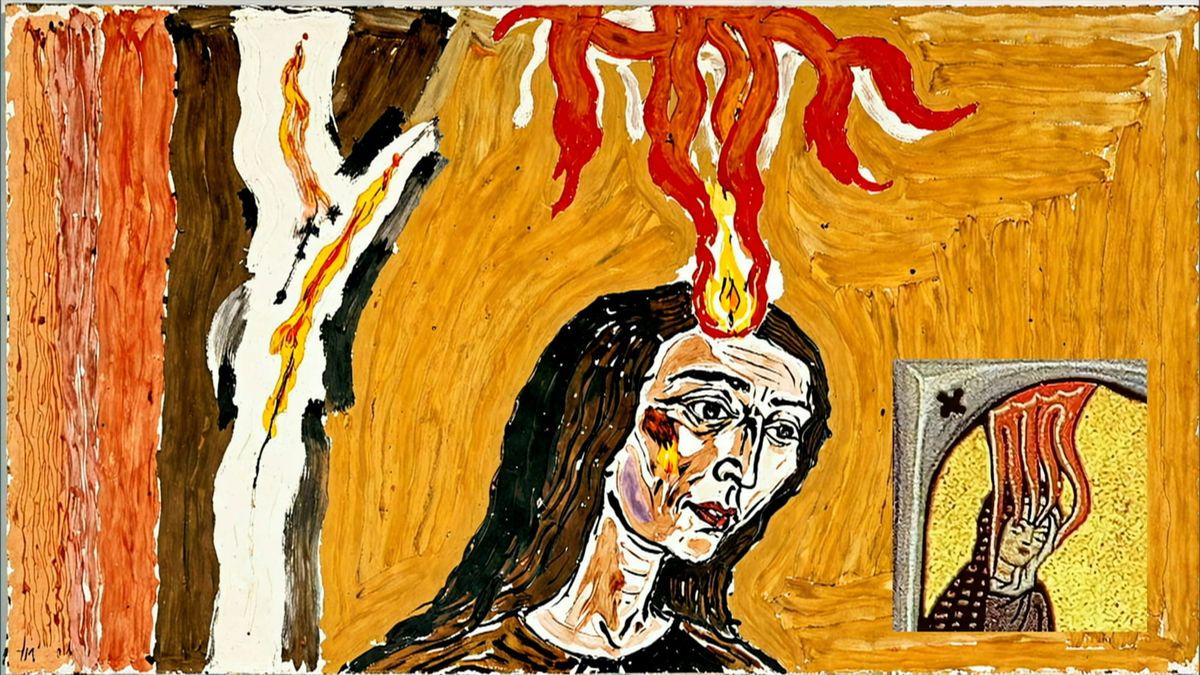
The Pope appears more progressive than many heads of state these days, and at times more outspoken than parts of the art world. In such a moment, the Pavilion of the Holy See in Venice becomes this year, somewhat unexpectedly, a timely backdrop for a curatorial proposition by Hans Ulrich Obrist and Ben Vickers. Turning to Hildegard of Bingen (1098–1179) as a figure for whom sound, vision, and transmission cannot be separated, they bring contemporary pop icons and medieval monastic chants into an unorthodox shared field. The conversation unfolds through gardens, listening, and modes of attention that resist fixed categories, while gesturing, somewhat opaquely, toward renewed forms of essentialism.
María Inés Plaza Lazo: I wonder what Hildegard von Bingen teaches us to see or hear about the present that contemporary art theory cannot yet articulate?
Hans Ulrich Obrist: It’s a great starting point. Ben and I worked together for ten years at the Serpentine. We kept returning to Hildegard.
The invitation to the Vatican Pavilion came through Cardinal José Tolentino Calaça de Mendonça—a poet and the Prefect of the Dicastery for Culture and Education of the Holy See. It was a rare constellation: someone shaping culture from within a religious and political space. We felt it could open a different kind of exhibition—not a white cube, but a garden.
From there, the idea of a sound garden emerged. For Hildegard, sound is a form of knowledge. In her work, vision moves from breath to chant to understanding. Music becomes a bridge between body and world, macrocosm and microcosm. That felt urgent.
The Carmelite garden in Venice became a reference point. We had never been there, but we knew it through the writer Cees Nooteboom, who describes it as a hidden silence near the railway station. That contrast stayed with us.
Ben Vickers: I would add that Hildegard is an extraordinary polymathic figure. There is medicine, language, theology—she even invents her own language—and then, of course, music and voice.
To respond to your question, she offers a way of bringing together these different disciplines into a unified voice. That is one reading, but it is a key inspiration for us today. Very specifically, she holds the artistic, the scientific, and the spiritual as one unified practice. We feel we need more figures like that.
HUO: Which brings us to Alexander Kluge. Every year on January 1st, I would meet him at 3 PM in Sils-Maria, and we would talk about what would be necessary to pay attention to in the year ahead. I already miss him. [Kluge passed on March 25, 2026]
From those conversations, I knew how deeply he was drawn to Hildegard. We went to Munich together, and he immediately said what Ben has just articulated: it is about bringing things together, overcoming the fear of integrating knowledge forms.
Hildegard was a mystic, composer, herbalist, naturalist, poet, saint, visionary writer—and also the author of extraordinary letters. Maura Satoni’s Das große Hildegard Lesebuch: Worte wie von Feuerzungen [still untranslated into English] is one of the key studies of her work. She highlights Hildegard’s vision writing: not only the invention of a language, the lingua, but also a form that turns vision into script.
Kluge himself is a polymath: student of Adorno, filmmaker with Fritz Lang, writer, theorist, producer, lawyer, and institution founder. For him, Hildegard is about one thing above all: the need to create connections and constellations in the world.
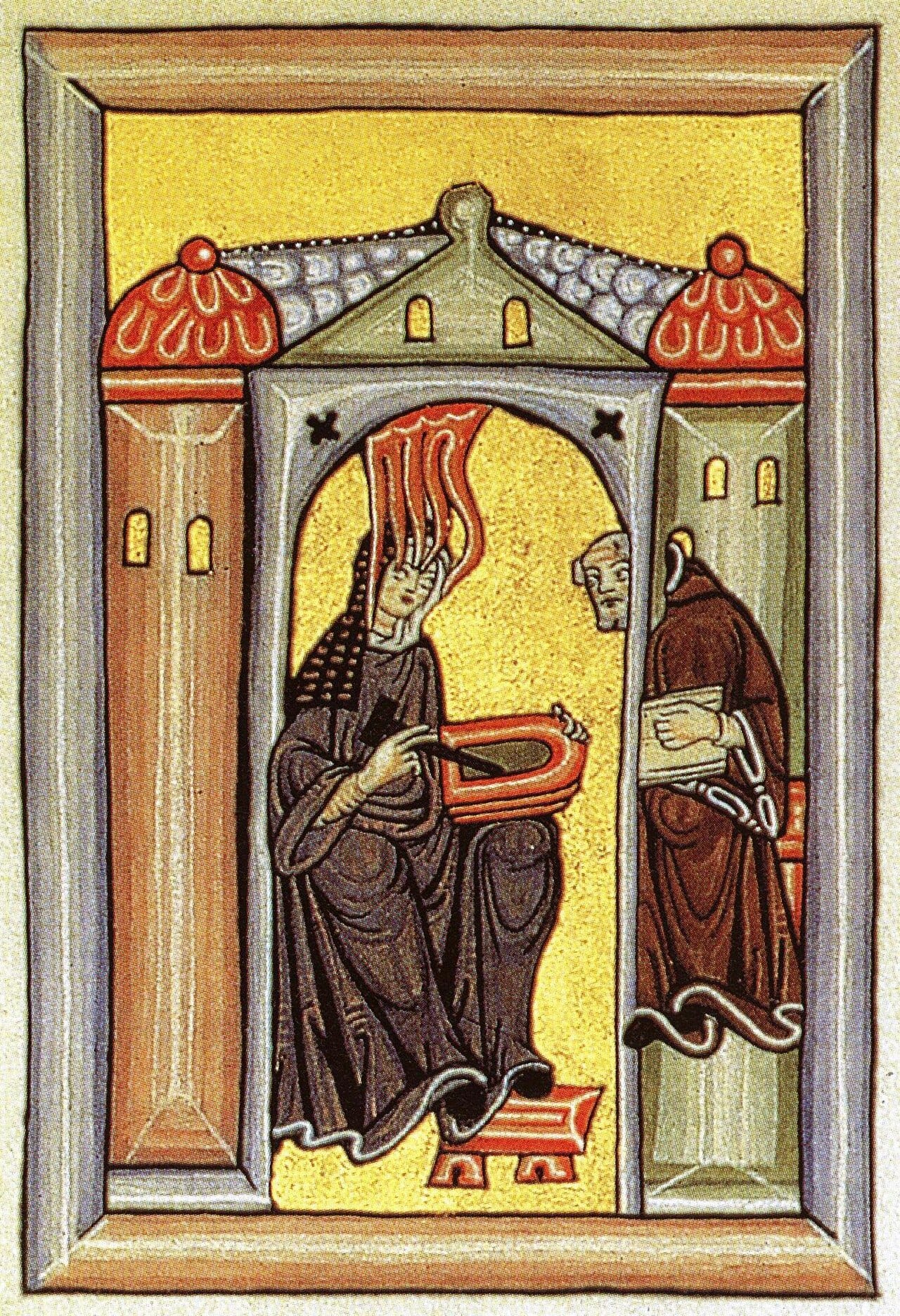
Hildegard von Bingen, Scivias, Frontispiece depicting Hildegard receiving a vision, dictating to Volmar and sketching on a wax tablet, 1150. Ink and gold leaf drawing
MI: These points of interdependency are so clear in both Alexander Kluge and Hildegard von Bingen, but are also complex to grasp. It is not only about polymathy or channeling knowledge, but about creating cosmologies that can be shared. I wonder if you could deepen our understanding through Kluge.
HUO: Kluge was deeply interested in what a common horizon could be—how we bring constellations together in an age that is so divided and polarized. In an age of wars, how do we still create a shared horizon?
That brought him to the question of universalism. Two years ago, with Lorenzo Marsili and the Berggruen Institute, we organized a conference on universalism at Palazzo Tre Oci, around Souleymane Bachir Diagne, whom Kluge was very interested in.
Diagne argues that we must think of a common horizon from a non–Western-centric perspective. Kluge was very engaged with that.
We will show some of Kluge’s films, present the book Universalism, which is dedicated to him, and reprint the 40 “universalist cards” he designed. It is very moving that his last work was created for Venice. It is sad, of course, that it is his final work, but he worked on it intensely until the very last days. It will be shown in Castello.
MI: In this pavilion, transmission seems to matter more than the medium itself. So I wonder how you understand this shift from objects to states of attention.
BV: In the run-up to the press conference, I ran an inventory of the overall project and realized it is composed of around 45 different elements. But in its making, we have a very refined and singular perspective on what we are trying to produce. It doesn’t actually feel that complex.
I used the analogy of love in the press conference: it’s complicated to explain, but very simple to feel. And that’s where the difficulty lies—describing something in its parts, when in fact it is something to be experienced, a transmission, as you say.
We have to be careful in the context we are working in, because there is an enormous history and scholarship around the theological implications of Hildegard and her work. One thing she herself pointed to is that she was not subject to ecstatic experience in a passive way. She was very clear that these were gifts—things given by God to be transmitted through her on Earth. And this is something that, in an art context, has largely been abandoned in curatorial discourse, museum language, and institutional frameworks.
But when you speak privately with artists, you know these ideas don’t come from theory books. They come from dreams, from visions, from conversations, from lived experience, sometimes even just in the shower—an idea drops out of the sky and we don’t know from where.
That is very much the mode we are interested in. And it also speaks to why we chose sound. Because in this context, there can be no overcomplication. Sound must be heard. It must be experienced. It is an expression of emotion, but everyone receives it differently.
If we attempted the same with visual art in the garden, there would be too many mediating factors in how the work is approached.
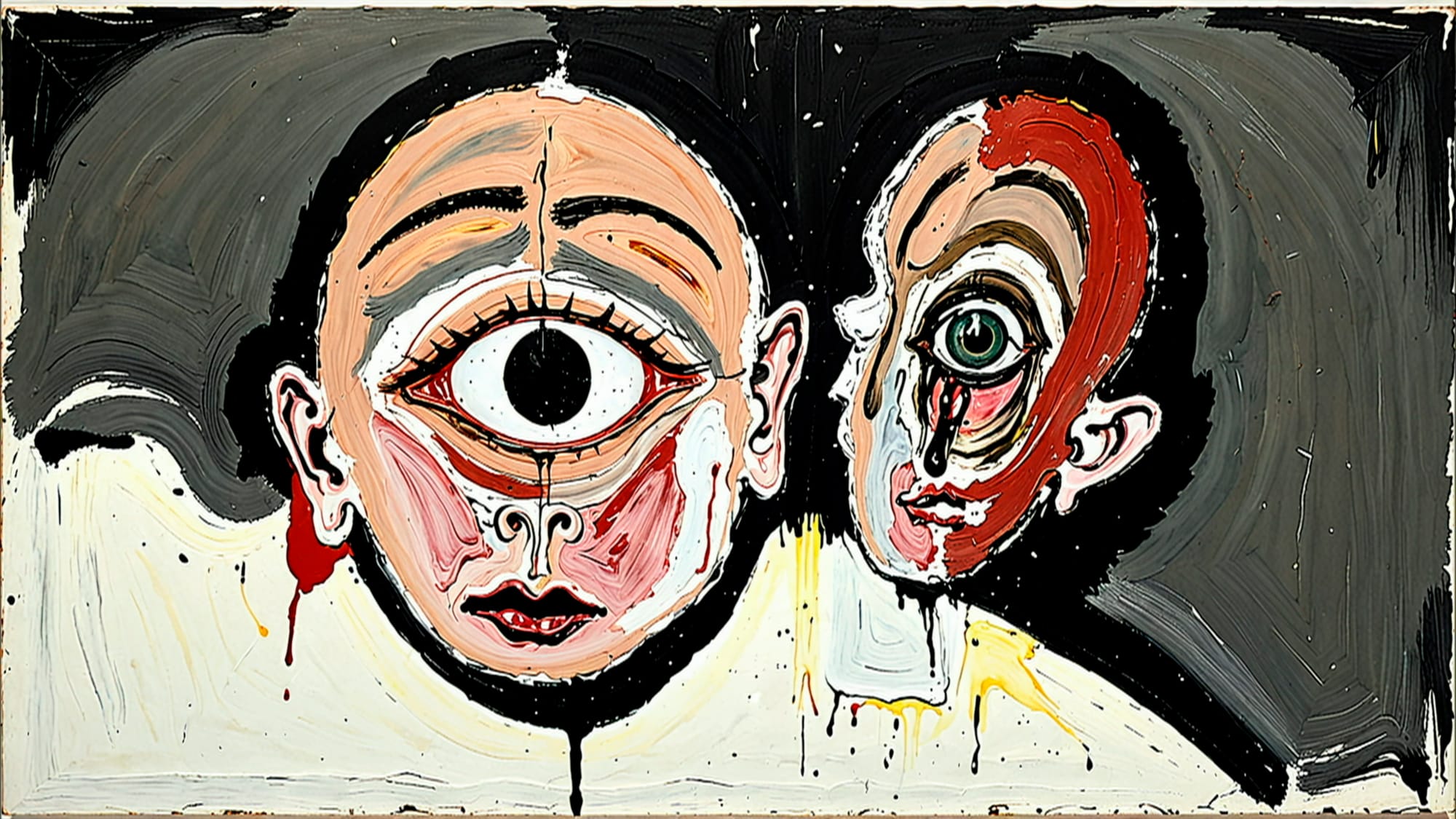
Alexander Kluge, The Ear is the Eye of the Soul, 2026. The Pavilion of the Holy See, The Ear is the Eye of the Soul
MI: This idea of feeling art—and reconfiguring how we approach it—how does it connect with the spatial division you have chosen for the show: the garden and the scriptorium, between listening and inscription?
BV: As we know, in monastic traditions, there are multiple contemplative modes. In the garden, we give primacy to listening, to sound, to walking. We describe it as a sonic prayer. That is one mode of contemplation. Another mode is to sit with words. So the division between the two spaces is not oppositional—they are offering different articulations of the same thing.
HUO: There was no master plan that began with two spaces. The idea evolved. Ben had long wanted to work in a garden. Then his Eminence the Cardinal, with Cristiano, brought us this site.
From there, we understood we needed a more holistic experience for musicians, composers, and artists. That led us to Soundwalk Collective, whom we deeply admire, and with whom we began to shape the garden almost as an instrument.
I also had a long-standing concern, from my experience curating the Swiss Pavilion for the Architecture Biennale, about how exhibitions are produced. Each edition starts from zero: things are built, then dismantled, then erased.
The question became: how do we avoid this reset? At the Serpentine, we already try to reduce transport and reuse structures. But more fundamentally, what if exhibitions could evolve rather than restart?
What brought us to what Adrianna Bilbao and Dogma architects had done for this fantastic pavilion called “Opera Aperta”. It was conceived as a homage to Umberto Eco, but it was essentially a construction site. They renovated the print, or rather the building—it was about a stage of repair. They repaired the structure.
We loved this idea that “Opera Aperta” was actually about repairing the building, and that we could simply continue that process and add further layers.
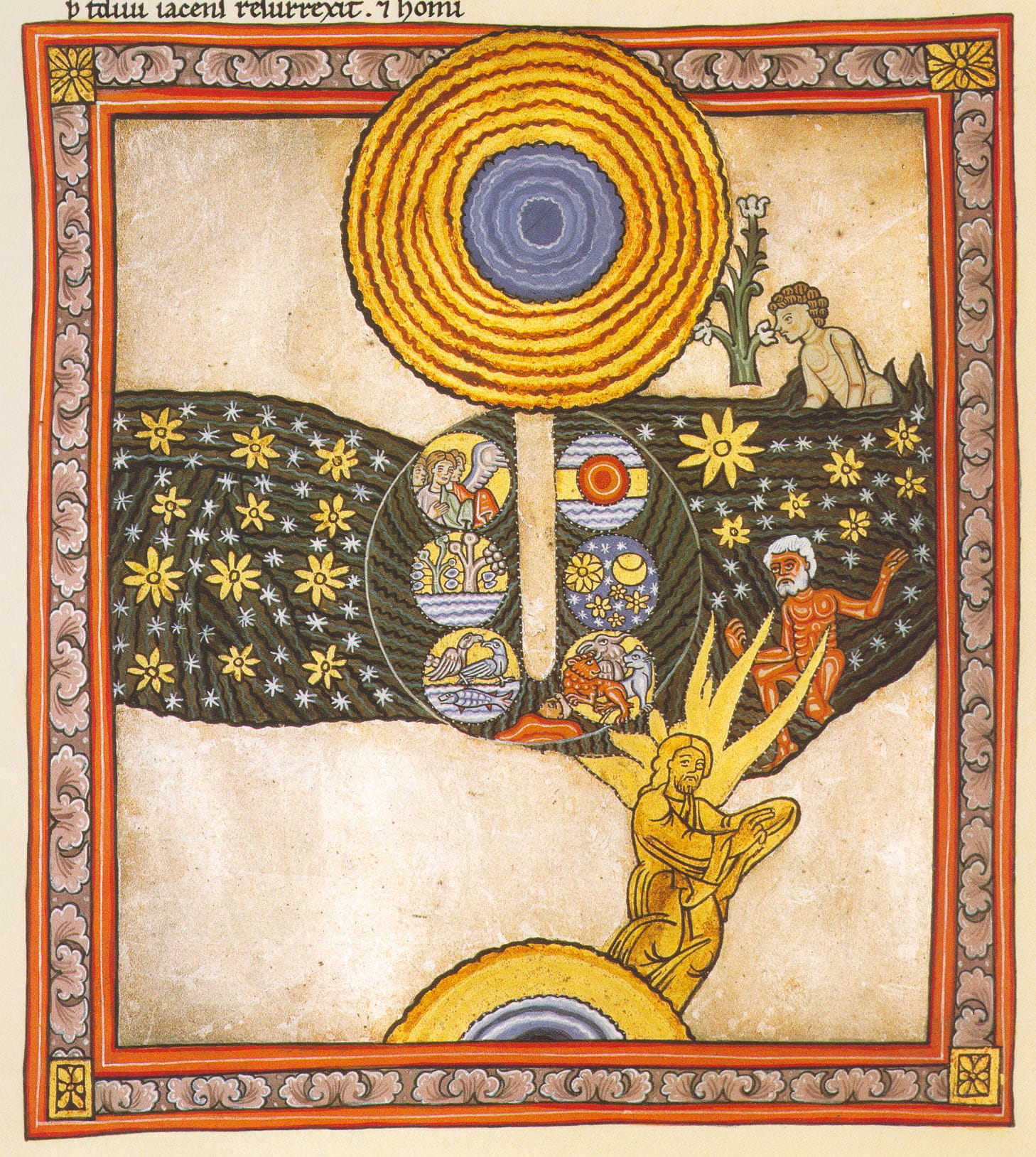
Hildegard von Bingen, Scivias 2.1 - The Redeemer, 1151. Ink and gold leaf drawing
BV: One layer is the archive, departing from the same book that Hans Ulrich was quoting earlier. Sister Maura played a critical role in the canonization of Hildegard as a Doctor of the Church. She is one of the leading scholars on Hildegard.
The book Hans Ulrich refers to is one in which she works through Hildegard’s visions and explains them very clearly, in a way that can be understood by any audience—academic or otherwise. She comes from Eibingen, Germany. The Abbey of Eibingen is actually founded on the site of Hildegard’s original monastery.
So, of course, we also needed to make that connection to Hildegard directly. In the library, which will grow over time, we are starting with around 100 to 150 books: key primary texts on Hildegard, focusing on multilingual access, so that people coming from all over the world can read these carefully assembled texts in their own languages.
There are two further elements in the library. The nuns still cultivate the different herbal formulas that Hildegard described—she wrote two texts on healing compositions of herbs and foods. We will have these teas on site, so that people can read and drink tea at the same time.
MI: This is exciting. I love multilingual archives. I also heard that the Benedictine nuns continue Hildegard’s chant as a living practice, and her herbalism as well.
I wonder how you understand continuity here, not as preservation, but as something else. What does it mean when repetition becomes a form of transmission across centuries?
BV: I have something very specific to say on that in relation to monasticism. The real force of the Benedictine rule—and of monastic rules more broadly—is precisely the act of repetition.
The recording we have from Eibingen is part of the liturgy of the Hours. Every single day, according to the Benedictine rule, these offices are sung. There is a synchronization between spaces, and more importantly, it is repetition itself that allows monastic life to exist across centuries.
HUO: And in a way, your question brings us to the idea of longue durée. As you mentioned, this is something that will continue far beyond the Biennale. It is not only a continuation of last year’s architectural project, but something we see as ongoing research.
That has always been our approach—whether in “do it” or “on the move,” or in my handwriting project on Instagram. These are projects that exist over 10, 20 years. Ben shares the same conviction. As the founder of a monastery in Matera some years ago, he has always been interested in long-duration practices.
For us, the Biennale is a very short chapter—six months is extremely brief if you think in terms of long duration. We hope this is only the beginning, and that the project will continue to evolve and learn.
There are many gardens in the world where this could continue after Venice. It is also a very sustainable project, because there is no transport involved. We simply transmit the sound, and it can reappear in another garden, on another continent.
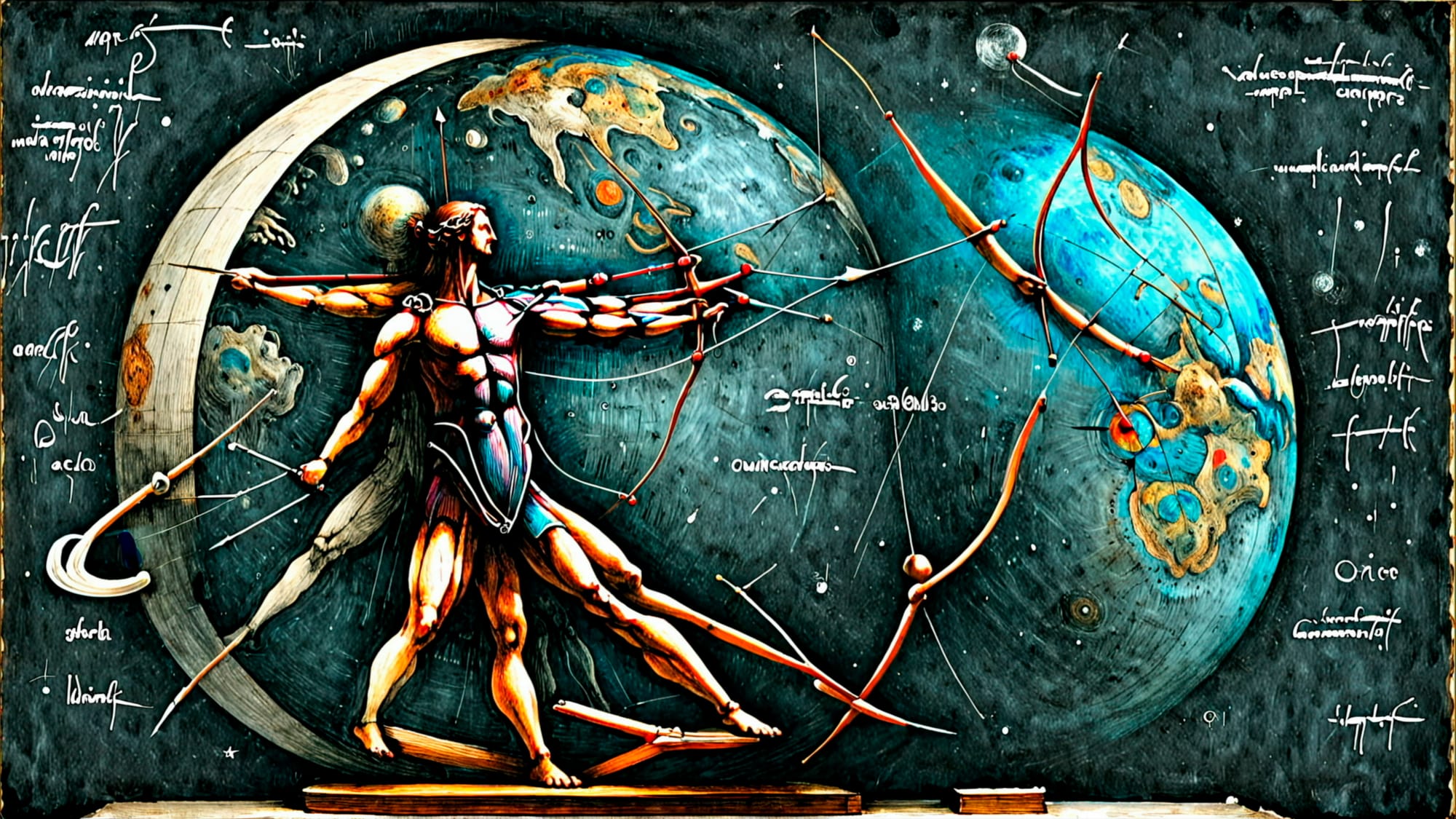
Alexander Kluge, The Soul on Its Globe, 2026. The Pavilion of the Holy See, The Ear is the Eye of the Soul
MI: We haven’t spoken about all the major figures involved: the pop icons. How do you bring them together with religion today, especially at a moment when forms of essentialism are reasserting themselves? And how are they shaping contemporary art’s vocabulary—its permissions and its limits?
BV: The entire project has evolved from one conversation to the next. Soundwalk Collective has been absolutely instrumental in this, in the sense that they are able to identify many of the artists and musicians we’ve worked with as being very attuned to the subject and to the kinds of sounds we want to produce.
Hans Ulrich and I then brought in connections to those artists, knowing so many people who are already deeply inspired by Hildegard of Bingen and have engaged with her work in different ways. Meredith Monk, for example, had already produced an entire album on Hildegard. Laraji is someone who is already working in this contemplative, expressive, transmission-based mode of music.
So it may look like a very eclectic mix of people, but for all of them, working around Hildegard felt very natural. It really emerged from a sense of pushing on an open door—inviting people into something that was already resonating with them.
HUO: It wasn’t that we started from scratch a year ago when His Eminence the Cardinal invited us to do this pavilion. We already had long conversations with Holly Herndon and Mat Dryhurst, who have a very deep connection to Hildegard. We had worked many times with Brian Eno and knew about his engagement with her—he has even composed music inspired by Hildegard. So there was already a foundation of research. From there, we extended it further—towards new horizons.
For example, going to a concert by Dev Hynes and realizing to what extent Blood Orange [his nom de scene] connects, in an unexpected way, to spirituality. Dev has also produced an extraordinary solo piano piece in response to Hildegard—it is deeply personal, almost like a mystery.
With FKA Twigs, too, we wanted to include not only a younger generation, but something more fundamental: the sense that we must overcome the fear of “not knowing” and bring together electronic music, pop music, classical music, and visual arts.
In a period where everything is so divided, it feels essential to bring disciplines together again.
Some will come for Twigs and discover Terry Riley. Some will come for Patti Smith and discover the poet Raúl Zurita. Some will come for art by Precious Okoyomon or Otobong Nkanga, and then encounter music.
Some will come for Carminho and realize that Jim Jarmusch is also a musician. And then, of course, we see that this connects to the broader structure of the Biennale itself—because Venice is not only the art Biennale, but also the music Biennale, the architecture Biennale, and the film festival.
So, in that sense, we are already in an interdisciplinary field. And there are natural connections across all of them.
MI: It wouldn’t really do justice to this proposal to reduce it to interdisciplinarity or accessibility.
I think this exhibition allows us to reframe music as infrastructure, rather than expression. And this is exactly what Holly Herndon and Mat Dryhurst have been developing—first at the Serpentine, then in Berlin [at KW] , and coming up in Düsseldorf [at K21]: the notion of what they call protocol art.
So my final question is: how does this notion of protocol art, and of music as infrastructure, destabilize the question of authorship when voices become distributed across humans, machines, and beyond disciplines?
BV: I have a simple answer—and then you [HUO] have a show to promote [curated with Holly Herndon and Matt Dryhurst at Palazzo Diedo].
My simple answer is that the Benedictine rule is the original protocol. It demonstrates what a rule can do. No one in the Benedictine monastic orders set out to revolutionize medicine, invent new agricultural systems, or build structures across Europe. And yet that is what emerged.
So it shows how a protocol can operate—and how protocols have always been with us. And that has a very direct relevance today.
HUO: Yes—and that brings us to another show in Venice, namely “Strange Rules”, the exhibition that Holly, Matt, and I are doing with Adrianna Rissoli at Palazzo Diedo.
Holly and Matt have long been working on exactly this idea of rules and protocols as a practice—engaging with the underlying systems that shape how culture is produced, distributed, and perceived today.
These rules can take many forms. They can be algorithms, artificial intelligence models, large language models, computational systems. They can also be curatorial structures. They can be infrastructures themselves. In that sense, protocol art uses these tools, but also transforms them into artistic material, as Holly and Matt describe it.
So the artwork is not a final product—it is a process governed by instructions. This is exactly what is happening with the datasets of choirs at the Serpentine, which can now continue evolving, next in Düsseldorf. And it is interesting that this is not a tour in the traditional sense—it is an evolving system.
We see our project with Hildegard in exactly the same way. We are not sending it on tour from Venice. It will evolve, shift, and transform. So in that sense, it is a move from an exhibition of objects to a system. From the singular to collaboration.
And that collaboration can be between humans—but also between humans and machines.
//
The Pavilion of the Holy See at the 61st International Art Exhibition of La Biennale di Venezia
The Ear is the Eye of the Soul
Commissioned by Cardinal José Tolentino de Mendonça, Prefect of the Dicastery for Culture and Education of the Holy See
Curated by Hans Ulrich Obrist and Ben Vickers, in collaboration with Soundwalk Collective
With contributions by Alexander Kluge, Benedictine Nuns of the Abbey of St. Hildegard Eibingen, Bhanu Kapil, Brian Eno, Carminho, Caterina Barbieri, Devonté Hynes, FKA Twigs, Holly Herndon & Mat Dryhurst, Ilda David’, Jim Jarmusch, Kali Malone, Kazu Makino, Laraaji, Meredith Monk, Moor Mother, Otobong Nkanga, Patti Smith, Precious Okoyomon, Raúl Zurita, Soundwalk Collective, Suzanne Ciani, Tatiana Bilbao – MAIO Architects - DOGMA, Terry Riley.
Produced by Nicola Picco & Raul Betti – Mattia Marzaro
Soundwalk Collective & Tessa Nijdam – Elena Origliasso
Venues:
Complesso di Santa Maria Ausiliatrice, Fondamenta S. Gioachin, Castello 450
No booking required
Giardino Mistico dei Carmelitani Scalzi, Cannaregio 54
Registration required at www.coopculture.it
Pavilion Hours:
11 am - 7 pm (from May to September)
10 am - 6 pm (from October to 22 November)
Closed on Mondays (except 11 May, 1 June, 7 September, 16 November)
www.dce.va
Cover Image
Alexander Kluge, The Visionary Hildegard of Bingen with the Flame above Her Head, 2026. The Pavilion of the Holy See, The Ear is the Eye of the Soul
María Inés Plaza Lazo is editor-at-large, publisher and founder of Arts of the Working Class.