
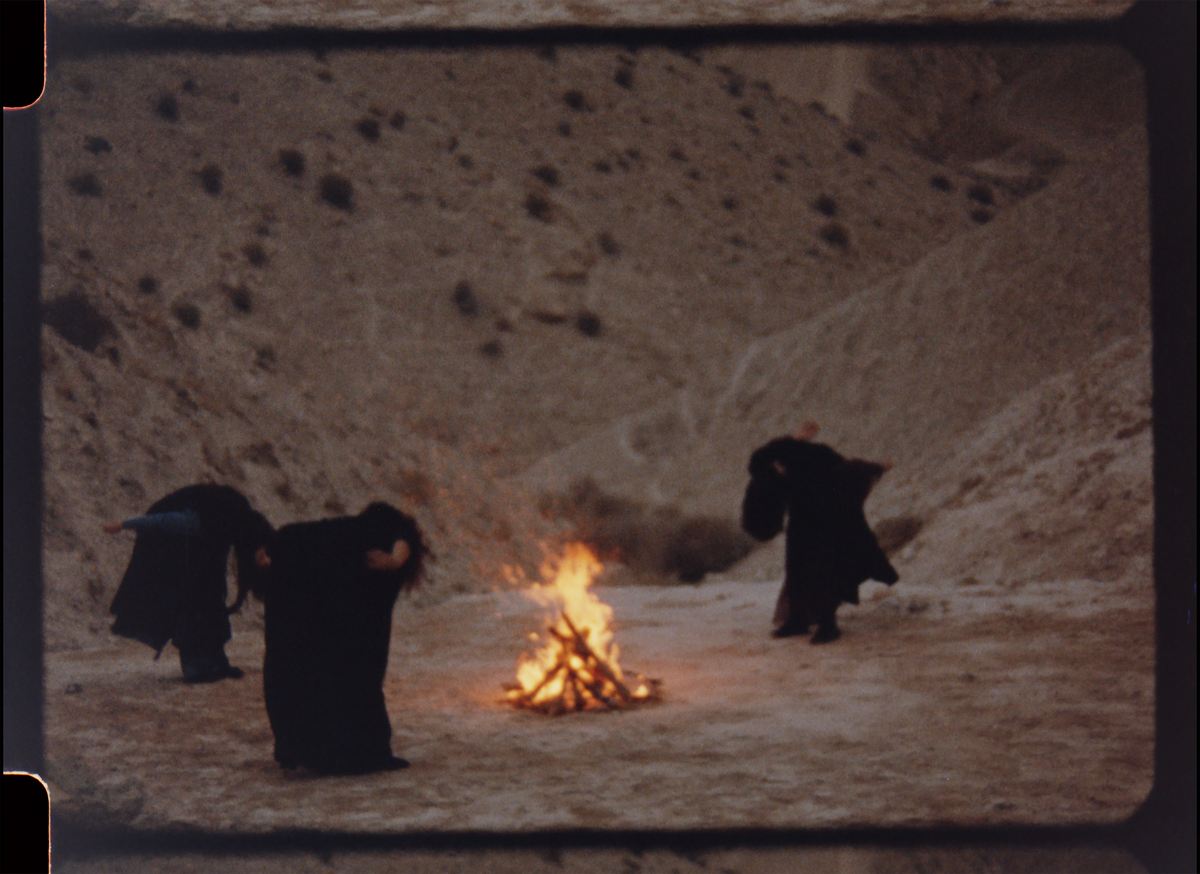
Consoling yet oppressive, the Adagio sostenuto from Beethoven’s “Moonlight Sonata” ushers visitors into the 13th Göteborg Biennial with an uneasy weight. You might know it well, so hum along. The low, restrained melody threads through Basma Al-Sharif’s Old Masters, wherein two young European men, Diego Marcon and Federico Chiari (Al-Sharif’s friends and artists), move through the halls of the Göteborg Museum of Art. Their footsteps converse in silence with the waves on screen at the shore of Gaza City and the interior of a house where a Black Muslim woman wanders; each frame of the film is charged with absence and presence. There is no romantic sweep; even the Nordic painters displayed on the walls of the gallery, their works depicting bucolic surroundings with horses and sunrises, seem unsettled by the fractures the film opens.
Old Masters, commissioned by Christina Lehnert, curator of this year's Biennial, unfolds a conversation between European painting traditions and the history of colonial violence to which they belong. The ouroboros-like form of the canon—timeless, (self)venerated—is probed through the fragile gestures of Al-Sharif’s collaborators. Often silent, visibly (painfully) helpless, they embody the impossibility of fully speaking about the genocide in Gaza, while Beethoven’s music underscores the contradictions of a European heritage that, when confronted with contemporary dispossession, reveals its detachment and inadequacy. The work is less about representation than relational witnessing: an encounter in which artists and audience grapple together with the impossibilities of knowledge, speech, and ethical presence.
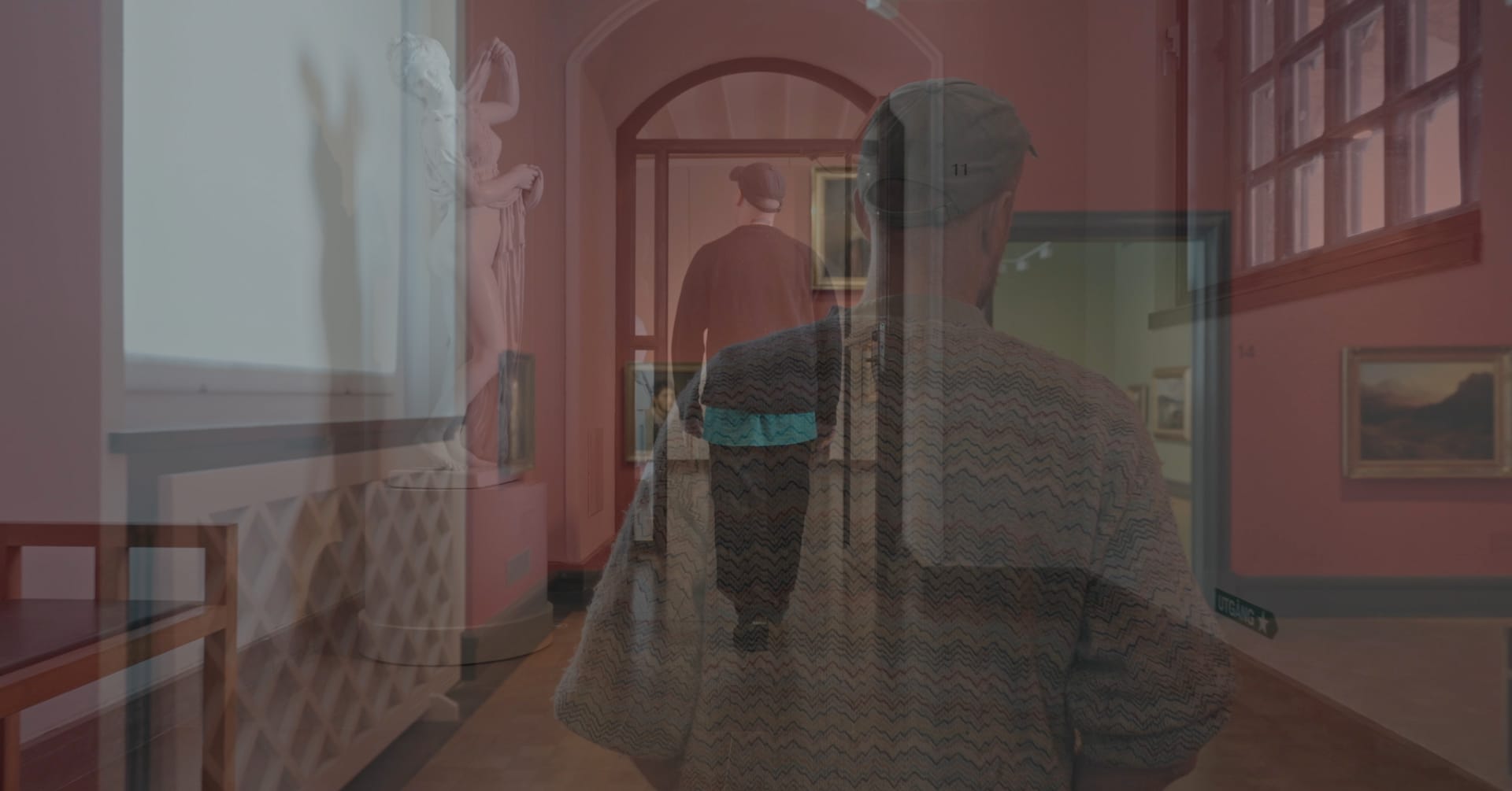
Fig.1
The Moonlight Sonata reverberates across three further rooms in a subtle intervention within a heavily loaded painting collection of idealized, unbothered white lives. It sharpens the senses for a Biennial that is not interested in recreating the spectacle of others, but Gothenburg offers a necessary depth, and a necessary pace that is everything but busy. Its focus lies with those persecuted and displaced under the heading of the “Global War on Terror”, the US-coined term for the destabilisation of the Middle East, Central Asia, and North Africa, and the ongoing extraction of these countries’ resources. Instead of inflating this subject through curatorial ambition, the exhibition acknowledges its own limitations, reflecting on structural conditions while resisting the illusion of limitless relatability. It does so by grounding its narratives in the participants’ own histories of migration, labor, and extraction, where global violence is registered not as an abstract theme but as lived entanglement. Such entanglements are, of course, barely reflected in a city like Göteborg—a former imperial port caught in an identity crisis, haunted by its isolation and fantasies of greatness. To sustain a biennial here is to cling to one of the few remaining frameworks through which culture can still aspire to transformation.
The Biennial’s title comes from Solmaz Sharif’s poem “Personal Effects”, which was read aloud during the opening before any of the official speeches: “a hand that is all our hands combined”. Appearing in Sharif’s 2016 collection Look, the poem grapples with war, displacement, and language as a site of conflict. It touches the remnants of identity amid loss—belongings, memories, traces of life persisting after violence. Through this choice, Christina Lehnert frames responsibility not as burden, but as possibility: something that can be shared and carried collectively. As humans have done, and still do.
The title is evocative of a drawing by Cecilia Vicuña, where two red hands hold two blue hands, which themselves hold two yellow hands. Christina and I spoke about this image while she was unfolding her research for the Biennial. It became clear that the growing political pressures on artists, institutions, and cultural communities across Europe demanded the commensurate eloquence from her as from the artists she presents. Rather than withdraw into abstraction, Christina accepted the precarious frameworks of an underfunded institution possessed of a grassroots spirit and a renowned legacy, and shaped her exhibition through subtle resistance—an aesthetic, ethical, and material stance that worked by quietly insisting on situated forms of antifascist awareness.
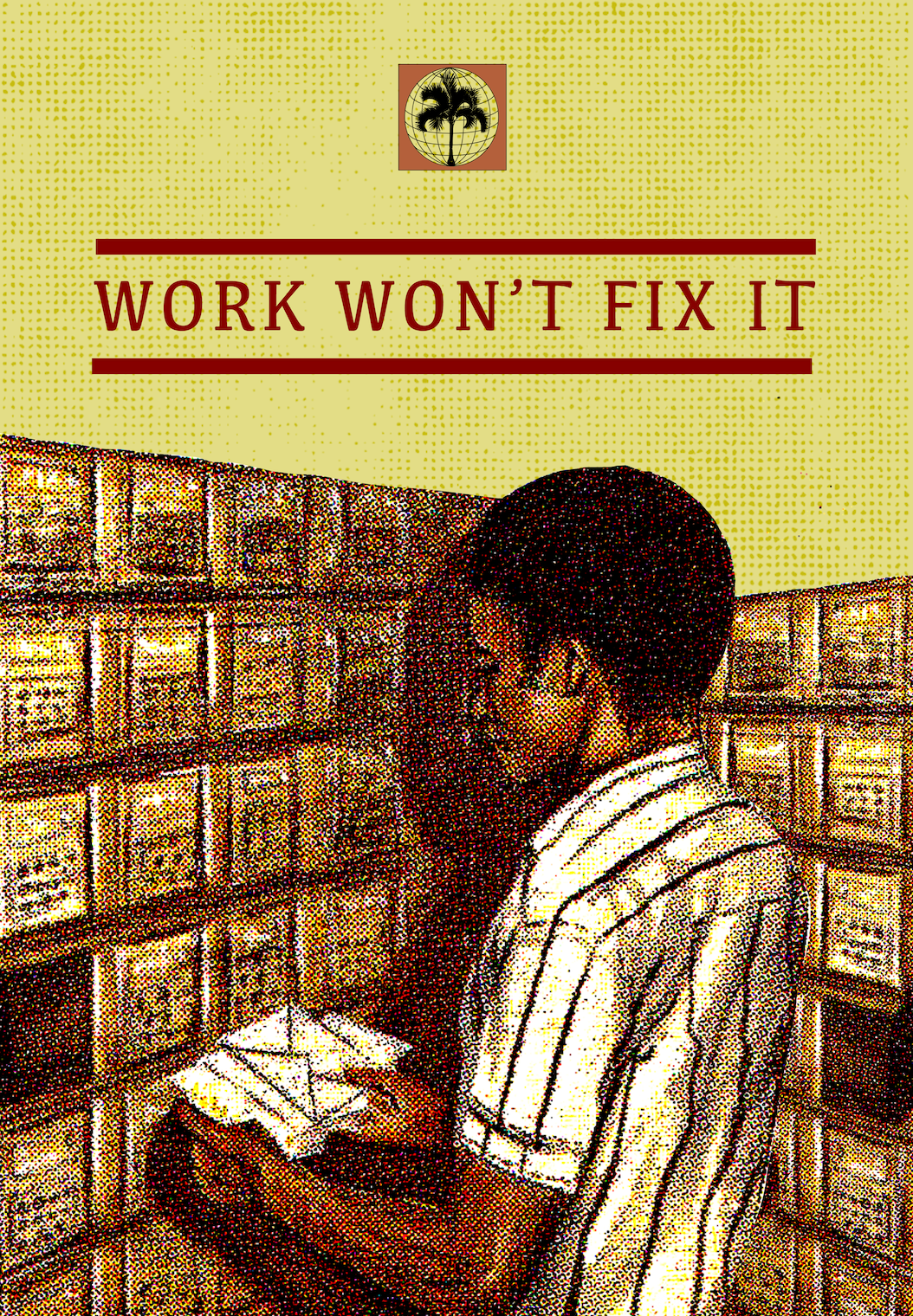
Fig.2
This positioning of solidarity above righteousness also echoed in the conversations that informed the Biennial. At the Central Library, Moshtari Hilal and Sinthujan Varatarajah presented their essay “Hierarchies of Solidarity”, distilling the refusal to excuse silence by hiding behind appeals to “complexity”:
There is this assumption that things are so complicated that we cannot speak about them. But complication is often used as an excuse—sometimes to excuse yourself, sometimes to silence others. Take Gaza: is that a genocide or not? Suddenly everyone wants to cite scholar X, Y, or Z. But some things are not that complicated. Between right and wrong, it’s not that complicated. Nor is the basic principle: treat others the way you want to be treated. […] When we recognize that; we see how violence and its dynamics repeat across contexts and histories. […] At the same time, the public sphere has been transformed by globalization and digital media. Social media platforms are not neutral—they are controlled by corporations that act like unelected states, interfering in political processes without accountability. [...] Still, despite these risks, the digital sphere remains crucial: it allows people displaced geographically to organize across borders. Fragile and contradictory, it nonetheless holds a potential for solidarity that we cannot dismiss.
Drawing from Hilal and Varatarajah’s reflection, what people who build biennials ultimately need to emphasize is that every artistic work can be a form of resistance to silencing. This is, however, only possible through solidarity among the practitioners. Take Jonelle Twum’s I saw you when you watched me die, a speculative radio broadcast played in a space of rest created by the artist and grounded in Black feminist thought. The work, made together with the Swedish Black Archives, embodies such possibility. Inside a small cabin in the work, two visitors can sit together and listen to the voices from the Black Panther Party, Audre Lorde, and Sadiya Hartmann as they reflect on idleness and refusal in the face of extractive logics of productivity. Twum insists on rest as resistance, a gesture that holds care and protest in the same breath, and proposes withdrawal from labor as a radical act, suggesting that solidarity can also be forged in stillness and in listening.
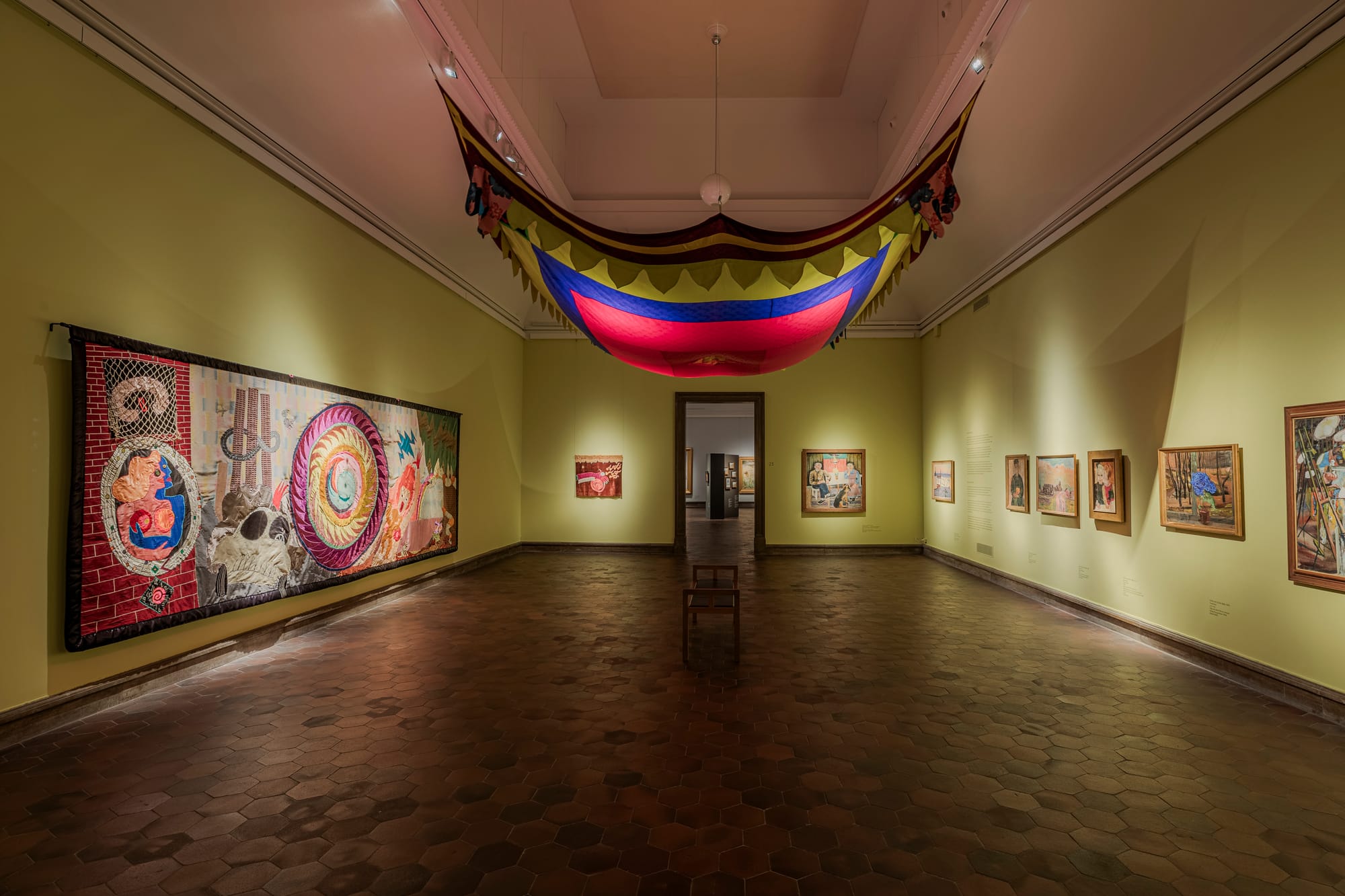
Fig.3
Moki Cherry’s vibrant textiles in the next room, surrounded by Vera Nilsson’s paintings of children and domestic intimacy, embodying her holistic philosophy of “home as stage, stage as home.” Through tapestry, costume, and immersive environments developed with the jazz legend Don Cherry for the Organic Music Theatre, she blurs the lines between the domestic and the performative. The textiles presented here center her feminist stance, her engagement with Buddhism, and her affinity with the narrative strategies of children’s literature. Cherry’s practice renders art inseparable from everyday life, where functional fabrics and symbolic imagery articulate nature, spirituality, and community. Her depictions of wombs, cells—equally regarded as of the body—at home in the living room and on stage, transform ordinary spaces into sites of shared creativity.
At Röda Sten Konsthall, the Biennial’s motherboard, visitors are greeted by a more austere encounter: A documentation of Hans Haacke’s Der Bevölkerung (To the Population), a work that distills the clarity and poetics which Haacke has long wielded, art as a tool of direct democracy and a demand for accountability.
Twenty-five years ago, Haacke provoked the German parliament by proposing to supplement the Reichstag’s historic dedication “To the German People” (Dem Deutschen Volke) with an inscription of equal weight to be placed in the courtyard: “To the Population” (Der Bevölkerung). The ensuing debate exposed both the persistence of racist structures in German politics and the urgency of reimagining society’s future. Some critics decried the work as unconstitutional, even accusing Haacke of attempting “to take the Bundestag away from the German people”. Others, for example, Gert Weisskirchen of the SPD, defended the project, insisting that the dedications were not opposed but placed in dialogue: “They ask the question: what kind of society do we want to live in in the future? That is what the artist wants to tell us.”
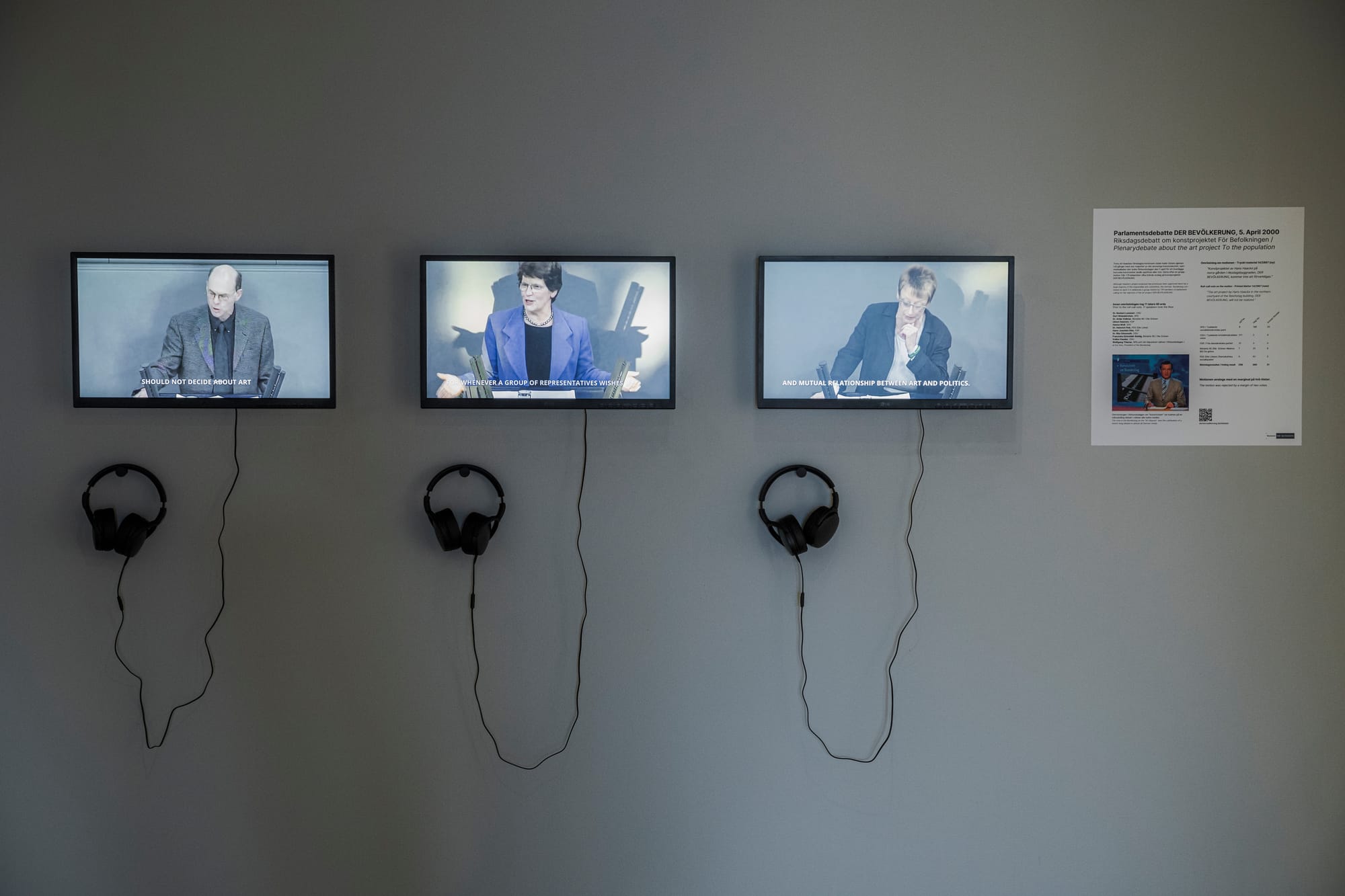
Fig.4
Haacke’s installation consists of a large wooden trough in the Reichstag’s northern courtyard filled with soil brought by parliamentarians from their constituencies across Germany. From these deposits, an unpredictable ecosystem emerged: seeds, roots, and small plants carried in the soil mingled with airborne seeds from Berlin. The vegetation, left uncultivated, developed freely as a living image of diversity and transformation. Fly honeysuckle, musk mallow, apple trees, raspberry, hazel, small-leaved lime, rose, and grapevine—more than a hundred species of plants and animals have appeared over the years. The biotope, continuously observed and documented by webcam, renders visible the natural processes of growth and decay as a parallel to democratic discourse itself: rooted, diverse, and in constant flux.
On the Konsthall’s second floor, Helena Uambembe’s installation features plastic flowers placed on soil and clay. The work resembles a cemetery. Drawing on her father’s history as a Black Angolan soldier conscripted into the South African Defence Force, she builds symbolic terrains of fences, sand, and grave-like forms. These materials evoke the normalization of violence across generations, exposing how cycles of oppression replicate themselves and entrench trauma within social structures.
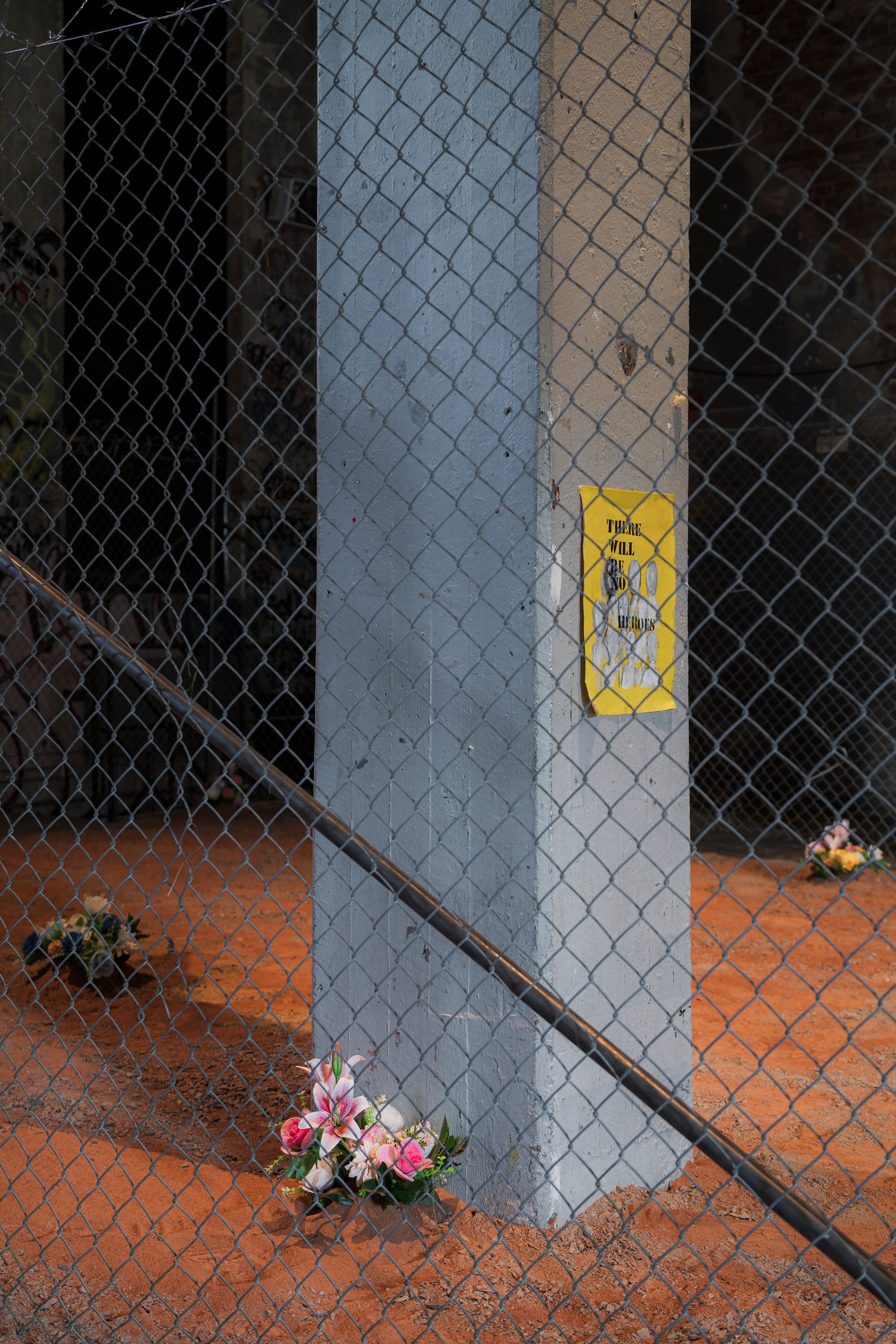
Fig.5
Here the Biennial reveals some of its most intense connections, where artworks resonate beyond scale, material, or form. An undercurrent of longing binds Uambembe’s work to Georgia Sagri’s performance Gone, Gone Beyond. Sagri shifts the focus from borders to breath, from concrete poetry to abstraction. The work—comprising a pressure-device sculpture and a performance—traces how grief and rupture can recompose identity. The sculpture inhales and exhales like a living organism, turning air into something tactile and resonant. The performance, in dialogue with Katerina Anghelaki-Rooke’s poetry, enacts self-assembly after loss. Sagri’s embodiment of heartbreak is not staged as private grief, rather it is reflective of the death-drive imposed on countless innocent lives across the globe. She performs within an inflatable mass that recalls the prism in Albrecht Dürer’s Melancolia I, evoking melancholy as both a condition and a tool for an art that insists on its own relevance.
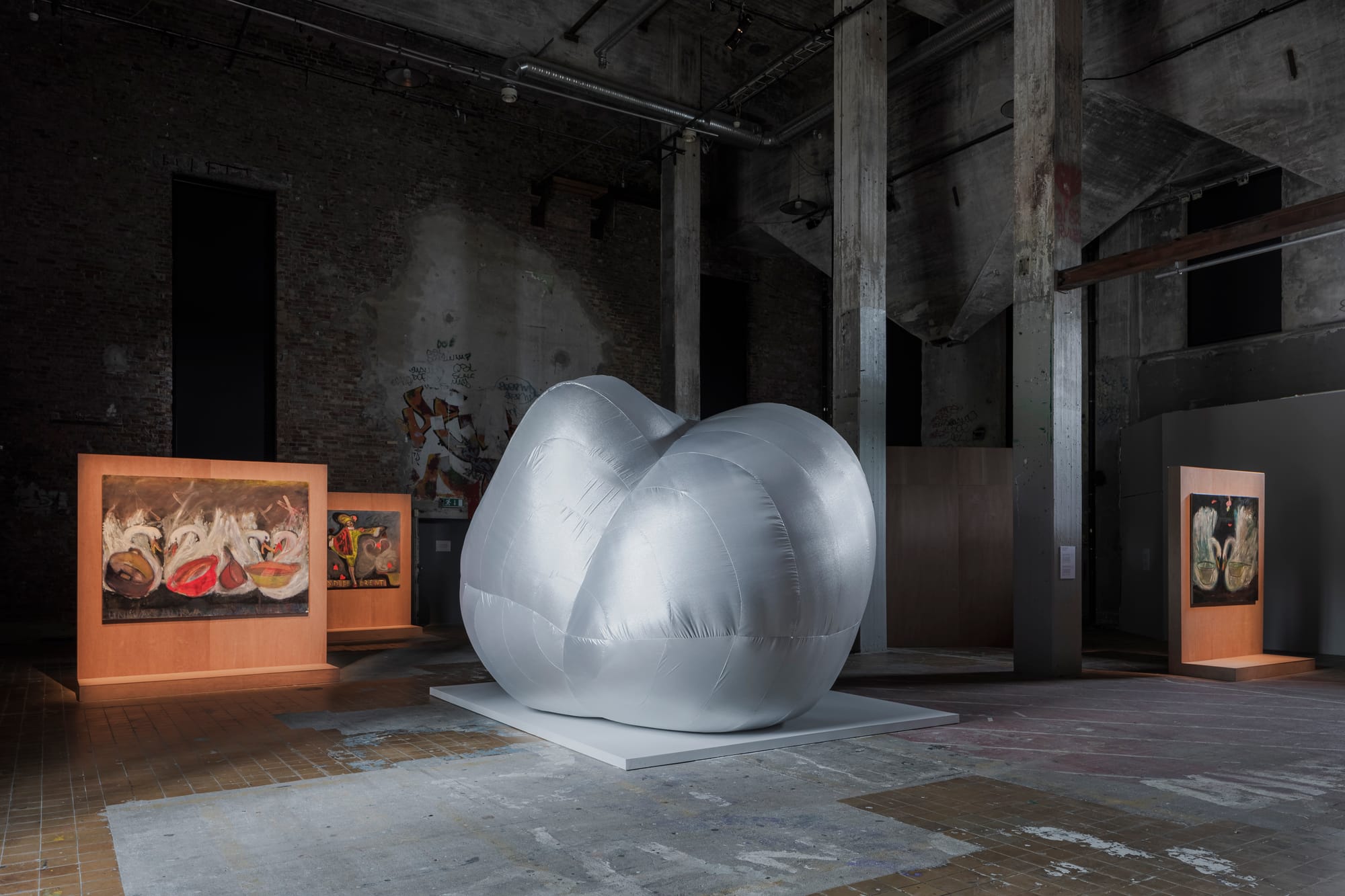
Fig.6
I look at her dance in sorrow, and I look at the swans in Rosalind Nashashibi’s paintings. They appear depicting empty pots, vibrating with color and movement that grows more anxious the longer you look. In the foreground, as in Renaissance painting, the acronym “UNRWA” anchors the image—referencing the United Nations Relief and Works Agency, founded in 1949 to register and support Palestinians born and living in displacement camps. The lettering connects these swans to horrifying images from Gaza, where children wait with empty pots in line at UNRWA stations as a result of Israel’s blocking of food supplies. The blockade and Israel’s expulsion of UNRWA from the territory have caused widespread starvation throughout 2025. The aesthetic beauty of the painting confronts the starkness of human suffering, pressing viewers to reflect on the tension between witnessing genocide and occupying positions of safety and distance. The Indifferent Man, inspired by J.A. Watteau’s L’Indifférent (c.1716), reimagines the carefree Rococo figure in today’s world of urgent responsibility. The painting asks: can we afford the luxury of indifference?
Later, images turn to old smartphones in Lydia Ourahmane’s Haraga, a work grounded in the testimonies of young Algerian migrants crossing the Mediterranean. Through phone videos sent by Houari, the artist shares moments suspended between hope and peril, as friends on a fragile boat speak of dreams and fears. Burning identity papers becomes both erasure and renewal—an embodied gamble for freedom. If Uambembe’s terrain reflects the perpetuation of militarized control, Ourahmane places us in the precarious crossings where lives of dispossession are risked at sea. Where Ourahmane foregrounds the vulnerability of collective journeys, Sagri situates fragility within the body, proposing breath itself as ground for survival and healing, and Noor Abed’s A Night We Held Between lets a folk piece become an anthem of life reassurance across the ancient landscapes and contemporary everyday life in Palestine.
Stairs at the Konsthall lead upward towards a cross in the colors of the Trans Pride flag, one side of a historically dense installation by Puppies Puppies (Jade Guanaro Kuriki-Olivo), addressing the legacy of Japanese American citizens’ internment during World War II. Invoking the Soul Consoling Tower and the contested memory of Tule Lake, the artist situates grief and resistance within sites of state violence and historical erasure. Familiar objects—ashes in an urn, archival prints, burned flags—are charged with political intensity, insisting that the fragility of memory demands constant vigilance. From Sagri’s attention to breath in the presence of death, Puppies Puppies’ work extends remembrance into the political space, where mourning becomes inseparable from activism against the growing xenophobia in the US.
This insistence on collective struggle reverberates in Raven Chacon’s Silent Choir which captures the Standing Rock protests of 2016–17. The silent defiance of water protectors, led by Indigenous women staring down armed police, transforms silence into a resonant force. The sonic trace amplifies both presence and imagination, embodying solidarity as nonviolent resistance. If Puppies Puppies exposes the fragility of historical memory, Chacon reveals silence itself as a living archive of resistance, carried through prayer, sound, and strategic unity.
Hanni Kamaly’s sculptures, ALI BEN MOHAMED and MUSSARD YAHIA, return the gaze to Europe’s racialized histories. Drawing on the Swedish physician and race “scientist” Herman Lundborg’s eugenicist catalogue Swedish Racial Types (1919), Kamaly abstracts figures once reduced to stereotypes, including “vagrant” or “criminal”, transforming these images into sculptural presences. The artist exposes how classification systems were weaponized to devalue human life—a violence latent in today’s politics of exclusion. Where Chacon reveals silence as a weapon, Kamaly confronts the violence embedded in archives and the persistence of structural racism.
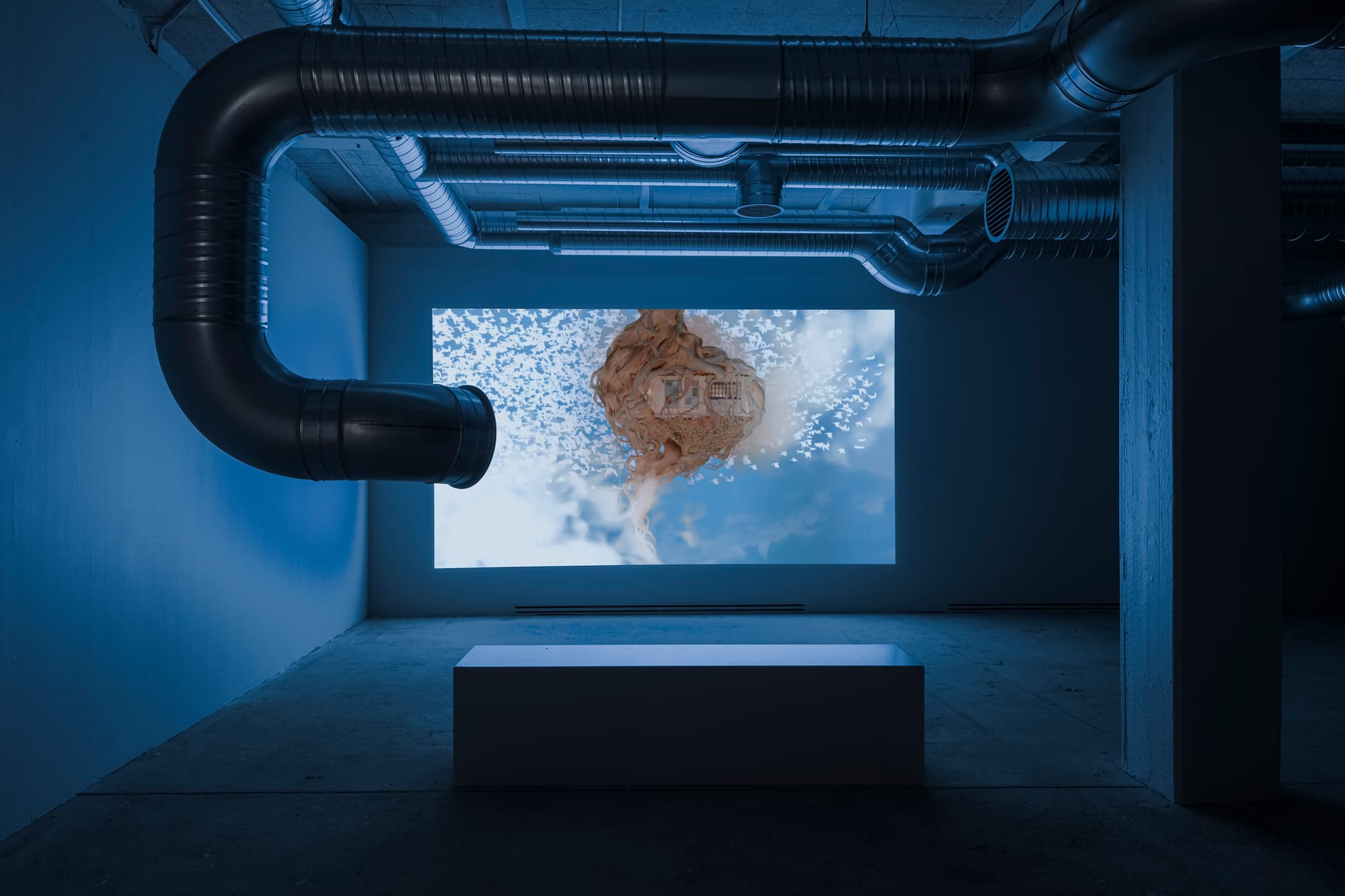
Fig.6
My parcours at the Kunsthall culminates in sitting for a long time with There’s enough light to drown in but never enough to enter the bones by Thuy-Han Nguyen-Chi, Dalena Tran, and Andrew Yong Hoon Leo. Sound, film, and sculpture converge in the work into a sprawling installation where aerial imagery, archival footage, and digital renderings interweave with a deep blue sky. Anchored in the story of the mathematician Alexander Grothendieck’s presentation of clandestine lectures in Hanoi during the Vietnam War, the work reimagines knowledge as resistance against imperial domination. The lectures, relocated outside the city for safety, always took place from 6 to 10 a.m.—before bombings began at 11. To dedicate oneself to the abstract beauty of mathematics in the midst of war, under the constant threat of destruction, is itself an act of resistance. Grothendieck’s practice of mathematics opened a space of infinity, a defiance of imperial and colonial time, connecting to timelessness amid devastation.
In moving through these temporalities and geographies, I find myself less mapping connections than being carried by them—family and community bleeding into rest and refusal, militarization into choreography, mourning into affirmation of life. Nothing resolves; each work leaves me suspended, as if insisting that responsibility lies not in closure but in staying with what unsettles. Perhaps this is what it means to share “a hand that is all our hands combined”: to remain within reach.
//
a hand that is all our hands combined
Göteborg International Biennial for Contemporary Art #13
On view throughout November 30, 2025
Noor Abed, Basma al-Sharif, Patricia L. Boyd, Simnikiwe Buhlungu, Raven Chacon, Moki Cherry, Siri Derkert, Hans Haacke, Hanni Kamaly, Rosalind Nashashibi, Thuy-Han Nguyen-Chi & Dalena Tran & Andrew Yong Hoon Lee, Christian Nyampeta, Lydia Ourahmane, Olivia Plender, Puppies Puppies (Jade Guanaro Kuriki-Olivo), Lala Rukh, Georgia Sagri, Helena Uambembe, Jonelle Twum, and, at the invitation of Black Archives Sweden, Kiluanji Kia Henda, Tiago Mena Abrantes, and Pamela Z.
Images
Cover Image. Noor Abed, Still image from A Night We Held Between, 2024
Fig. 1 Basma al Sharif, Still image from Old Masters
Fig. 2 Kiluanji Kia Henda & Tiago Mena Abrantes, poster images from Work Wont Fix it for Black Archives Sweden
Fig. 3 Moki Cherry, overview at The Gothenburg Museum of Art GIBCA 2025. Photo: Andrej lamut
Fig. 4 Hans Haacke DER BEVÖLKERUNG. Photo: Michael Arndt & Werkstatt
Fig. 5 Kiluanji Kia Henda & Tiago Mena Abrantes, poster images from Work Wont Fix it
Fig. 6 Installation view at Röda Sten Konsthall GIBCA 2025. Rosalind Nashashibi, Swans and pots (four), Rosalind Nashashibi, The Indifferent Man, Georgia Sagri, Gone, Gone Beyond Photo: Andrej lamut
Fig. 7 Thuy-Han Nguyen-Chi & Dalena Tran & Andrew Yong Hoon Lee, There’s enough light to drown in but never enough to enter the bones at Röda Sten Konsthall GIBCA 2025. Photo: Andrej lamut
All Images, Courtesy of the Götheborg Biennial for Contemporary Art, Copyright of the artists.
María Inés Plaza Lazo is editor-at-large, publisher and founder of Arts of the Working Class.