
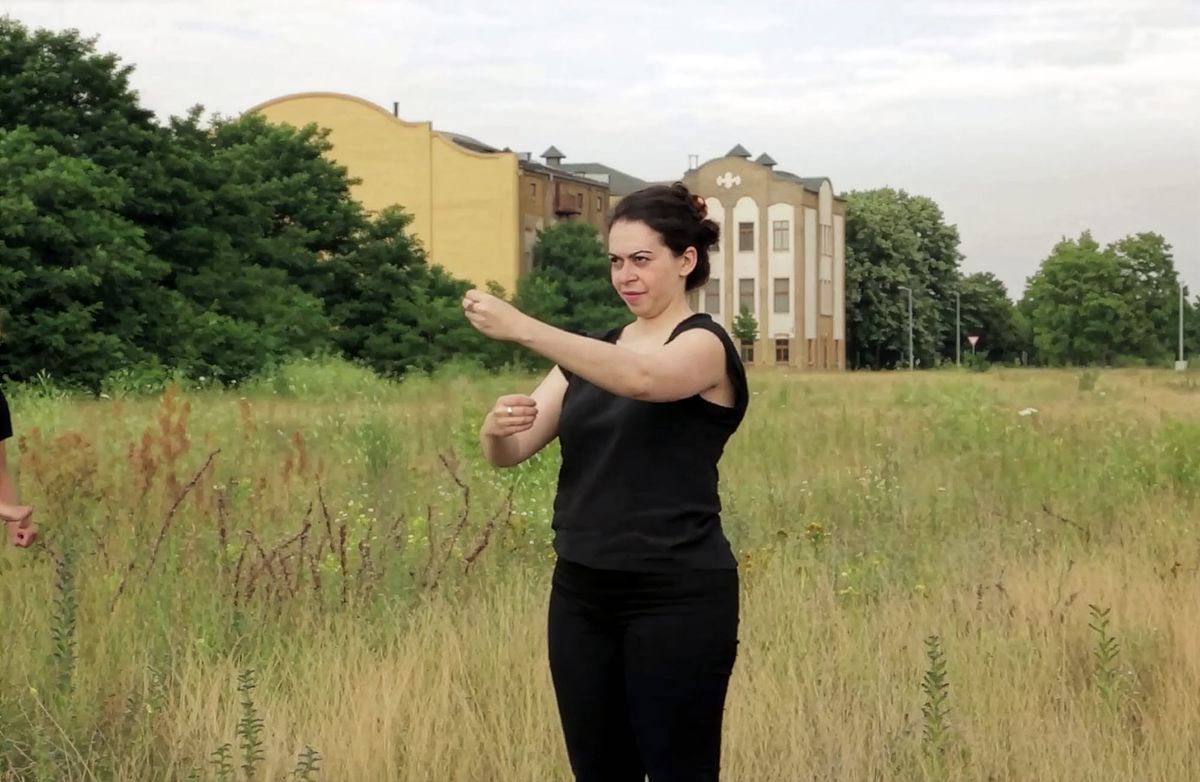
Marina and I (Kerstin) met in the realm of the Cinenova Working Group[1] in 2011. We shared the precious and precarious care for the collection that would frame our friendship. The collective processes and their (dis-)functionalities stemming from the DIY/riot grrrl subterranean microcosms of our teens and twenties was a common ground that traversed into the collective structures of watching and caring about a feminist film and video collection. I was also always drawn to Marina's writings and activisms around work and labour, the Full Unemployment Cinema screenings, and the constant interweaving of life, work, cinema—the ways in which each of those permeated the others, never forming categories of being in the world or 'microcosm(s) of social reality',[2] but rather a practice of belonging through films, music, films again and social gatherings, 'while also insisting on specificity—the specificity of particular social spaces with particular material possibilities or "affordances".'[3]
In the process of making Rainbow's Gravity,[4] in the spring and summer of 2012, we asked Marina to join us for a research trip to Wolfen, near Bitterfeld in deep Eastern Germany, the heavily industrialised zone where the Agfa film factory is located—the setting and topic of Rainbow's Gravity. Our attempt to film this place, in which productive work is made invisible since it takes place in the dark, was a sort of experiment; but it was an experiment also in part because of the strange chemical or molecular dissolution of the boundaries between the medium film, the industrialised product film, and life captured on film, worked through film, and edited through the film apparatus. Our presence in the former factory, as well as our encounter with former factory workers, expressed a precarious, somewhat awkward care for and understanding of the world through film(s), 'displacing the boundaries between production and its conditions'.[5]
Our attempt was to transform information about the bodily memories experienced and related to us by two former film factory workers into an improvised choreography. 'In this way, the speculative is brought together with the "materialist", with the former the vector of transformation and the latter of social reality. (A)s tendencies, as constitutive of relations rather than objects, and objects as temporary crystals of relations in a wider "social synthesis".'[6] In reflecting on our processes, I feel there was always a 'crystallised' continuum in time. These memories of our crossings speak of our own formations and building of autonomous infrastructures of care. 'As if life and capital can go their separate ways.' [7]
Without having met Marina in the past, I (Angela) am writing these lines as a listener and reader of texts and voices gathered from friends who came from Marina's life in London and Germany. Her powerful weavings describe the unfathomable machine of capitalist powers at present—her lying in wait, hunting and tracing down the tools of resistance embedded in our doings with spirits and matters, with threads following others from activism to art and philosophy.
Infrastructural critique, whether in the visual arts or in the socio-political sphere, can intuitively be understood as the structure of a mnemonic crystallisation that determines our future actions. Isn't that precisely what infrastructure means? A foundation for shared imaginary worlds that could subsequently become effective for a shared future?
As Maurizio Lazzarato and I noted in our reflections on resistant subjectivities of a machinic animism [8]—which is neither a ghostly malfunction of a machine nor a viral political idea from the resistant cosmologies of the Global South—part of the problem of a globally integrated capitalism is infrastructural: our perception, which is part of scientific analysis, is unable to precisely distinguish what a subject and what an object is. Viveiros de Castro's anthropological critique of the colonial Western gaze and Félix Guattari's concern with the dividing categories in our modern subjectivities have rightly stated: 'There is something before the subject/object opposition and we must start from their point of fusion.'[9] Viveiros de Castro reiterates this idea and assumes that Guattari prefers to speak of 'objectity' and 'subjectity' to mark their non-separation and their reciprocal imbrication. 'A subject is describing the action and behaviours of things and subjectivity is thus a fusion of multiplicity and not of unity.'[10]
The 11th Year
Our—Angela and Kerstin's—understanding of infrastructure points to the machinic qualities as being entangled parts in the making of subjectities: as qualities of connecting towards an exterior, to other machines, a denied machinic unconscious that reigns in the understanding of politics. So let us look first to a proto-machine of modernity itself and examine the industrial making of train lines, spurring the imperial military-capitalist complex in German history: namely the Baghdad Railway.
This massive deterritorialisation machine was not only a product of the Industrial Revolution and war, but also operated through forced labour and forced displacement. The non-Muslim minorities in the Ottoman Empire were forced to leave their homes forever. This genocidal policy of total war was linked to a fantasy of omnipotence that echoed the theories of Prussian Clausewitzian military thought, which justified the nation-state extending war to all spheres and spurred German industrialists to seek new territories and clientele to generate profits. The German industrialists of the 19th century believed they could thrive through the powers of imperial control and reign over people whom they perceived, in an Orientalist fashion, as disorganised.
In 1914, the German navy, under the Ottoman flag, attacked the Ukrainian Crimea in the Russian Empire. From 1917 onwards, the civil war in Russia began a revolution that invented the concepts of Kinoki forces of cinema, which 'crystallised time' through moving images.
In 1928, Dziga Vertov made The 11th Year, showing the industrial development in Ukraine, along the river Dnipro, in the eleven years since the October Revolution. Recently we returned to Vertov's film project in the context of our research project 'Industries of Denial'. Thinking and discussing industrialised and infrastructural processes—virtually with Marina in mind—we were 'being moved'. It has been helpful to think an industrialised implementation of the national project of 'denialism' through repetition, contingency, and continuity as an infrastructure.
'Kinoki / Kino-eye' means the visual linkage of people throughout the entire world based on the continuous exchange of visible facts, of cine-documents, as opposed to the exchange of cine-theatrical representations. 'Cinesensation is interpreted by Vertov as a constitutive force. Cinelinkage, connecting the proletariat of all nations through audio-visual means (kino-eye), is an anticipation of television, digital, and satellite networks, which power and the markets utilise for production and enslavement.'[11]
The power of expression that we could discover in our works with experimental video and cinema led to a new form of connectivity, which we expanded politically towards a critique of the dividing categories and normative objectivations reigning within aesthetic paradigms of representation. An image does not represent reality but points to another image as a form of mnemonic pointer.
'Vertov's new proletariat is not just an ideological reference point but primarily a new aesthetic and productive paradigm of assemblage: the factory instead of the theatre, the cyborg of the collective worker, and the assemblage of human and machine, instead of purely subjective representation.'
Away from exclusionary practices of representational normative aesthetics, our autonomous and self-invented expanded cinema form is necessarily philosophical, as we use the machines of crystallising time for new cartographies and documentary forms. We experiment with these machines for seeing and thinking that connect us to new collective agencies of expression and non-linear, transversal, and machinic forms of narrative, of performance, of thinking together.
As Maurizio Lazzarato reiterates in his book Videophilosophy, on video art and politics, he sees these art practices as vital mnemonic work with 'machines for seeing and thinking' that 'must remain open to all other semiotics and to all other forms of subjectivity and temporality that the multitude and cosmos express.'[12]
'Vertov interpreted the Soviet revolution not only as the general collapse of power and of capitalist institutions in Russia but also as a collapse of the human and its world. Cinema was immediately understood as a mechanic expression of forces—assembled in different ways with human forces such as seeing, feeling, perceiving, and thinking—capable of opening up new forms of subjectivation. These forces of the outside that capitalism brings to the foreground are, in the first place, forces of time and of the virtual that can be located within machines that crystallise time as powerful means of expression.'
'Infrastructures Repeat Across Scales'[13]
Departing from Vertov's proposition of the Soviet revolution—constructing a 'new' world upon the ruins of the capitalist and feudal systems of the 19th century—we do not want to give a shortsighted analysis of contemporary finance capitalism but rather look at today's forms of denialism through the lens of interpretations from 100 years ago. We look at the repeating structures of systemic denial and structural violence, and at genocidal policies in the construction and formation of nation-states after the breakdown of the imperial states in World War One—in particular the Ottoman Empire and its entanglement with the German Reich.
In Lenin's famous work Imperialism, the Highest Stage of Capitalism (1916), he developed his theories of how financial capitalism at the beginning of the 20th century leads to an aggressive form of imperialism. He showed how German banks and steel, weapons, and railway industries are entangled in neo-colonial expansions, especially in the example of Deutsche Bank. In Lenin's analysis of capitalist economies, railways are viewed as a crucial support for capitalist expansion. He saw the building of railways as an essential component of industrial development, but also as something that reflected deeper contradictions in capitalism.
The development of railways was a central machine of capital. Large capitalist enterprises, including railway companies, became monopolies, and these monopolies consolidated power within the hands of a few. The dominance of monopolistic corporations and the concentration of finance capital through large banks controlled the economy—but they needed to expand abroad to maintain their profits, into colonial territories or newly industrialised regions. This process was, in Lenin's view, a hallmark of imperialism in the final stage of capitalism. [14]
Train Lines as Borders
The fluidity and passages of a geographically entangled understanding of milieus and shifting subjectities is most at home in trains, while being moved. In train rides as such, what one thinks and what one perceives is imbricated but differential—a gliding temporal setting of belonging and not belonging at the same time, one that entangles bodies to an extra body constructed through the energetic and mechanical history of superstructures propelling us into a distant, moving, fast, and missing realm of disconnection.
I (Angela) have often described Benjamin's spleen in modern spaces, his search for trance as a moment enabling oneself to utter thoughts that escapes the overruling power systems of the socially hierarchised patriarchal realms of a place.
Trance movements in trains thus allow us to set up a plane of consistency for an emerging 'subjectity'—necessary to recognise ourselves within the infrastructural level of an industrial denial. Within this machinic proliferation, quite singular moments appear in which we can grasp a crystallised moment allowing ourselves to reflect.
Today, we are waking up in a very unpleasant crystallisation of this industrialised power of denial that holds people in check and forces them to repeat structures of exploitation. The debt crisis, as Maurizio stated with the words of others, is the imprisonment of class through debt—like driving on the monotonous road of the autobahn with no exit to be taken. A certain way of dying a life while living it, a starving matter making oneself a fixed subject with no potential to change. Hellish.
How was the machinic superstructure of the train—which includes a history of wheels, of mechanics, of energetic transformations, the thing that translates circular movements into linear ones—how can this meta-object of progress become the kernel of the financial capitalist imperialism that Lenin analysed so well in his book?
'Industries of Denial’ is about trains, banks and imperial investment projects, rushing into an orientalist phantasmagoric imagination of an East that never existed, that always was a much too diverse cosmos for being propelled into progression of a monotonous societal construction allowing speculation, debt and war become the fundamental bases of Western societies.
Industries of Denial
Industries of Denial focuses on the history of the denial of the atrocities the minoritized peoples in the territory of the Ottoman Empire were subjected to by the German-Turkish alliance since the Berlin Conference (1878) which conducted ‘the division of the world’.[15] Germany’s alliance has contributed to the genocidal policies of the late Ottoman Empire and the Turkish Republic. Structural denialism was and is operative as a national cultural homogenization factor in today’s Turkey and concurrently in the whole region called ‘the Middle East’.
Denialism – as a strategy – constructs positions of power through the assertion of truth and its negation, i.e. the denial of facts, historical events or social contexts. The producibility of facts and the dissolution of community have become operative in the current structures of bio-political governance. In contemporary Turkey, this is used to exercise control over historical narratives by negating ethnic cleansing and cultural erasure.
Over and over, we are faced with denialism as the ongoing overarching mechanism that keeps the catastrophe of the Asia Minor Genocides in the first quarter of the 20th century an open wound, an ongoing transgression, and repeating violation across generations, classes, landscapes, and countries.
Infrastructure and in particular, the building of railroads by the German Reich not only exploited minoritized people through forced work but also contributed to their systemic negation. Simultaneously, the people themselves, their mere existence, their histories are denied; the denial of the mourning, the denial of loss, the denial of traces and paths through the landscapes.
In this moment, we hear Deleuze calling the missing people. “The moment the master, or the colonizer, proclaims ‘There have never been people here’, the missing people are becoming, they invent themselves, in shanty towns and camps, or in ghettos, in new conditions of struggle to which a necessarily political art must contribute.” [16]
The practice of denialism regarding mass atrocities is usually thought of as a simple denial of the facts. But rather, it is in that nebulous territory between fact and truth where denialism germinates. Denialism marshals its own facts, and it has its own truth.
“Turkish denialism regarding the events of the First World War is perhaps the most successful example of how the well-organized, deliberate, and systematic spreading of falsehoods is employing factual statements to construct a false “truth.” (…)
Another characteristic of this century of denialism is that it has been an inherent component of the genocide, since the beginning of the events themselves.
In other words, the denial of the Armenian Genocide began not in the wake of the massacres but was an intrinsic part of the plan itself.” [17]
Within the formation of modern nationalism and the violent ruptures modernity implied in the shaping of societies, photography appears as the modern invention that depicts these processes and is itself the optical-technical means that represents this paradigm shift.
We started digging, as if we were mnemonic archeologists. Tracing visual testimonies and transferring photo-chemical residues, which were unintentionally shot for technical purposes: observing the building of railways, documenting archeological finds, surveying territories in military operations during WW1, and “archiving the planet”, which was the title of Albert Kahn project. These photographic operations in the decline of the Ottoman Empire create a conflict of interests with the attempts of erasing and deny ‘what had happened’. Thus they were forbidden, some archival records have been denounced many times, some films have been prevented to being made, or all their copies have been lost.
But numerous images existed and persisted.
Our accumulated collection of archival photographs from a wide range of sources—including military archives, the archives of the German Foreign Office, the construction firm Philipp Holzmann, the archives of Deutsche Bank, photo collections of railway engineers, Christian missionaries, the Near East Relief Foundation, newspapers, the Archives de la Planète, and private photo collections– reveals them as mostly accidental witnesses of the genocidal atrocities that happened in the region, before, during and after WW1. In some instances, they make even more apparent how denialism operates.
//
This contribution was first presented in the frame of the conference "What Is Infrastructural Critique?” co-organized by KKP (Sofia Bempeza and Annette Krauss) together with Danny Hayward and Rose-Anne Gush, and hosted at the University of Applied Arts Vienna, in October 2025.
Footnotes
[1] The Cinenova Working Group began forming in 2009 with Em Hedditch, Cay Castagnetto, Megan Fraser, Henriette Heise, Karolin Meunier, Irene Revell, and Marina. I joined between 2011 and 2019. Marina continued to be involved until her passing.
[2] Marina Vishmidt, Infrastructural Critique: Contemporary Art Between Reproduction and Abolition (London: Verso, forthcoming), p 26.
[3] ibid.
[4] Rainbow’s Gravity, video essay 33 min, Mareike Bernien/Kerstin Schroedinger 2014. Our research trip was made one year prior to our actual film shoot with a different group of performers. Hence, the footage shown at the symposium and the video still had not been published anywhere.
[5] MV, p 62.
[6] MV, p 30.
[7] Ibid p 64.
[8] Angela Melitopoulos and Maurizio Lazzarato, “Machinic Animism“ in Félix Guattari in the Age of Semiocapitalism, Deleuze Studies, Vol. 6, No. 2, Edinburgh UniversityPress. 2012, pp. 240-249.
[9] Ibid.
[10] Viveiros de Castro in an interview for Assemblages, an audiovisual research by Angela Melitopoulos and Maurizio Lazzarato, 2010.
[11] Lazzarato, p 27.
[12] ibid p 20.
[13] MV p 26.
[14] Vladimir Lenin (1948), Imperialism, the Highest Stage of Capitalism, London: Lawrence and Wishart.
[15] ibid.
[16] Gilles Deleuze, Cinema 2: The Time-Image, Minneapolis, 1989, p 217.
[17] Taner Akçam: Killing Orders, Palgrave Macmillan 2018, p 3.
Cover Image:
Marina outside the Film Factory in Wolfen, unreleased research footage filmed in 2012, for Rainbow’s Gravity, Mareike Bernien/Kerstin Schroedinger, Ger/UK, 2014.
Angela Melitopoulos is an artist and realizes experimental media art pieces, mostly multi-screen video installations. She named her projects “cine(so)matic essays”. Her methodology foregrounds her interest in mnemopolitics, time, geography, and collective memory in relation to electronic/digital media and documentation.
Kerstin Schroedinger works on long-term, research-based projects at the intersection of film, sound, and performance, engaging with the social and political formations of time-based media through their historicity and materiality.