Rather than treating fragmentation solely as a symptom of crisis, the curators and artists engaged its contradictions and possibilities. Earlier this month, the sixteenth edition of curated by unfolded across Vienna, with 24 galleries testing how economic, political, and aesthetic forces splinter yet also reconfigure the ways we experience the present. This review follows their lead, not in a seamless account but through a series of fragments, each tracing a different encounter within the festival. Under the new direction of Attilia Fattori Franchini and Christina Linher, the format remained one of galleries inviting external curators to respond to a shared urgency. Since its founding in 2009 as a city-funded platform, the festival has foregrounded curating as both method and subject; this year it turned that lens toward fragmentation as the condition shaping contemporary subjectivity under late capitalism.
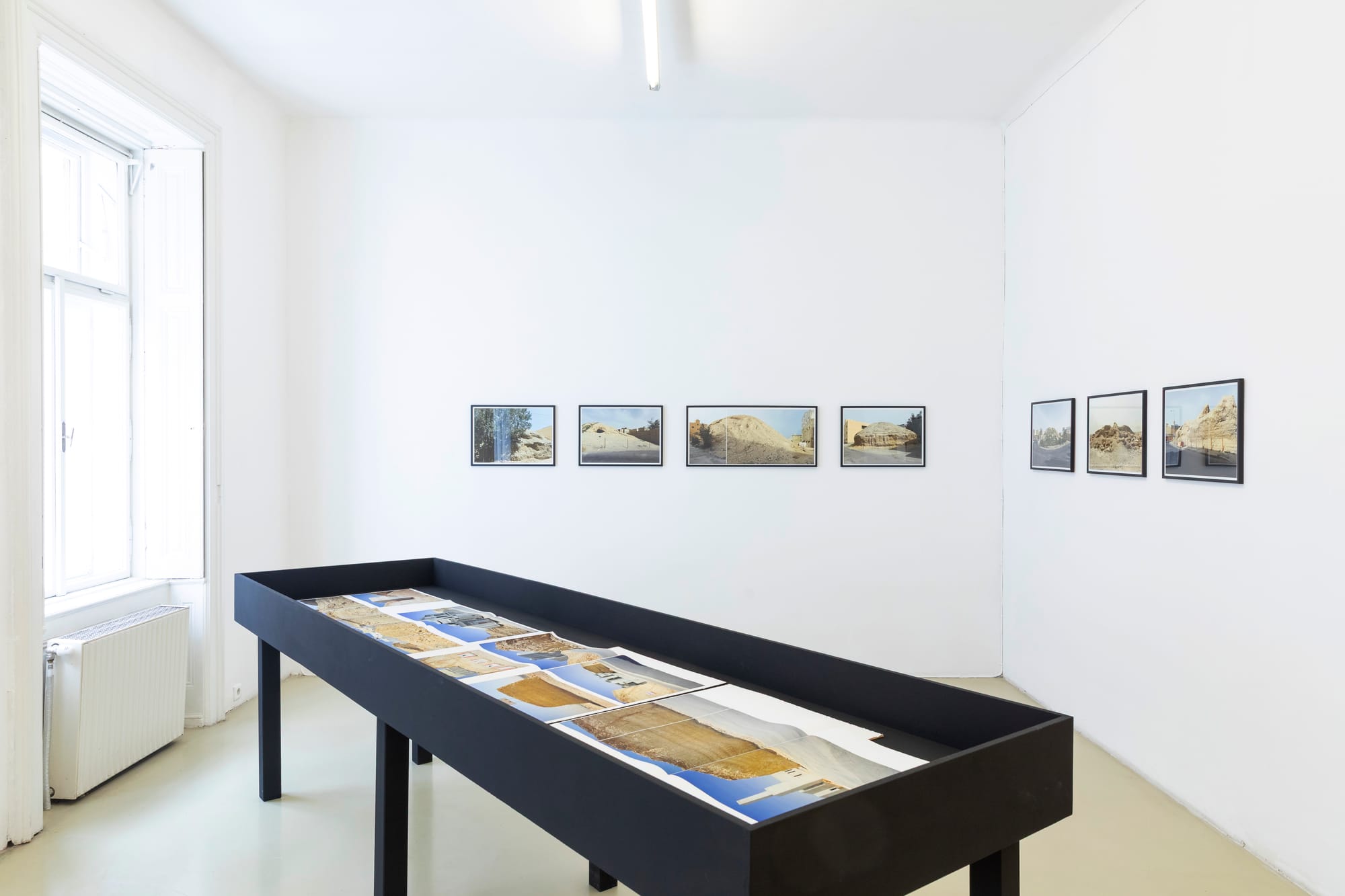
Fig.1
Fragment I: Navigation
Fragmentation is inscribed into the festival’s spatial format. With a network of 24 participating exhibition spaces dispersed across the city, it primes visitors through a rhythm of interruption. These interruptions not only condition my engagement with the exhibitions but also make the walks to the galleries explicitly become part of the experience of the festival. Navigating the routes from one show to another, the memory of previously seen artwork is punctuated by distractions on the streets, detours, and breaks; these disruptions are not merely incidental. They become part of how the event performs its theme, enacting modes of attention ascribed to the fragmented subject in navigating urban space. During the opening weekend, the festival offers artist- and curator-led tours, each with a distinct focus and route through selected galleries. These tours navigate the spatial fragmentation, suggesting possible narratives whereby walking becomes a mediating act through which the artworks of the festival are apprehended.
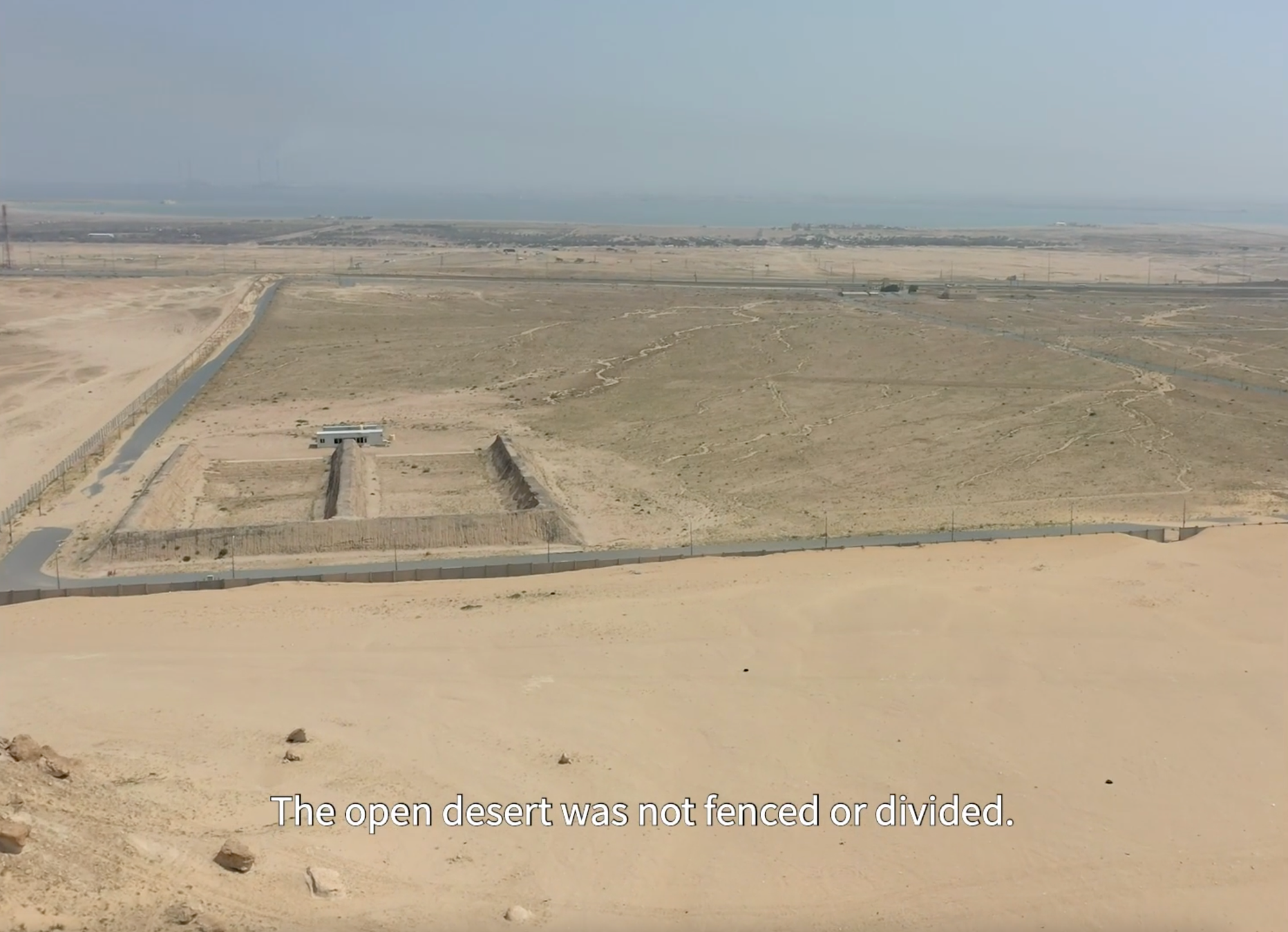
Fig.2
Fragment II: Desert as Allegory and Material Reality
Galerie Krinzinger Schottenfeld’s exhibition The Desert Has No Shadow mirrors this interplay of space and subjectivity by crystallising how fragmentation materially impacts the structuring of a landscape. Curated by Ute Meta Bauer and Wejdan Reda, the group show frames desert landscapes not only as physical spaces but as sites of memory, myth, loss, identity, and imagination deeply interwoven with histories of dispossession, colonialism, and ecological loss, but also utopian narratives are written into the work. Hind Nasser’s ink paintings Petra I and Petra II (1987) depict an uninhabited rocky desert landscape as silent yet dense with history. Nearby, The Desert Was Beautiful (2021), a video essay by Saphiya Abu Al-Maati, Aseel Alyaqoub, and Yousef Awaad Hussein, recalls the history of the desert of Kuwait, interlacing archival fragments and voiceover. As the narrating voice recounts, “The open desert was not fenced or divided. It was open. What increased, and more than anything, were sheep. Unregulated sheep roam the desert freely, consuming any vulnerable vegetation […] this is how desertification began.”[1] The work situates ecological damage within a history of urban expansion, domestication, and modernization. Camille Zakharia’s A’ali Burial Mounds photographs frame fenced archaeological sites encroached upon by housing blocks, underscoring how mapping, divisions and territorialization fracture landscapes. The fragmented desert thereby becomes a geographical analogy to the psychic fragmentations Rohwetter describes.
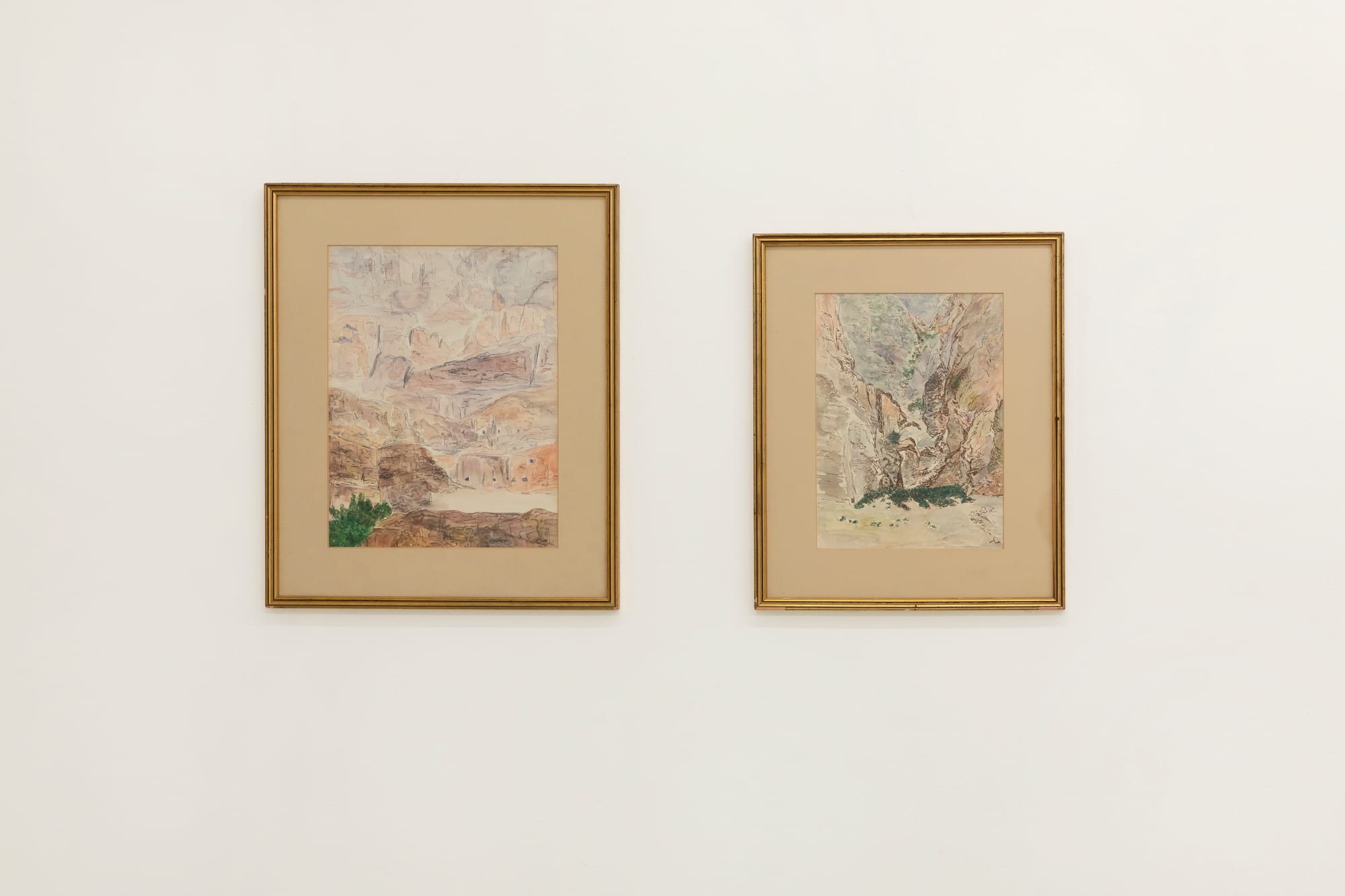
Fig.3
Fragment III: Performing Distraction
Drawing on Frederic Jameson’s conceptualization of the mediated experience of the self as suspended between attention and distraction, alienation and optical failure, Rohwetter reflects on the condition of contemporary subjectivity as a fracturing of attention.[2] Moving through curated by’s opening weekend is to embody precisely this oscillation. The crowded openings, with their convivial chaos of chatter and reunions, merge an engagement with the artworks with the social choreography that surrounds them. This distraction as a mode of sociability, which works against contemplative attention, mirrors the condition Rohwetter describes as an obvious characteristic of exhibition openings. What Irit Rogoff identifies as a deliberate act of Looking Away,[3] —opposing dominant modes of hierarchical attention in the perception of art—might be colliding with distraction as a necessity of participating in the cultural landscape. Attendance at the festival not only to see the art, but also to be seen by colleagues, curators, gallerists, and artists flown in for the occasion becomes reflective as a symptom of the current condition of the contemporary subject.
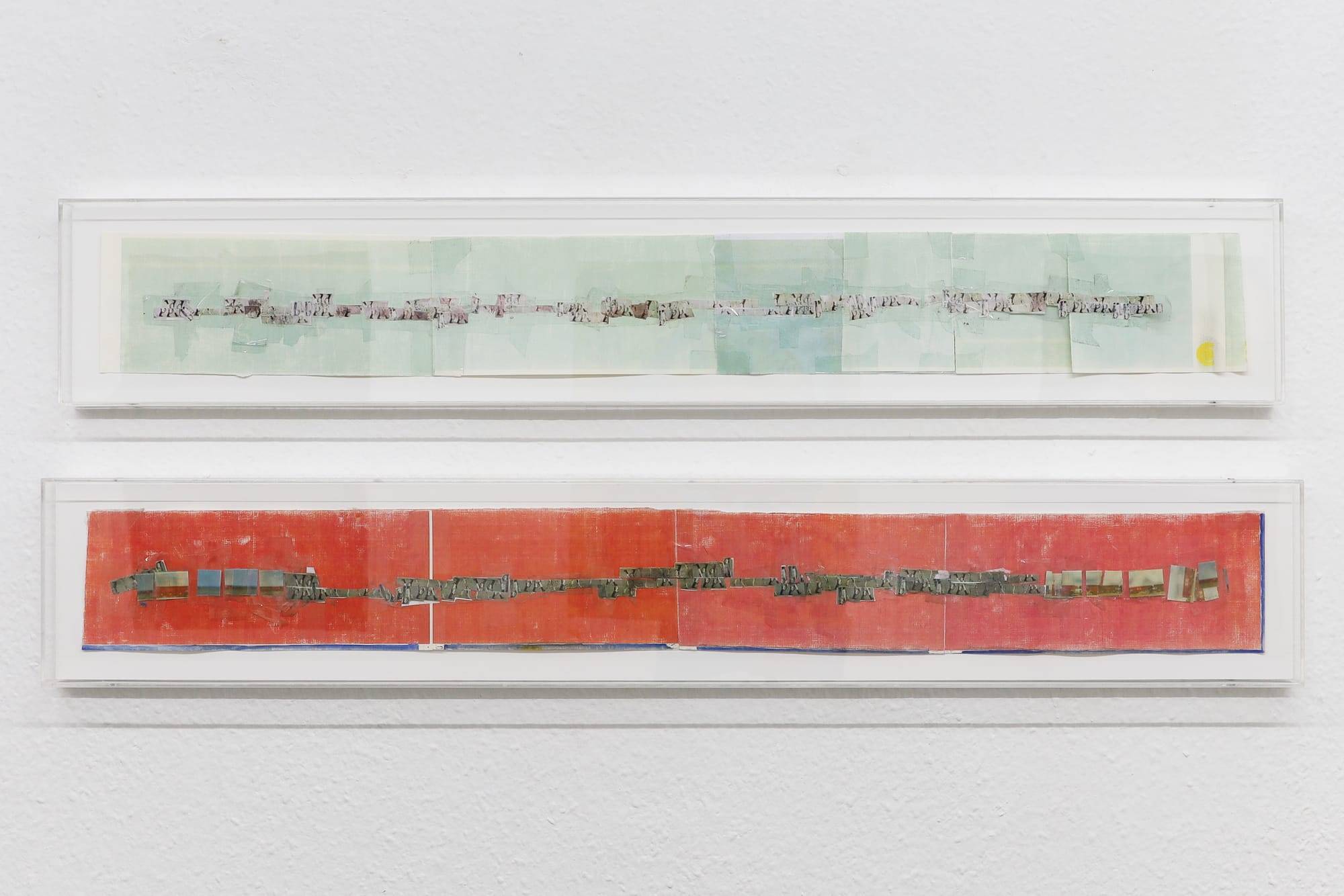
Fig.4
Fragment IV: Excess
The joint exhibition by LAYR and City Gallery Wien, Telepathy Curating presents: Teases and Synthesis; Empty Threads, Vienna Love and Anxiety Reality Paradoxes, amplifies a fragmented zeitgeist between excess, distortion and alienation with their show taking place in both galleries which are located within walking distance of each other. With 66 participating artists, the show is by far the biggest group exhibition of the festival. The exhibition’s unwieldy title mirrors its heterogeneous contents: a peace-sign print assembled using words such as “psychosis”, “vomit”, and “terror” entitled Life (2023) by Bedros Yeretzian and Morag Keil; an abandoned mop and painted wet floor sign by Merlin Carpenter entitled Birthday Card Against the Far Right In the Art World - Now Wash Your Hands (2025), images of install workers on a still life painting by Birgit Megerle entitled Altglas II (2012). In its density of disparate positions the show alternates between oblique sincerity, dark humor, hollowed-out symbolism and a disenchanting absurdity of the present. Reflecting both an oversaturation of signs and a staging of alienation, the show seems to encapsulate what Peter Osbourne identifies as a model for distracted attention.[4] Cited by Rohwetter, his reflection on art as historically positioned as either a source of distraction, a demanding of focus, or as something that merges both, seems particularly palpable in this show which stages this ambivalence rather than trying to overcome it.
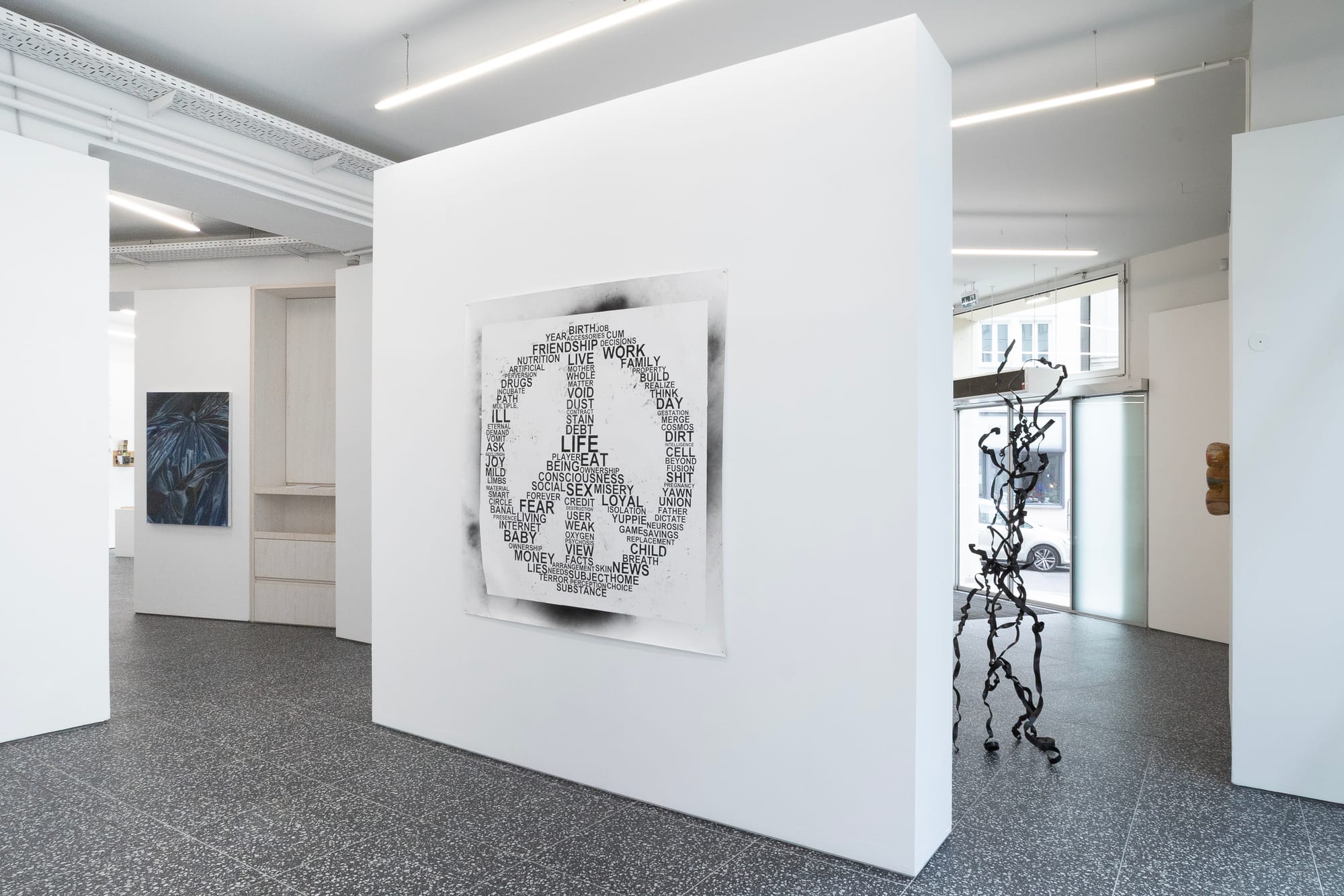
Fig.5
Fragment V: Paper, Tape, Process
Shore’s exhibition September gathers drawings and collages by Jennifer Aldred, Eyrie Alzate, Ericka Beckman, Ada Friedman, Jack Salzar, and Julia Yerger. The show’s subtle formal language evokes a quietness and demands a different mode of attention. The curator, Otto Bonnen, described the show on the festival’s Instagram as an inquiry into the processes of art production. Eyrie Alzate’s Rover, Inner Scar (2024), a collage of stills of walking legs, rudimentarily fixed on painted cardboard with transparent tape, appears as if taken out of the studio during a fragile stage of drafting. Jack Salzar’s intricate black-and-white drawing Untitled (2024), placed beside the narrow spiral staircase leading to the second floor, requires the viewer to pause midway between floors, disrupting the flow of visitors walking up and down the stairs. The show seems to produce disruptions to the pace of viewing, demanding visitors to stop midway, to zoom into the detailed drawings, and to retrace the temporality of production processes through the lines on paper.
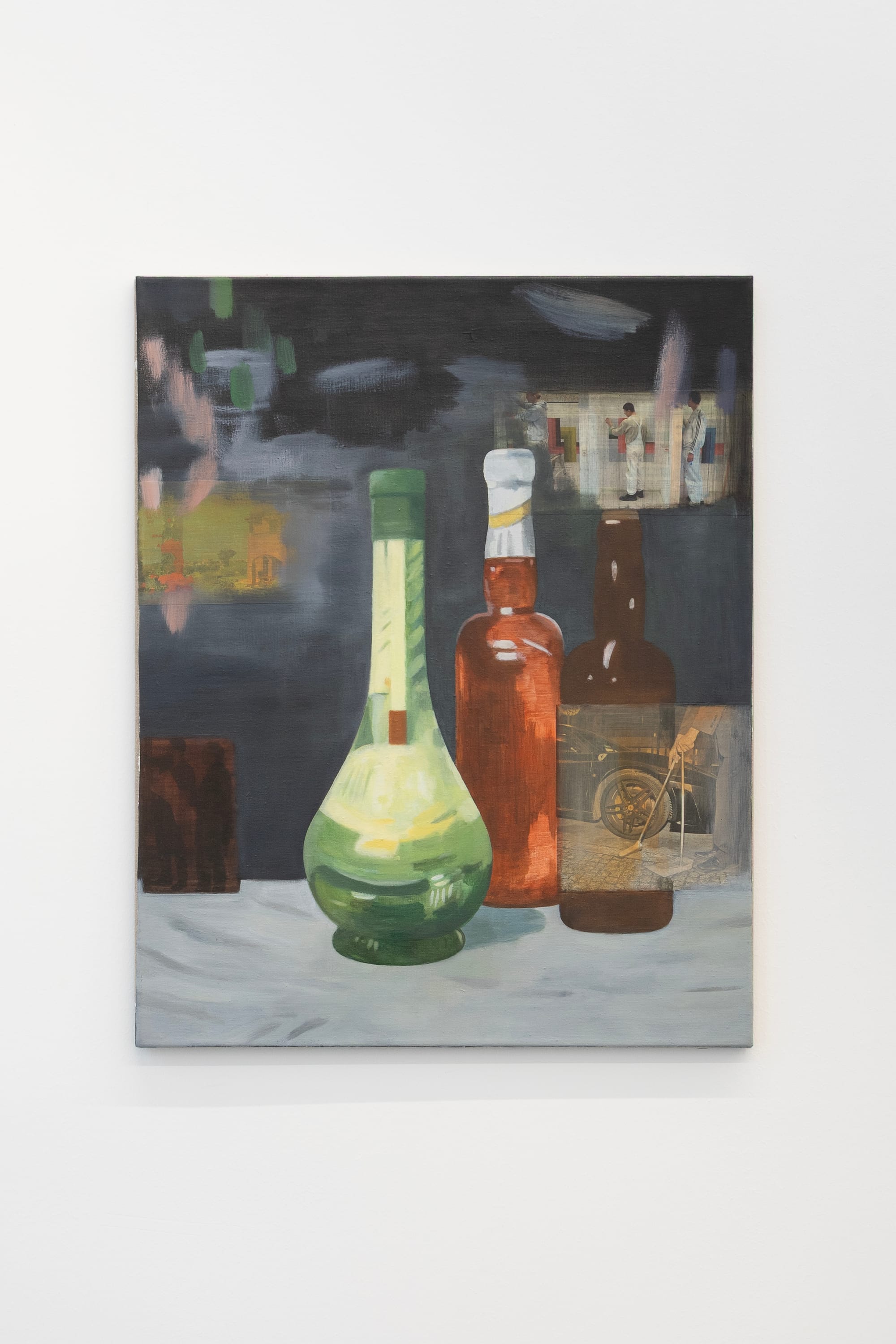
Fig.6
Fragment VI: Negation
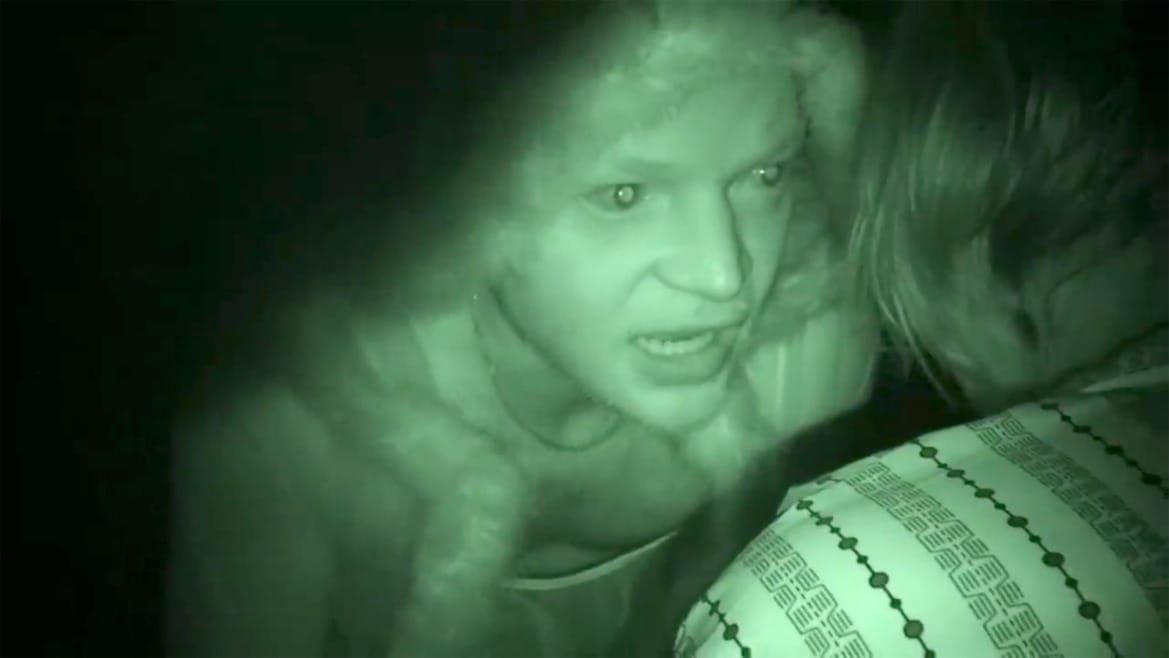
At Exile S.M. van der Linden’s The DEPRESSIVA Revolutions confronts commodified images of the female body with acts of refusal. As a rejection of the promise of a fixed identity or solidity, van der Linden’s work complicates any longing for synthesis. While her Depressiva Trilogy (2010-2011) projected in the darkened gallery space, stages —what the curator Oliver Koerner von Gustorf calls — the after-effects of a narcissistic overdose. Late ‘90s animations with a soundtrack of Stereo Total on screens installed in the same space disrupt immersion into the scenes. By framing depression not as an individualized pathology but as a response to oppressive systems under capitalism’s “economy of narcissistic reward,” van der Linden’s refusals and disidentifications from the social inscriptions on her body align with Marina Vishmidt’s notion of negative speculation as an antagonistic strategy, cited in Rohwetter’s essay. Vishmidt describes negative speculation as withholding investment in capitalism’s horizon of value, using withdrawal or suspension to expose its limits and open space for alternatives. Seen this way, van der Linden’s gestures unsettle the reward economy, turning depression and embodied resistance into critiques of the infrastructures that shape and police subjectivity.
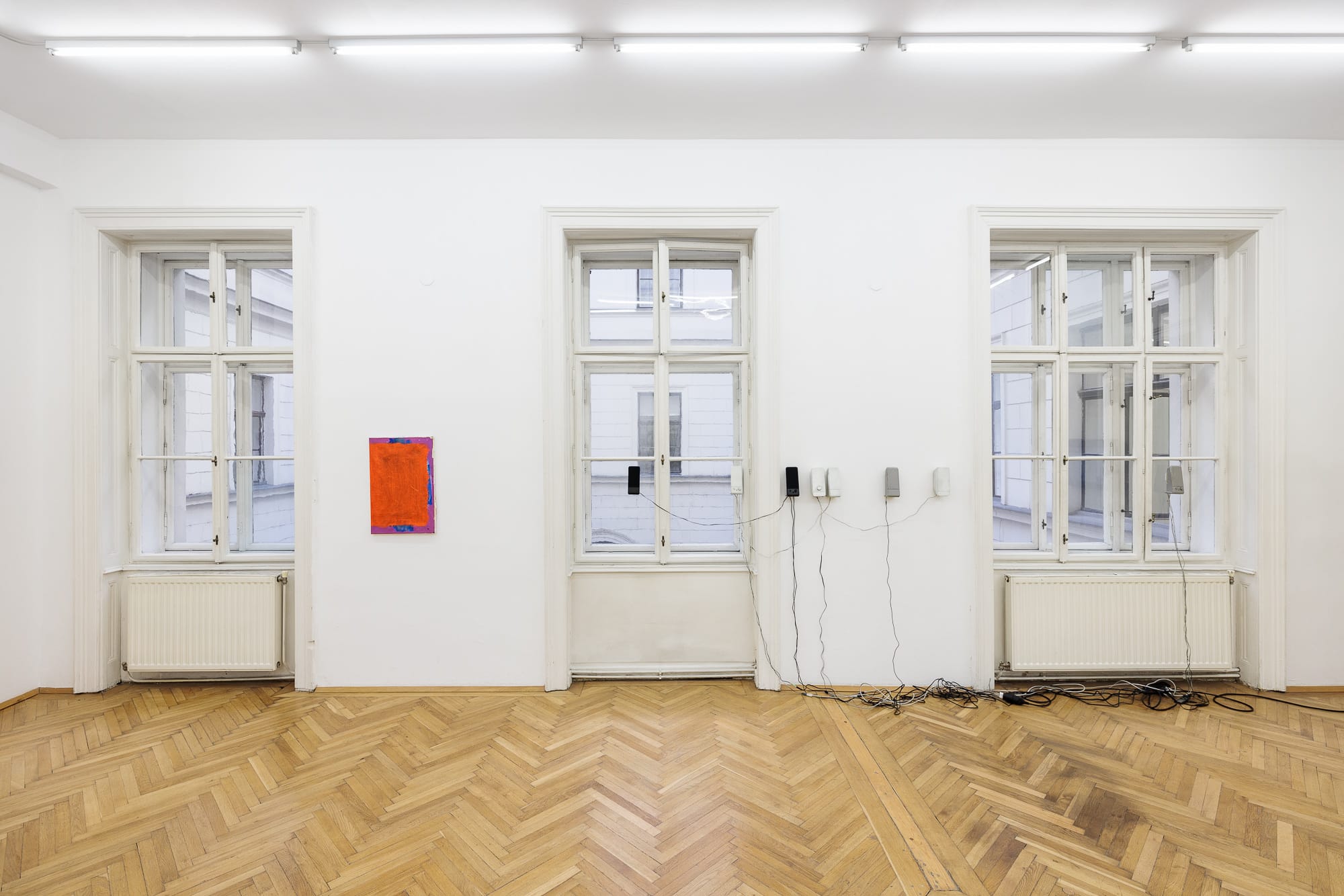
Fig.7
Fragment VII: Curatorial Gravity
Running beneath these encounters is a reflection on curation’s centrality. As already suggested by the festival’s name, curated by is invested in how exhibitions think through the assemblage of a curatorial concept. The emergence of the “curatorial turn”[5] in the early 2000s, framing curating as a site of cultural production and critical discursive inquiry, repositions the role of the curator and artist and situates artworks within broader conceptual frameworks rather than isolating them as self-sufficient. This emphasis invites scrutiny: what disappears when mediation becomes the main object of attention? How much of the artist’s work risks being absorbed by the discourse that surrounds it? The exhibition title The Artists Alone Decide—borrowed from Bradley Kronz’s 2015 show for the artist-run space CAN’s group show at Felix Gaudlitz can be read as a provocation toward the curatorial centrality of the festival, but also as a wry nod to the space’s own tension between pretension and ingratiation. In the gallery’s windows, the sound piece Innere Stadt (2019) by Simon Lässig and Vera Lutz plays from early-2000s computer speakers, their outmoded design conjuring anachronistic intimacy, alongside Flora M. Galwitz’s fnsystems featurin Pen’s Bungalow (music for refreshing the Systems) (1998), in which scenes of three women posing and dancing for the camera flicker in oversaturated colors. In correlation with works by Edward Dean & Matthew Linde, Bradley Kronz, Hans-Christian Lotz, Teak Ramos, Nora Schultz and Pol Summer, these works echo the show’s assertion that, despite the inevitable pull of context and audience, the artist’s relative freedom—however precarious or ironic—remains a vital stake in the encounter.
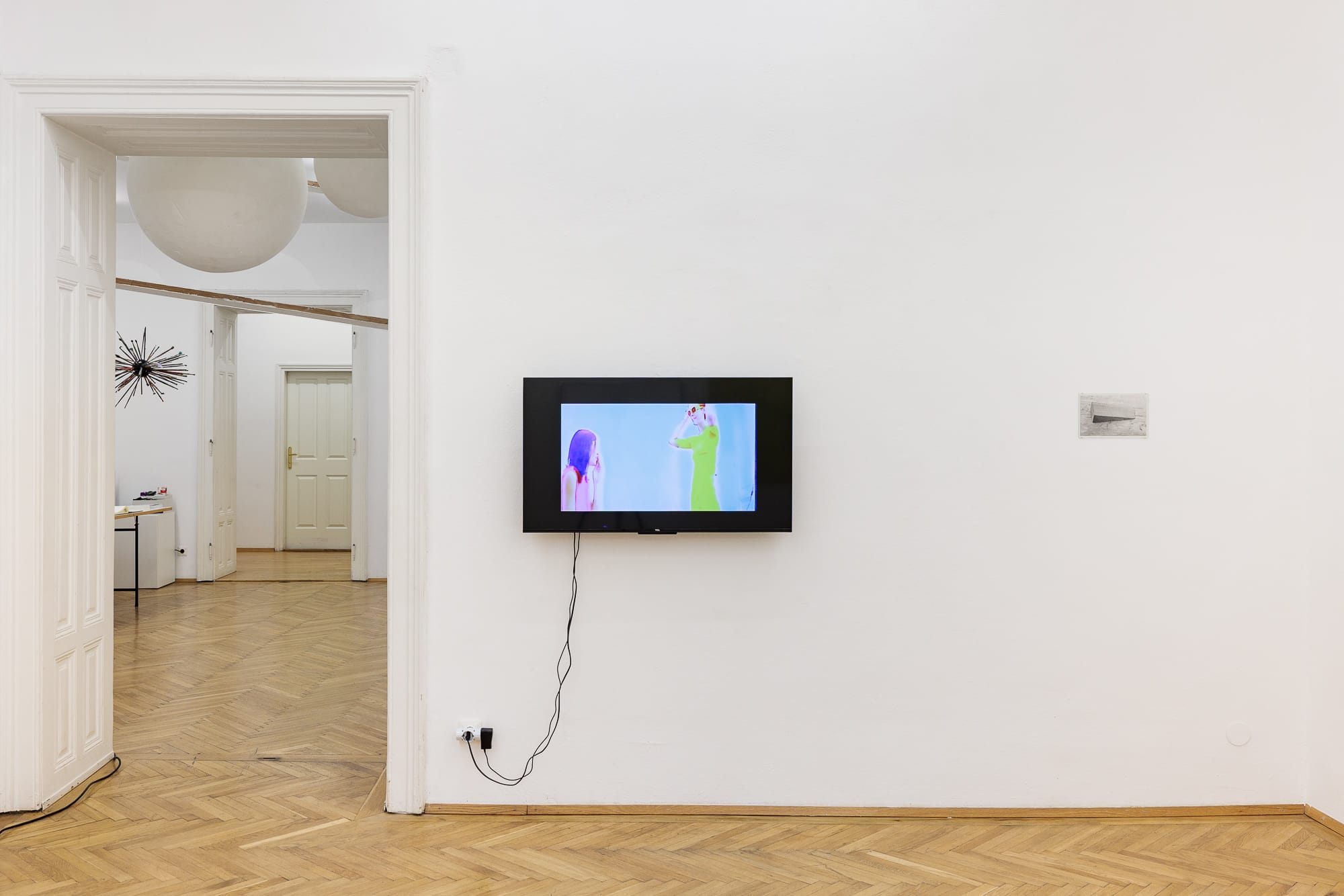
Fig.8
Fragment VIII: Debating the Middleman
The debates surrounding the curatorial turn were echoed in a talk happening parallel to the festival at the independent art space Pech!, where Mohammad Salemy and Sean Tatol staged a talk provocatively entitled Contemporary Art’s Need for History. Under the premise of a lack of historicization of contemporary art post 9/11, they juxtaposed the alleged scarcity of art historians’ engagement with the recent past with a proliferation of curatorial and research-driven practices. In identifying these positions as middlemen, their critique stands in tension with Anna Kornbluh’s much-debated book Immediacy, in which she diagnoses the opposite condition: the cutting out of the middleman as mediator, a symptom of what she calls “too late capitalism”.[6] Where Salemy and Total purport to see too many mediators, Kornbluh sees their erasure for the sake of an alleged obsession with unmediated experience in contemporary culture.
Fragment IX: Distracted Attention
Placed against the backdrop of curated by, such conflicting perspectives might not resolve but rather complicate each other and add new paradoxes to the question of how curation intervenes, mediates, or takes precedence in conditions of fragmentation. If fragmented subjectivity is a symptom of the negativity emerging from capital’s ability to adapt, rather than its capacity to liberate, then art might offer a way to observe these forms of alienation, as Sophia Rohwetter suggests. If attention is an economy, shaped by visibility, market logics, and discourse, the artists' subjectivities appear as exemplars of fragmented subjectivities, not only thematically but structurally, as their work circulates within the festival’s networks. Curated by does not aim to resolve these kinds of tensions but stages them as a shared condition of subjectivity in the present. The festival fragments itself across the city, between spaces and networks, between attention and distraction. Yet it also opens the question of whether this mode enables fleeting structures that contest dispersal even while depending on it, temporary alliances that rather form in antagonistic negation or speculation. To write about curated by as a continuous narrative already risks smoothing over what it exposes: that fragmented subjectivity, like the exhibitions that articulate it, describes a field of interruptions, negotiations, alienation, and precarious coherences. Acknowledging this instability may thereby be an attempt at fidelity: patching together, however provisionally, the distracted attentions that curated by reflects and evokes.
//
Footnotes
[1] Transcribed from: Saphiya Abu Al-Maati, Aseel Alyaqoub, Yousef Awaad Hussein, The Desert Was Beautiful, video, 2021, Galerie Krinzinger Schottenfeld.
[2] Sophia Rohwetter, “Fragmented Subjectivity”, (curated by festival booklet, 2025) p.2.
[3] Irit Rogoff, "Looking Away: Participations in Visual Culture”, in: Gavin Butt, ed., After Criticism: New Responses to Art and Performance (Blackwell, 2005).
[4] Peter Osborne, Anywhere or Not at All: Philosophy of Contemporary Art (Verso, 2013).
[5] Paul O’Neill. The Curatorial Turn: From Practice to Discourse (Open Editions, 2007).
[6] Anna Kornbluh, Immediacy, or the Style of Too Late Capitalism (Verso, 2024).
Images:
Cover: Filmstill, S.M. van der Linden, Depressiva (W + me), 2010, video, 08:01 min. © S.M van der Linden.
Fig.1 Camille Zakharia, A’ali Burial Mounds, 2018, Installation View, The Desert has no Shadow, 2025, Galerie Krintzinger. © Tamara Rametsteiner. 2025.
Fig.2 Filmstill, Saphiya Abu Al-Maati, Aseel Alyaqoub, Yousef Awaad Hussein, The Desert Was Beautiful, 2021. © the artists.
Fig.3 Hind Nasser, Petra I & Petra II, 1987, Installation View, The Desert has no Shadow, 2025, Galerie Krintzinger. © Tamara Rametsteiner.
Fig.4 Eyrie Alzate, Rover, Inner Scar, 2024, Installation View, September, 2025, Shore Gallery, © Shore Gallery.
Fig.5 Installation View, Telepathy Curating presents: Teases and Synthesis; Empty Threads, Vienna Love and Anxiety Reality Paradoxes, curated by Kristoffer Ceziando Karlsen, Josef Strau, City Gallery Wien and Layr, Vienna, 2025. © Paul Makowsky.
Fig.6 Birgit Megerle, Altglas II, 2012, Installation View, Telepathy Curating presents: Teases and Synthesis; Empty Threads, Vienna Love and Anxiety Reality Paradoxes, curated by Kristoffer Ceziando Karlsen, Josef Strau, City Gallery Wien and Layr, Vienna, 2025. © Paul Makowsky.
Fig.7 Pol Summer, I miss Brennesselsamen, 2025, Vera Lutz & Simon Lässig, Innere Stadt, 2019, Installation view, The Artists Alone Decide, curated by CAN, Galerie Felix Gaudlitz, 2025. © the artists and FELIX GAUDLITZ, Vienna.
Fig.8 Flora M. Galwitz’s fnsystems featurin Pen’s Bungalow (music for refreshing the Systems), 1998, Nora Schultz, Keil 2, 2025, Installation View, The Artists Alone Decide, curated by CAN, Galerie Felix Gaudlitz, 2025. © the artists and FELIX GAUDLITZ, Vienna.
Theresa Zwerschke works as an artist, writer and organiser. She is the co-initiator of Catwings and part of the Arts of the Working Class team.