
I only have a sensation to offer; it’s the sensation of dust.
I’m not even sure if it’s theoretically sound, but it feels right in how it’s unbearable while making me curious about the problem it poses. Dust everywhere. It’s in my mouth, powdering my eyelids, creeping up my nostrils, sitting in my auricles. Not a lair left ungritted, no corner untouched.
Last year it tasted like an ending. Now, not so much any longer. The dust became a figure, a toy of speculation, something to spend time with, to pay close attention to without knowing the outcome, a concrete universal perhaps. Endings are really transformations: “change”, as Lauren Oya Olamina says in Parable of the Sower. I’m thinking of Robert Morris’ The Box with the Sound of its own Making (1961), a work that Marina liked for the way it helped her think about speculation.
I could not make any art last year. The mere thought of creating left a bad taste. I also could not motivate myself to show any work. Cultural institutions felt impossible to even enter. In the course of a few months they had fully unmasked and they looked really ugly. The alienation was profound and while it was not altogether new it was new in its scope and depth and it felt irreparable, irreversible. Contemporary Art triggered nausea. Then I learned that more people experienced similar things. It had been a shared experience of an ending, as part of a collective sense of loss and rage, depression, and despair. Having not only been unable to stop a genocide but being complicit in so many ways pulled the plug from many things that had somehow managed to be normalized.
During the last ten years the liberal cultural institutions had almost made us believe in the sincerity of their desire for reforms. People working in those institutions seemed to have embraced the necessity to dismantle structural racisms and colonial hegemonies. Turns out, a lot of them quickly faltered under pressure. Some actively turned into genocide defenders and it became clear that freedom of expression, one of their core values, had a price tag. The hurried and anxious obedience of institutional leadership giving in to pressure from right-wing bullies to throw artists and scholars under the bus, exposed the actual priorities of the institutions. Within an order built on property relations, they would merely protect their own ruinous “right to exist”.
The liberal order had never been separate from fascism, in fact they share a kernel. Marina paid close attention to this and she spelled it out for us. In this maximally alienated and alienating moment, it’s been preciously helpful to revisit Marina’s analysis of the ruin at the core of the liberal order: the sovereign individual.
I came to call last year Year Zero. Marina left in Year Zero. Her razor-sharp analysis and her abundant humor is irreplaceable, yet she left us with invaluable writing that will keep us busy for years to come.
In Year One, the genocide is still going on with impunity. Institutions are in a state of blathering agnosia. The space of politics has been largely evacuated and busies itself with warmongering clamor and bullying. The dust has rendered habitual spaces near unrecognizable, friend or foe. Still, something is different. In Year One I observe being oddly more able to collect my thoughts. Suddenly it appears all the more meaningful to gather, to build, to self-organize, to dream and speculate, and to imagine what—in Saidiya Hartman’s words—you have no evidence for at all, outside of the plausible, outside of existing categories. The pulverisation of the liberal order spreads the dust everywhere, most of it toxic, some profoundly nourishing and its spread strangely opens the imagination—or fantasy, as Kerstin Stakemeier would have it—beyond the ruinous ruin the liberal order had been, even when it was still doing fine.
All the more, examination of the dust seems crucial. It happens sensuously above all, grappling with the impact, the taste, the sound, the smell of it. It’s a matter of survival to discern the toxic from the nourishing, the able from the irredeemable. Amid the debris might lie socialities that are still recoverable, analysis still valid and sharp, and tools useful for instantiating, communizing, infrastructures, very concretely.
While sifting through the dust, the toxic parts especially seem saturated with ideology, while missing all purpose or structure. In their ruinous state, these remains appear highly aestheticized. All gesture, all meme. Following Marina, I read these parts as somehow still cultured or culturally circulated. How to grasp both the ideological residue as well as its structural understory requires analysis.
In her essay “New Ruins” (a version of which Marina first gave as a talk in Paris at the White West conference and then in another version in Venice, before rewriting it to be included in the publication Beyond Repair in 2020), she speaks of culture as a shorthand for ideology “while being as structural as it gets”. According to Marina structural critique and critique of ideology, while seemingly divergent, are actually very close. They yield analytic value in their combination not their separation.
The main ruin that Marina attends to in “New Ruins” is the fetishization of the sovereign individual, the source of all biopolitical value, moral authority and cognitive credibility in liberalism.
She writes:
The fetish of the individual (artist or citizen) and the sanctity of the individual’s property rights to their speech and creative imagination should be seen as both a result of and a compensation for the suppression of thinking in terms of community, collectivity, or trans-individual responsibility that decades of neoliberal ideology, as enforced by the conditions of everyday life, have established as the absolute bedrock of whatever social contract we can still talk about. Fascists mobilize the fetish of the sovereign individual to organize wounded individuals who feel their rights are being infringed.
During the collapse of the liberal order, the fetish of the individual is mobilized under the rubric of dispossession. An atomized society of wounded individuals, having conceived of their own speech in terms of property rights, now demands blood money for the disenfranchisement. The perpetrators must be named and punished. For Marina, the value of the individual points to a primary route (and root) of fascisms both historical and contemporary. Accordingly, it is no contradiction that the sovereign individual, while being ideologically and opaquely pluralist, is structurally synonymous with the dominant categories under capitalism, whiteness and patriarchy.
Marina continues:
Why is fascism only named as such when it is whiteness that splinters into lives worthy of life on the one hand, and the death or deportation of other newly or newly forcefully de-humanized whites, as in the Second World War and the Holocaust, but not recognized in the consolidation of whiteness against its predetermined others that constituted and continues to constitute the modern polity? From that vantage point, fascism comes to seem like simply the intensification of the long-engrained lethal tendencies of the existing mode of production and governance. Capitalism without a filter, the grinning face of more and more people rendered surplus on a global scale, which now also includes the planet being burnt in the furnace of accumulation.
The lethal tendencies—whose impact was always felt more by some bodies than by others, was always more destructive in some places than in others have come for a whole lot of people and non-people, places and non-places. Now it has arrived once more at whiteness’s doorstep, allotting surplus populations in spades. That’s when liberals suddenly become “alarmed” and declare “firewalls” so that their property rights shall not be infringed by fascism. Yes, there is still a residue of leftover liberals roaming the rubble. They are mostly hiding in cultural institutions, hoping that the firewall holds and they might be spared.
Marina writes:
Every time an artist is given a free pass to “question” or “problematize” without any consequences, regardless of their own ethical or political beliefs, it’s a feedback loop between the sovereign individuality of the artist and the sovereign “free zone” of the institution of art. Certainly, this is a notion of autonomy that has been comprehensively deconstructed at the level of discourse, but this makes no difference so long as the institution of art is maintained through and affirms the sovereignty of capitalist accumulation through its practical existence as a “space apart”.
Marina spoke about art that captures its own making. I want to believe that this would have to include its unmaking, its abolition. Tracing the unmaking of the fetish of the sovereign individual in the dust as a way to unearth the ruinous presets that erected it in the first place. In that spirit, I want to share a short piece I just published with Reliable Copy. It features three voices. Allow me to briefly introduce two of them:
Robbie Williams is a fictitious artist, created as a means to record the sound of his own making. He first appears in 2008 when his SOLO SHOW portrays the work of mixed media berlin, a company producing the works of many known artists but staying largely invisible. The SOLO SHOW is spelled out as the making of many hands and minds and begins the work of abolition. Abolition of alienated labor, of authorship and of the sovereign individual and the sanctity of his property rights.
Seda Naiumad appears around the same time as Robbie Williams. She is an assistant, equally fictitious, and equally and gradually writing herself into the fabric of the real. She is, by virtue of her reproductive activity, a collectivist, flighty but strategic, associative but not identifying, let alone owning.
So now we are in 2025, and it might as well be Robbie Williams’ final SOLO SHOW.
Seda Naiumad:
I think it was me who saw the marble with its pearlescent shimmer first. It rested next to the base of the stage, between security and the protesters. Its perfectly smooth roundness flashed and twinkled as protesters were moving. When I looked up to Robbie he seemed to have seen it as well. He glanced at it curiously, while his body otherwise seemed calm and held. He was standing on stage next to the curators, his hands holding onto something, maybe a note. For a split second our eyes locked and I could see everything that I felt but could not put in words. It was as if the room, no, actually the world, had come apart—split in two opposing stakes—and we both held our breath, staring at the marble’s curve.
I was with the protesters. I had told Robbie before and he had just nodded—not looking happy, more in general, not because of me necessarily. He didn’t say it, but I knew that he knew that this show was going to blow up in his face. It had been ill-fated from the get-go, but ambitions and the pressure from his gallery had dominated the conversation early on. He was convinced he could use his leverage then, to make a difference and win the museum over. “If we just abandon the institutions, they will never change,” he said. I felt he said it more to himself than to me because he knew my position. Institutions had been consistent in being hypocritical and the genocide just fully unmasked their complicity in a rotten system. “Robert Cemil Williams, you know I’m not a liberal,” I responded. “I can’t help you.” I looked at him and saw a flat character. He was not Robbie, who I knew as a friend intimately for so many years, he was the protagonist of a warped social order. And he was not ready to disrupt the social field that had made him. He believed he could negotiate with the museum. And he believed in his leverage. “I have to go, good luck habibi.”
Robbie Williams:
It was to be my biggest solo show to date. Everybody was excited and had been working tirelessly. Both Tim and Mark had encouraged me to think of this as my personal blockbuster—a move into the upper echelons of the arts. So I don’t know, I just felt unusually hesitant, almost uncertain. Besides, the past two years had been beyond horrid.
There were tensions way before the opening. The entire art world was in turmoil, divided over the response (or the lack thereof) towards war crimes committed by Israel. Some people had signed stuff in protest and were then pressured by collectors to remove their signatures. Some people had been laying low in public but were very vocal in private. Some people were confused and felt they didn’t know enough to take an informed position in what they called a polarised situation. Anyways, it was complicated. Sometimes it felt as if it was tearing at the very core of stuff in the arts.
I felt devastated by what my feed was showing but also too occupied with production to properly participate in anything. The news kept me up at night, endless heart-wrenching testimonies of death and destruction, but also of defiance and resistance. Palestinians documenting the targeting of their homes, of schools, hospitals, universities. Parents burying their children, infants who lost their entire families, doctors operating without painkillers or anaesthesia, cemeteries bulldozed, farmers salvaging crops from the rubble, starving aid-seekers being shot while collecting moldy flour from aid sites. It was utterly depressing and enraging.
At some point activists from Seda’s circle reached out to me asking if I would be ready to cancel the show in protest. Many people were involved in this exhibition, several institutions had teamed up, an architectural firm was commissioned for the displays, and some people who had been supportive throughout my career were backing it. There was simply no way I could pull out. I did think about it, I had to. Who wants to stand on the wrong side of history? But it was impossible, too late in the process to let all these people down. But I could do something from within. I felt I had leverage and was on good terms with the curators. Haha, what a joke!
Now, standing on stage next to Tim and Mark, I felt as if the floor had cracked right open, leaving us hovering over a gut of steaming viscera. I could foresee how we would all be devoured and turned into dust. Nothing would survive the nonsense written in Tim’s opening address. Nothing would remain. What a shitshow.
My mother’s voice purrs, “Cemil canım, they are afraid of us. Be kind to them.” She always defended them like a good immigrant would. She was married to one of them, so yeah. Was that what I was doing here? Being kind?
Then I saw the marble. It was sitting there right in front of the stage—that gaping gut under my feet. It was so small but shiny and round like a pearl. I saw Seda among the crowd. She had seen it as well. We looked at each other for a second. And suddenly all fell still and silent in the midst of the boisterous, urgent chants drowning Tim’s lies. I saw Tim leaning into the microphone, his mouth uttering words I could not hear. He looked like AI, continuing his speech despite the fact that he would be turning into dust any moment now. I saw banners carried by waves of bodies. I saw many faces—some familiar, some not—chanting and clapping, and I saw the marble somehow being the epicentre of all anticipation, all possible outcomes and direction. I remember thinking: it’s so perfectly smooth while all else is rugged. It felt like everything was falling apart except for the pearlescent shimmer of this marble.
By the time I was able to get down from the stage, the crowd was traversing towards the exit. I glanced at the marble next to my foot and then at Seda and the protesters swiftly exiting the museum, banners held high and still chanting. Gradually Tim’s voice reappeared from under the clamor “...Our work is grounded in essential values that are non-negotiable. As a museum we are deeply committed to freedom of art and freedom of expression....” My gaze followed the crowd moving by outside, behind the huge glass walls of the modernist building. In the window frame behind Tim a large banner started to appear. It advanced like the wind, unfolding under many hands. Once stretched over the entire glass surface, it read “STAATSRÄSON is GENOCIDE”. I watched the staff and security inside rushing to the window, trying to cover the word GENOCIDE with their bodies.
Another glance at the marble and my hand reaches for it. I don’t know whether I actually manage to touch it as it all happens in a single breath. While my eyes are pinned to the shiny round surface, the entire museum around me folds down, everts, and spills its glass and steel structure into the surroundings. The fresh air hits my face like a rock and makes me gasp. I had intended to take the marble and walk out of the museum, but now there’s nothing left to walk out of. Only the marble, still sitting next to my foot, is unaffected. I gasp for air again. Apparently, my body is still standing upright, but I do sense a strange ripple across its surface, almost like a shiver. My lips are moving, channeling the strokes of air, my eyes are touching all that has unraveled around my feet. I can’t discern inside and outside, and I do not dare to look further ahead. Keeping my eyes to the ground, I start walking towards where I suspect Seda is, the crunching sound of pulverized glass under my feet. In the residue, I recognize remnants of my sculptures. “I’m done,” I hear my own voice, “tamam hadi, I’m done.” In the distance, I hear chants.
Marble:
Of course we didn’t destroy the museum. We’re not brutes. Not that we have issues with militancy, but we actually like modernist architecture. What you saw was all in Robbie’s head. This is how he imagines things ending. Quite cliché if you ask us, but to give Robbie some credit, it is kind of consistent with his imagination if you look at his work. So this is not exactly what went down. What did, in fact, happen was that Contemporary Art died that night. Well, not exactly that night, but that’s a longer story. You’re asking why it had to die?
Before the revocation, “contemporary” was another word for “complicit”. It was inevitable that something had to happen, and something would have happened anyway if we’d left it to the new reactionaries.
But when Contemporary Art ended, it did not end art. Quite the contrary. Contemporary Art had been holding art hostage in an endless present that continuously deferred and suspended the historical. In this deferral, it cultivated a general numbness that it called “aesthetic experience”. Let us tell you, it was really an anaesthetics that eventually became a playground for fascism. Contemporary Art had reigned by means of a whimsical but sophisticated operant conditioning system with unbounded rewards, but also coercive narratives of exclusion. Funnily, it held definitive power without accountability. In short, it was a joke, as Robbie found out that night. What happened was that time had started counting again. The time of the dead is as much as that of the unborn. The time of stones. The time of dust and dirt. The time of things breathing and breaking. The time of names and naming. As Solmaz said: “Let it matter what we call a thing.” It goes without saying that praxis is a thing, that study is a thing. And things are looking pretty bleak. For now, art remains as a thermal shadow, allowing us to disperse and feel out the topologies of the surround. We linger at folds and recesses, traverse open fields of utter devastation, and we find remains of sociality in the stretches between what, for now, we call tradition and anticipation. We find that flatness and roundness are not opposed, and that some properties are preserved even in dust. We learn how to touch these properties and turn them into infrastructures.
//
This contribution was first presented in the frame of the conference "What Is Infrastructural Critique?” co-organized by KKP (Sofia Bempeza and Annette Krauss) together with Danny Hayward and Rose-Anne Gush, and hosted at the University of Applied Arts Vienna, in October 2025.
Cover Image:
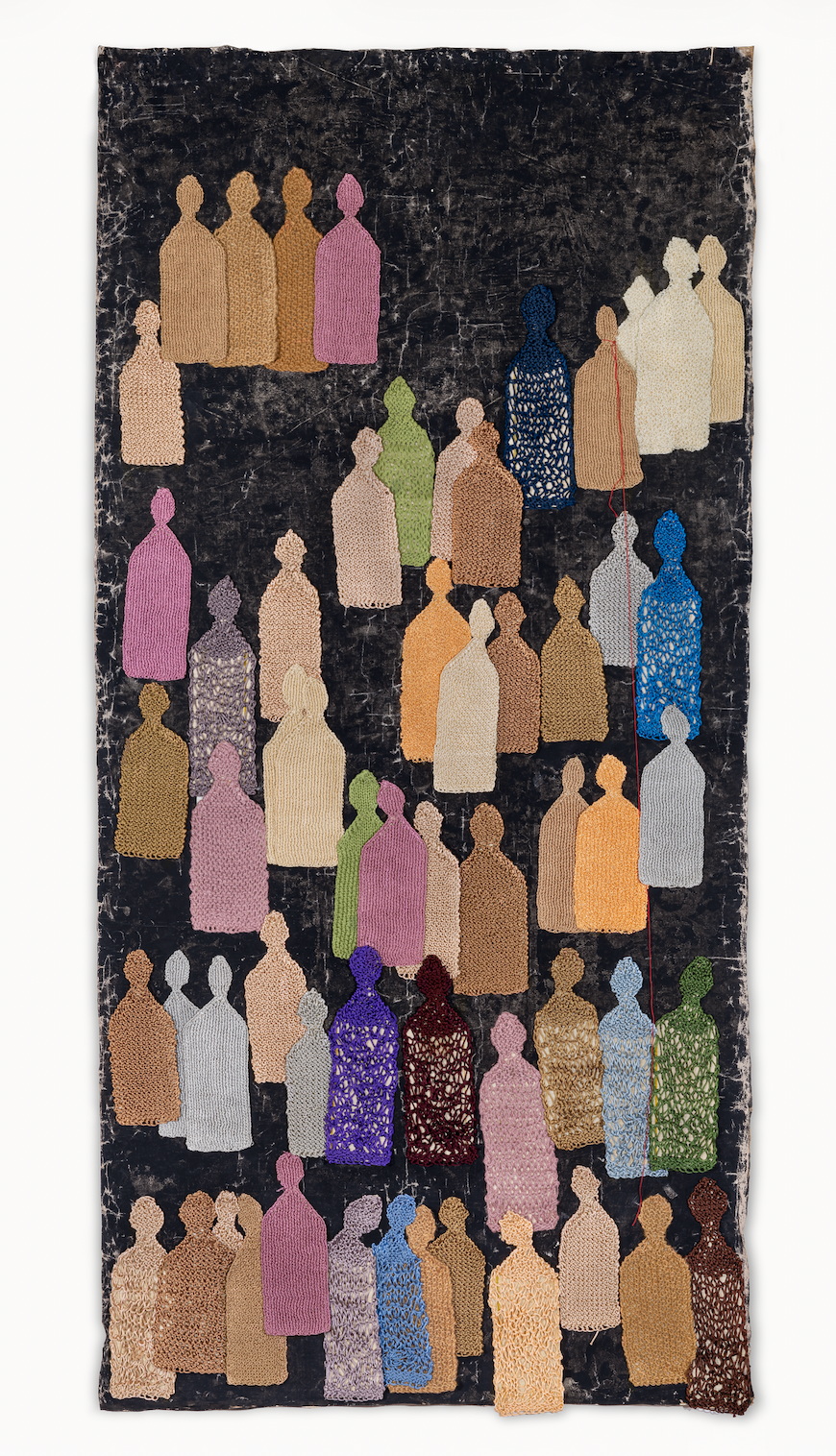
Mariuccia Secol, Mom Has Gone Out (La mamma è uscita), 1980. © Mariuccia Secol. Courtesy of the artist’s family. Photo: Magdalena Typiak
Natascha Sadr Haghighian is an artist known for assuming multiple identities. Her official press releases and gallery biographies conflict on country of origin, date of birth, and place of residence.