
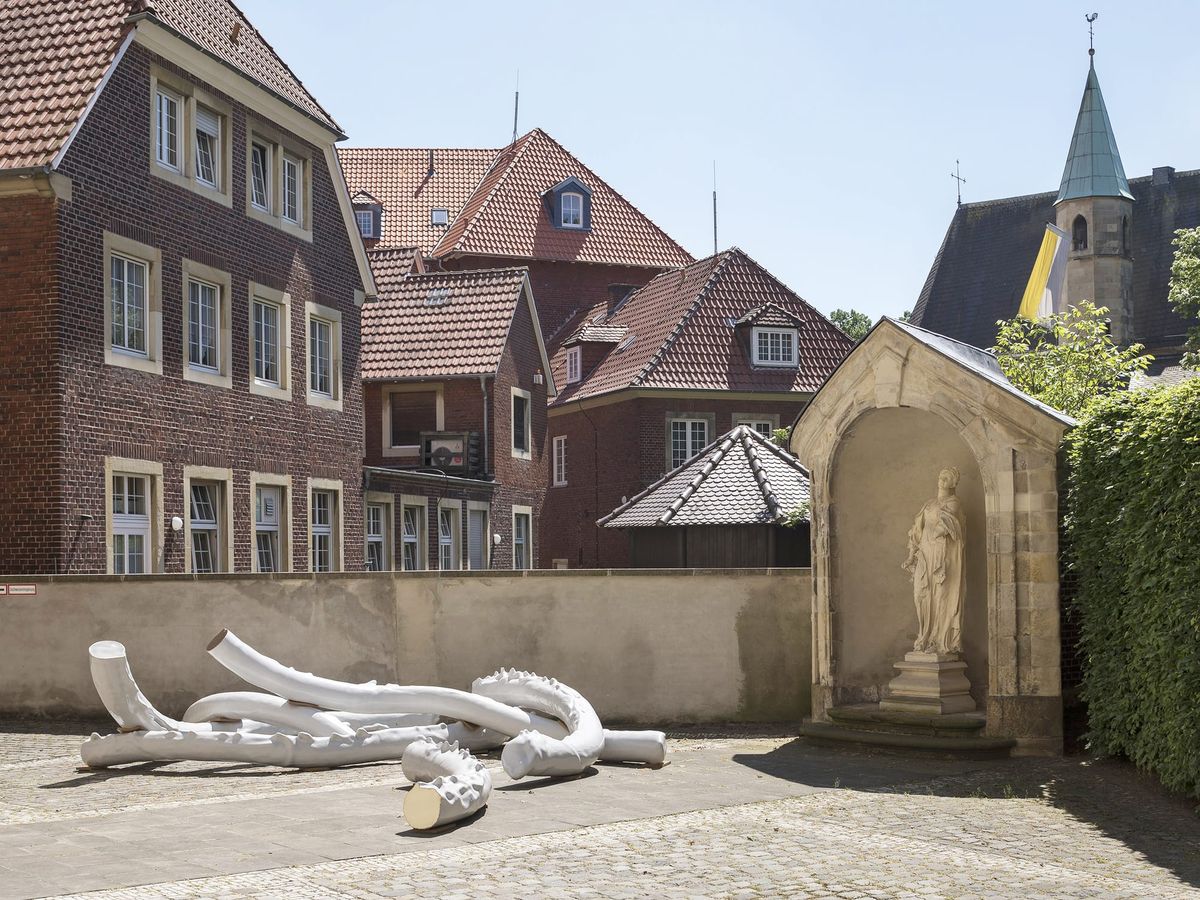
Her long reflection on what sculpture is—when stripped of stability, produced under constraint, displacement, or lack—could be called choreographic. It doesn’t offer closure or unity. Instead, it moves through provisional structures, fragile materials, and historical fragments to pose the following question: how does an artwork survive its own conditions of emergence?
Nairy Baghramian describes her upcoming exhibition project for WIELS, Nameless, as “light” in material terms but “heavy” in cognitive weight. There is an intentional emptiness, comprising walls leaning against columns, glass works that resemble neons but do not emit light through blown glass. This confluence of volumes might simply mean “a multitude of abstract selves— caught in passages, uncertain whether they are arriving or vanishing,” as she says—forms caught in transition, unsure if they are arriving or disappearing. The exhibition will also include wax portraits, hooks, and quirky curves that never settle into static installation. “It will be very much about niches,” she notes—about the absence of a stable place or point of access, about the condition of being suspended in-between: as if you are on the verge of entering a space, or already in the act of leaving it.”
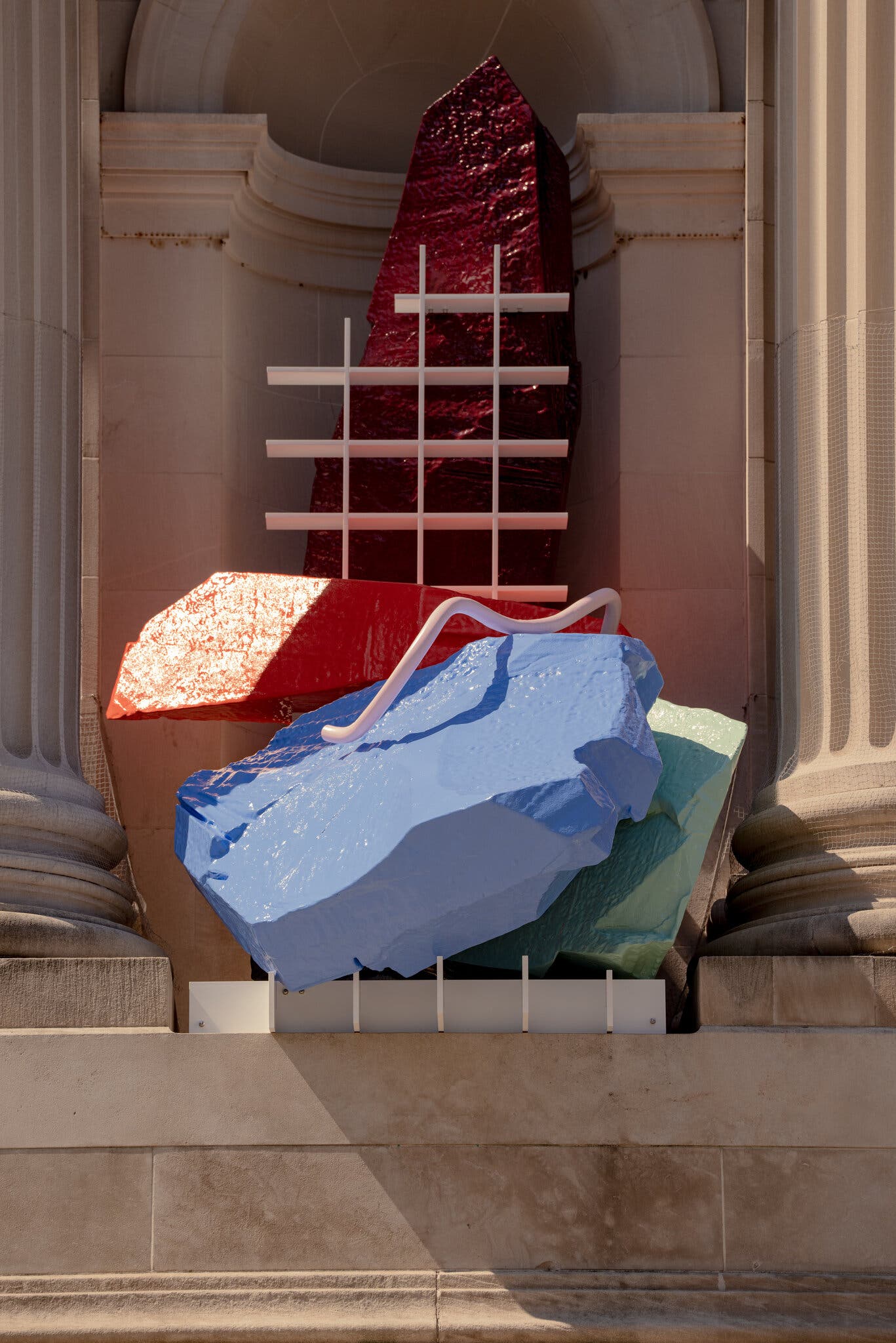
Fig.1
Or maybe not. She leaves everything open until the end. Even the title of the exhibition, for instance, emerged years ago from her notes about and around not only sculptural histories around WWII—from the ways works were destroyed, remade, or displaced, to the shifting material and historical conditions that shaped them. The list is endless but to name few for example Katarzyna Kobro, who, during the war, was forced to burn her wooden constructions to heat her home, while her husband, the painter Władysław Strzemiński, refused to sacrifice his canvases—Kobro’s works were, after all, “just sculptures.” Another is Hans Arp, who, while fleeing Nazi Germany, made a small papier-mâché figure in transit and titled it Stateless (1939). For Baghramian, these instances are not isolated anecdotes but material evidence: “Sculpture is never transcendent—it alters itself under the force of circumstance.” There is no transcendence here, no romanticization that shields it from necessity, from adapting, crossing, or even disfiguring itself in relation to its time.
Her insistence on material history—on the situatedness of form—runs through each of her previous epic scale exhibitions. A virtuosa in eschewing permanence, forging through materials an indescribable signature style, Baghramian explores what a body of work can be when it loses access to its own tools, spaces, or references. “You don’t have access almost to your own self,” she says. “The work is never fixed– it is always in motion, always in passage.” In Nameless, this transience takes the shape of works made of found neon, re-heated and bent again, mixed with newly blown glass. Nothing is stable. The light is off. The forms are fragile: “You have to carry them like eggs.”
There is no press release yet, if you visit WIELS’ website for information. Baghramian resists affirmative interpretations and avoids defining what the exhibition means in advance. “Dirk [Snauwaert, director and curator of the exhibition] wanted to write a longer text, and I thought it’s too early to put the words in place.” Such resistance is political in nature: part of the refusal to fix the work into a narrative of success or legibility. It is, after all, Nameless and not Untitled—a word that does not resist identification. Instead of fixity, processuality remains the imperative: art working against its own production; works interrupting their own methods and legacy, becoming fragile rather than durable. This is not to say Baghramian is uninterested in large-scale solid structures. She is well known for them, often returning to old techniques, but re-conditioning them for the present: “There is no such thing as simply reaching for what lies next door—something ready at hand. Instead there is always the condition of what is absent, what must be re-made”.
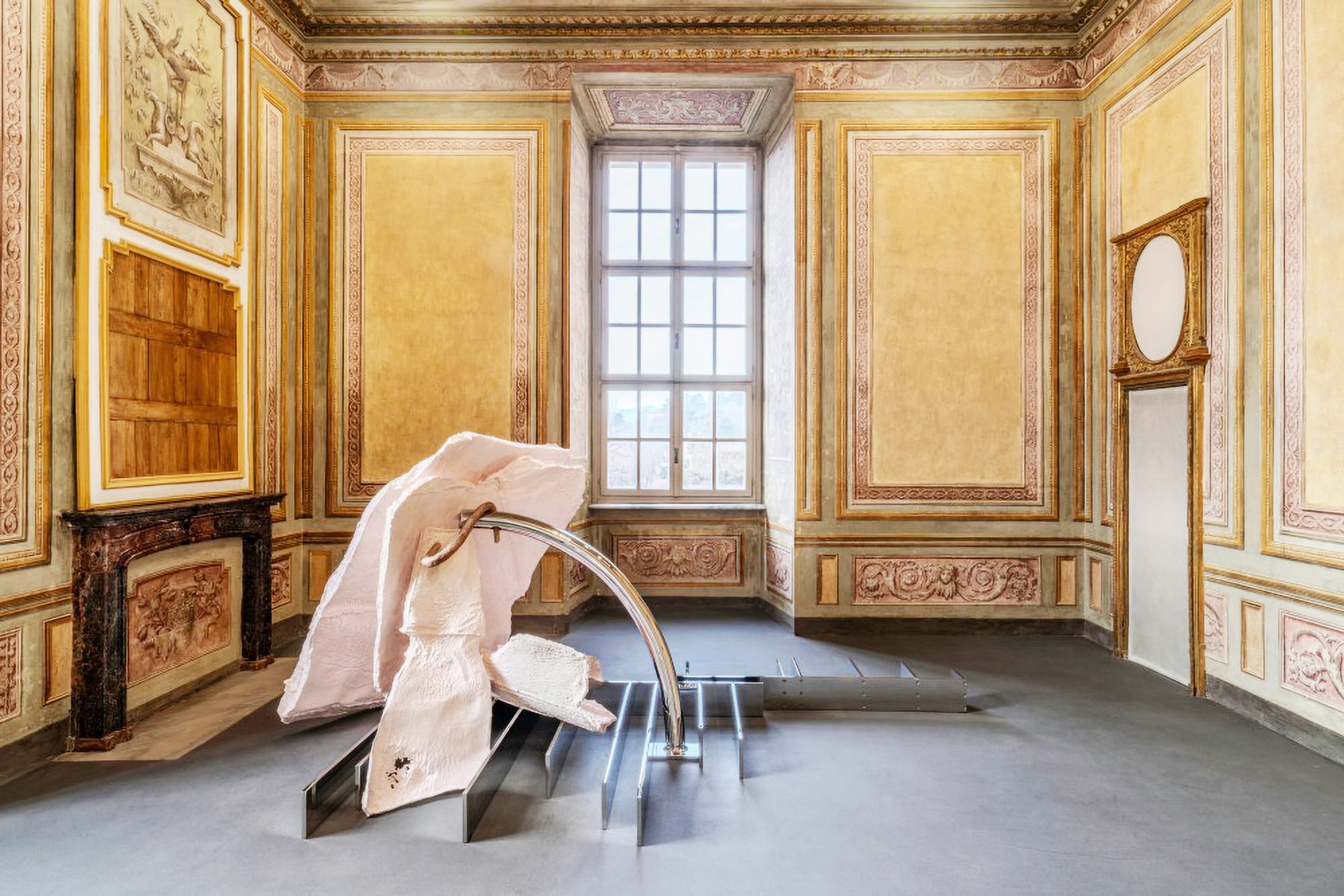
Fig.2
When I ask if the exhibition is about traces of the current wars, Baghramian replies: “No—the wars did not begin today. But there are always difficult thresholds when you consider the life of a work: how does it endure, how does it shift, and how does it survive, and how does it adapt to the world?” The concern is with temporality, not heroism, with how materials respond to (social, political, physical) constraint. With the recurring necessity of making things that can’t—or shouldn’t—last.
This attention to contingency links Nameless to earlier site-specific works, for example her exhibition in Sardinia’s Pratza e Duomo, where sculptures existed alongside civic infrastructure and the works of friends and artists including Oscar Murillo, and Mariantonia Urru, a weaver from Nivola. “You cannot live without neighbors,” she said of that project. Nameless works similarly. Not as a gesture of generosity, but as a material decision. The work doesn’t aim for autonomy. It’s dependent on space, bodies, and the surrounding conditions.
For me it is unavoidable to think of Marx here, whether explicitly stated or not: artworks are shaped by the relations of production, by where and when they are made, by what is available. Baghramian returns again and again to the question of what sculpture becomes when there is no proper studio, when tools are missing, when materials are broken or unstable, pulling softly apart the illusion of artistic mastery. It points instead to the work of modification, survival.
Even her neon works are structured by disappearance. In Turin, she observed neons mounted on buildings during daylight, with their lights off. After shops had closed, their neons remained. “The legacy of neon in the public sphere is gradually losing its meaning, as economic decisions increasingly push aside aesthetic considerations,” she said. “This prompted me to wonder about the role of neon in the streets today: which signs still glow, and which have fallen silent? What does their presence—or their absence—say about its shifting values” This question—what is off, what is on—runs through Nameless and through her broader sculptural language.
Only one of Baghramian’s neons will be lit, the one reading Nameless, displayed in the silo at WIELS. It is the only illuminated gesture in the show. It does not offer clarity but reminds us that naming is a kind of placeholder—always too much, or never enough. It also reminds us that the building had a life before becoming an (off) white cube.
Baghramian’s gouache and collage series Side Leaps operate through similar logics of dislocation and partiality. The series doesn’t aspire to the full presence of a sculpture in the round. The component works do not anchor themselves in anything specific. “Side Leaps don’t have a fixation on dates,” she says. They emerge out of gaps, residual gestures, marginal notes, and sculptural thoughts that don’t resolve into form. They are a politics of remainder—what survives not through durability but through not being central.
This conceptual thread—of stability versus precarious ground—continues from earlier projects such as Stay Downers, where the works are defined less by physical stance than by their social position: always downplayed, never aspiring to rise. “They do not carry names but rather a description or an attitude”. This refusal to individualize or elevate the work mirrors the way Baghramian treats her practice—not as a linear progression or set of iconic objects, but as a series of responses to conditions. A sculptural body of work always conditioned by the environment and never resolved in itself.
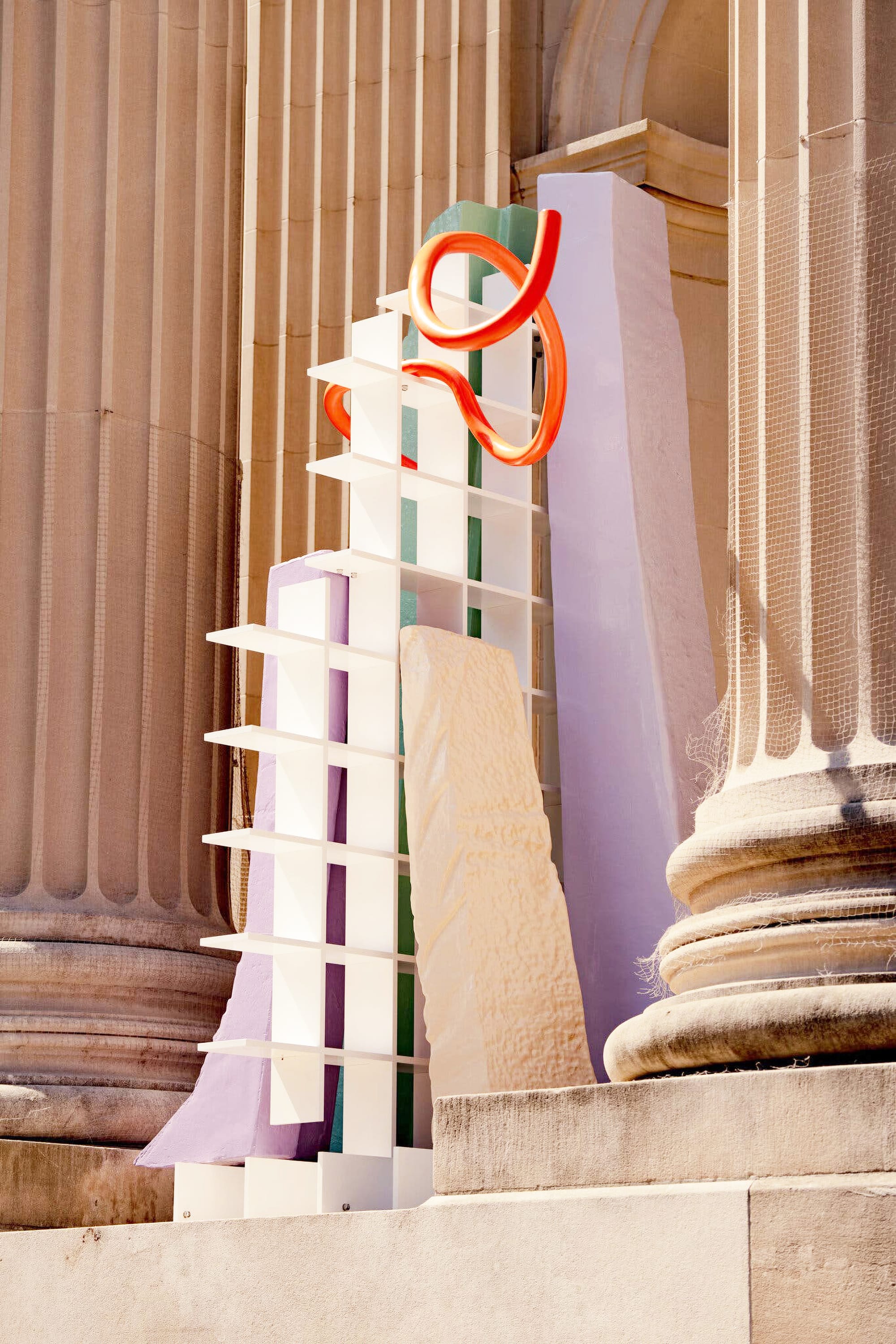
Fig.3
In Chin Up, her exhibition in Mexico City, these ideas were translated to architectural scale. A large work, mounted high on the wall, was maybe drawn from an adult’s advice on how to carry oneself in classed spaces: “Be proud. Chin up. Do not look down.” The body enters the work here not as representation, but as instruction. The exhibition title becomes both posture and critique. It signals how the body learns to move through the world—how it performs resilience and vulnerability through gesture. Whether “chin up” or “stay down”, these verbal cues circulate between the social and the sculptural, framing how we look and how we are looked at.
What links all of these works—Side Leaps, Stay Downers, Chin Up, and now Nameless—is a fundamental attention to how sculpture can be under pressure. Not pressure as a metaphor, but as actual historical and material constraint: war, exile, housing insecurity, lack of access to tools or studios, the loss of neighbors, or the over-presence of them. These are not biographical anecdotes; they are structural conditions.
This is why Baghramian pushes against the idea of sculpture as a signature. The work doesn’t repeat itself. It doesn’t perform coherence. If it sometimes returns to familiar materials—glass, wax, aluminum—it does so with interruption. “Materials sometimes return,” she poses, “but just as often there is the impossibility that they are accessible to you at all” The work continues, but always under new terms. Sometimes there’s no studio. Sometimes the found neon is too fragile to be rewired. Sometimes it must be blown anew.
Even the invitation to exhibit at WIELS, after seventeen years of conversations, came not as an act of career recognition but as a moment of shared timing. “Dirk tried to make my life easier by suggesting we bring a collection of existing works he had generously followed for many years”, she recalls. “But I knew I only wanted to pursue what I had been waiting so long to attempt”. The comfort and trust in that conversation allowed her to pursue Nameless, a project that might otherwise be considered too empty, too reduced, too unmonumental for a solo exhibition at such scale.
Indeed, emptiness is central here. Not in the sense of absence, but as refusal to overproduce. “Anywhere else,” she reflects, “people would say: it’s not enough. Too little work, too much empty space, the scale too vast. But for me, those very qualities are essential to this body of work.” But Baghramian sees that refusal as part of the work itself. The exhibition is not a display of mastery, but a material investigation into what happens when conditions do not allow for more.
This question—of how much space can be taken, and how much space even a sculpture should take—is not merely theoretical. It’s architectural, logistical, even ethical. “How much room can one claim?” with this question, she is not being rhetorical. “Sculpture demands this awareness: it unfolds in dialogue with the space and forms that surround. After all, no one should live entirely without neighbors”. Even if the neighbors are not the ones you would choose. Even if the space is not ideal. Even if the form cannot stand on its own.
Nostalgia is nowhere to be seen. No attempt to redeem fragility through metaphor. It is fragility as such: glass, wax, absence, silence. Not lit neons, but neons that suggest their own past illumination. Not full rooms, but transitional spaces that require reading in the dark. “It’s joyful,” she smiles, “but it’s stressful because it’s not a comfort zone either.”
What Baghramian offers in Nameless is a sculptural politics rooted in necessity. A refusal to monumentalize. A recognition that forms emerge conditionally—sometimes partially, sometimes not at all. That even the most ephemeral gesture—blown glass, leaning walls, unlit neon—can bear the full weight of historical pressure, and still remain unnamed.
//
Nairy Baghramian, Nameless. October 25, 2025 - March 1, 2026
WIELS Brussels
Images
Cover: Nairy Baghramian, Beliebte Stellen, 2017; bronze, paint, zinc-coated steel, rubber; installation view Skulptur Projekte Münster 2017, Münster, Germany; photograph Benjamin Westoby. Courtesy and copyright of the artist
Fig.1 Nairy Baghramian, Scratching the Back- Drift (Pink Ribbon), is the most monumental of her works here, and with its flood of red, the most ominous. Credit Amir Hamja: The New York Times
Fig.2 Nairy Baghramian, Se ployant (soufre), 2024; cast aluminium, stainless steel, bronze; installation view Castello di Rivoli, Turin, Italy; photograph Ela Bialkowska. Courtesy and copyright of the artist.
Fig.3 Nairy Baghramian, Scratching the Back- Drift (Orange Ribbon), 2023, suggests a meeting of two figures separated by a fence. Credit: Amir Hamja: The New York Times
María Inés Plaza Lazo is editor-at-large, publisher and founder of Arts of the Working Class.