
When the first edition of the Prague Biennale Matter of Art took place in 2020, the question of the biennale's format's relevance within the neoliberal paradigm was already present. The agenda of the curators was no longer whether we need a new biennale, but whether the very form itself could survive its own historical success, traditionally associated with scale, international visibility, and spectacular exhibition-making (controversies surrounding several recent iterations of documenta are expressions of this dynamic). Can spectacle itself be replaced by another form of intensity? Can the biennale connect and communicate with the specificities of a local art scene (rather than conform to the global standards of big shows)?
Since its very first edition, Matter of Art aims to subordinate the spectacular form to the political and social ambitions of the exhibition; to create a space for art that does not depend on scale, prestige, or spectacle. Rather than depending on collaboration, local context, or community-oriented work to compensate for the lack of scale, it treats collaboration as an inherent part of the exhibition.
Places
This year’s edition, curated by Jaroslava Tomanová, František Fekete, and Jakub Gawkowski, under the title “Necessary Wishes”, clearly continues this tendency, emphasizing not only collective forms of art-making and art appreciation, but also transinstitutional connections, anti-white cube installation strategies, and linkage between local context and major social issues of today.
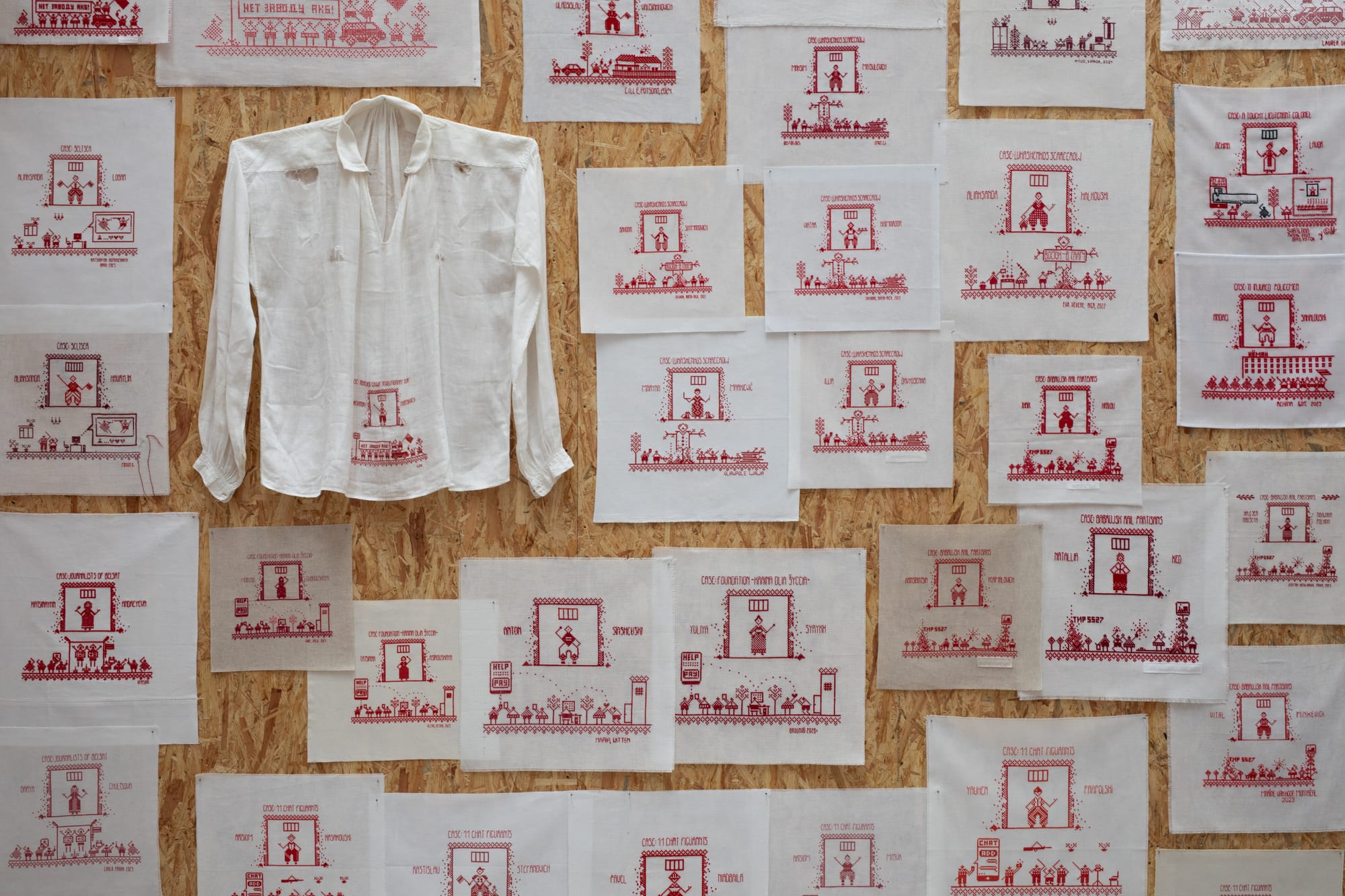
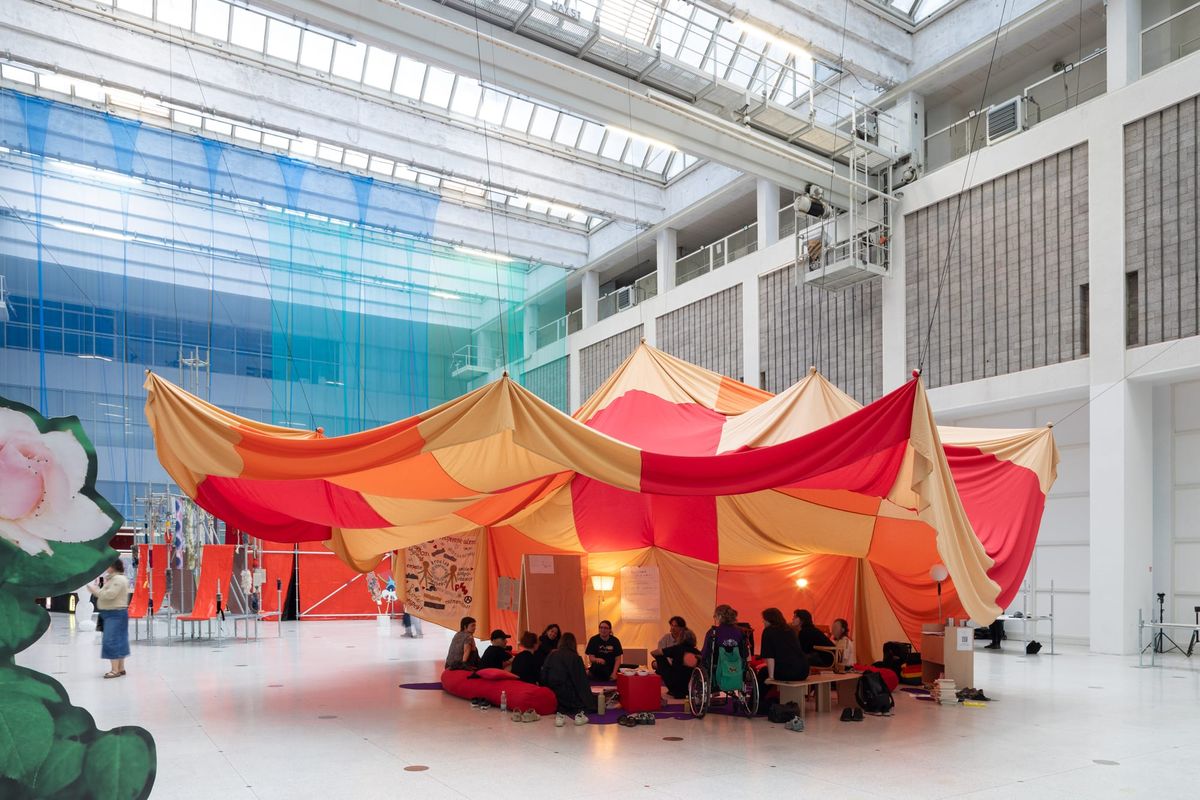
Entering the Great Hall of the National Gallery, one does not first encounter individual artworks but rather an environment. The intense architectural intervention created by Ruina Office transforms the space through scaffolding, dividers, and two projection black boxes (which are symbolically colored red). You pass a towering, enclosed structure erected for the embroideries of Rufina Bazlova and Stitch It Collective and a central Big Top. This “tent” represents a space for the reading group kroužek intersekce, other gatherings, workshops, and public activities. It also provides a lofty structure for sitting and listening to Shella Radio Community’s program.
A similar condition appears in GAMPA Pardubice, housed in one of the very few newly built cultural complexes of this type in the Czech Republic. Despite its newness, the building has a complicated history; it often functions more architecturally than institutionally. Its L-shaped interior, defined by exposed brick walls, usually demands highly interventionist exhibition strategies. The Biennale works differently and more simply: many works appear as framed images positioned between two large-scale projections at the end of the gallery.
The third location, Tusculum, occupies a residency space sharing a garden with an aftercare hospital in Prague. There is little here that resembles the traditional white cube or prestige-oriented exhibition model. Instead, artworks are embedded within spaces where art attempts to renew and reformulate its own functions and values.
Collaborations
What connects these diverse spaces and artworks are their ways of collaborating and sharing. Firstly, there is collaboration between a traditional centralized institution, a small, progressive municipal gallery, and an artist-run residential space. This year, a significant amount of the represented artists are collectives and initiatives such as Taring Padi, Michal durda & Izbová Teplota, kroužek intersekce, Rufina Bazlova/Stitch It Collective, FŮD Collective, Shella Radio, and Stony Tellers.
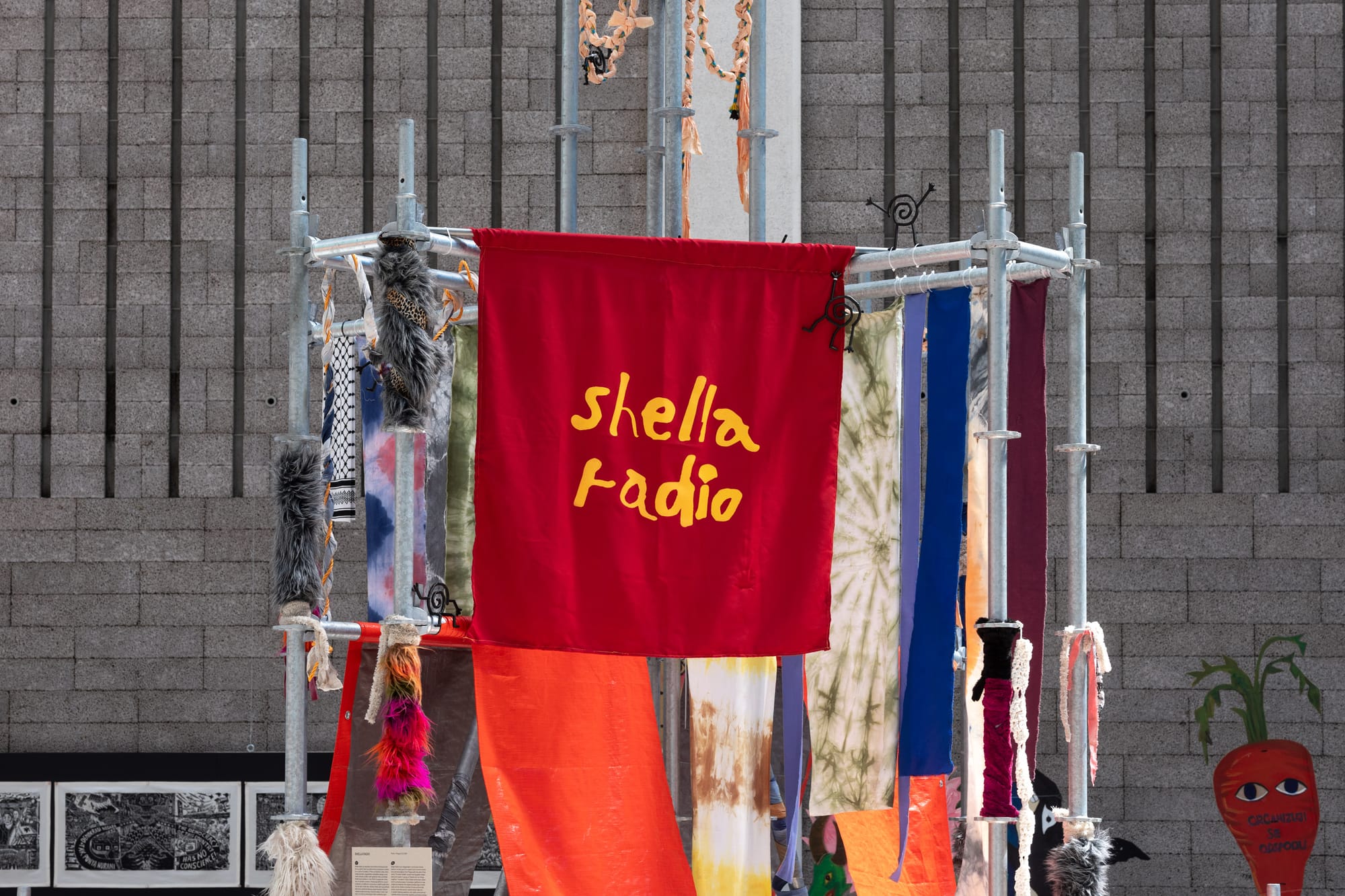
Collaboration forms the basis not only of the production of art, but also its reception; what Luis Camnitzer calls “art appreciation” and what Claire Bishop has dubbed “disordered attention” (that is to say, rich and shared energy as opposed to an undivided, “normative”, passive attention). In this regard, you might listen to the program of Shella Radio not as a sound piece or as music but as a community radio project consisting of DJ sets, discussions, and musical performances. Similarly, you can visit the narrative workshop organised by Stony Tellers and the live readings of kroužek intersekce.
The Biennale does not have a catalogue or standard official publication, but instead a zine published by FŮD collective, which is composed of invitations to think with the artists and curators rather than read curatorial statements. Tomanova, Fekete, and Gawkowski take the opportunity to lay out their vision of “Necessary Wishes”, which stems from an almost impossible combination: a wish belongs to the register of desire, imagination, and excess. Necessity connotes survival, obligation, and reality. By placing these terms together, the Biennale describes a prevalent condition in which art exists today: between hope and exhaustion, between political necessity and aesthetic uncertainty.
Community-based and collective practices, together with the connections between central art institutions, regional galleries, and artist-run initiatives, are not simply pragmatic solutions characteristic of smaller art scenes such as those in the Czech and Slovak context.
Tensions
Several projects address current geopolitical conflicts, particularly those taking place across the Levant as well as the ongoing war in Ukraine. In Prague’s Trade Fair Palace, one encounters copies of paintings of the Ukrainian Army by Davyd Chychkan, as well as a film by AntiGonna dedicated to the queer artist Artur Snitkus. Both Chychkan and Snitkus died at the front during the present war. The exhibition also presents work by the Polish GALAS Collective dedicated to supporting Ukrainian refugees.
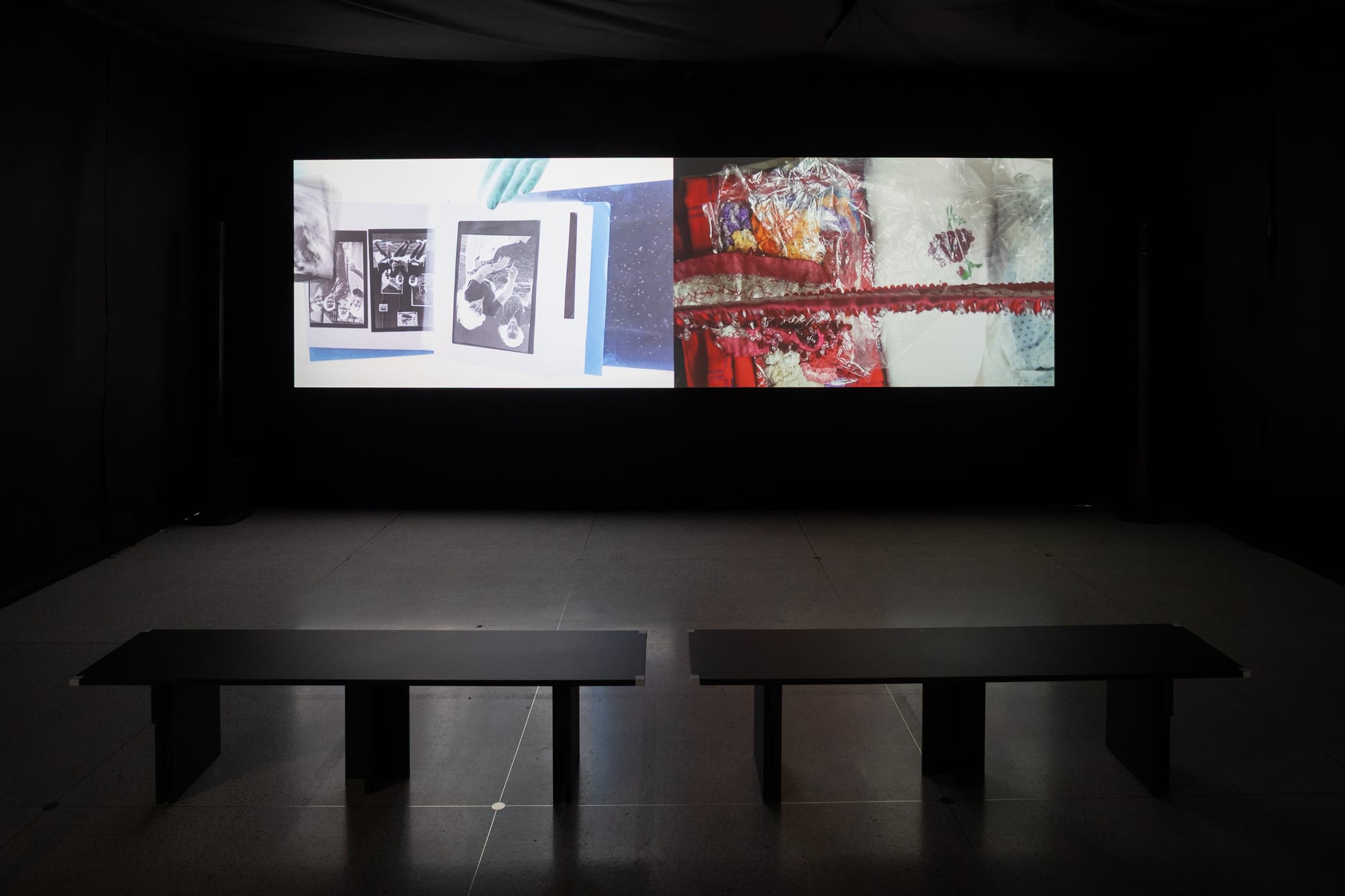
Huda Takriti’s film On Another Note (2024) traces the history of her grandmother and mother, both textile and fashion artists. Through a seemingly quotidian narration, the work unfolds experiences of displacement: being moved “somewhere else” (as in the case of Takriti’s mother, who married a Kuwaiti official) and being displaced vertically within one’s own territory.
The Palestinian artist Noor Abed’s we walk in our sleep (2026), commissioned for the Biennale, unfolds through two parallel monologues by women whose voices never fully meet. The film moves between scenes of everyday life and choreographed interventions in public space, where gestures, movement, and repetition transform ordinary environments into stages of memory and presence. The work connects the mundane and the sacred, the past and the present, allowing suppressed experiences to emerge between words.
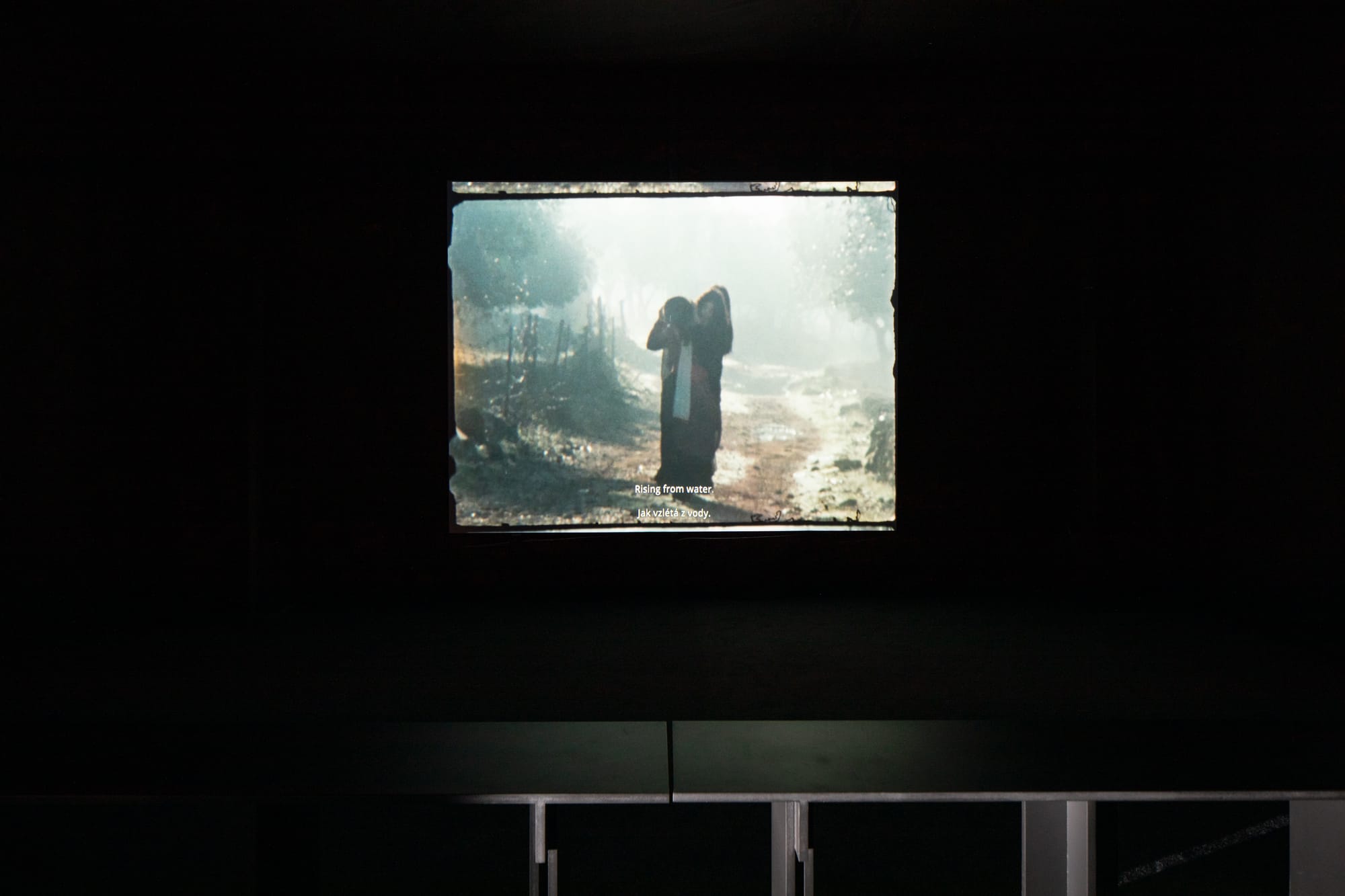
A third projection space in the main exhibition presents portraits of people from Southwest Asia and North Africa (SWANA) living in Prague as captured by Zaher Jureidini and Leila Basma, two Lebanese graduates of FAMU.
The exhibition in Pardubice also engages with cosmographical contexts. Two iconic works by Běla Kolářová create moon-like concentric compositions from everyday objects such as snap fasteners, while photographs of installation performances by the Ukrainian artist Fedir Tetynych resemble handmade spacecraft.
Bodies
But the most prominent storyline is body-related and queer. For example, Aron Neubert’s portrait series Warmth which only fire can give us (1995), follows the final months of Jürgen Baldiga’s life, presenting art not as a privilege but as a necessity. Jan Durina similarly works with textiles and embroidery, masking and revealing, self-creation and auto-theorization through queer-feminist approaches. Nearby, the Slovak artist Tina Bxqt explores the monsterification of bodies through xenomorphic forms, fragments, dissections, and ceramics—the works were also presented for the Academy of Fine Arts in Prague diploma exhibition, from which she graduated this year.
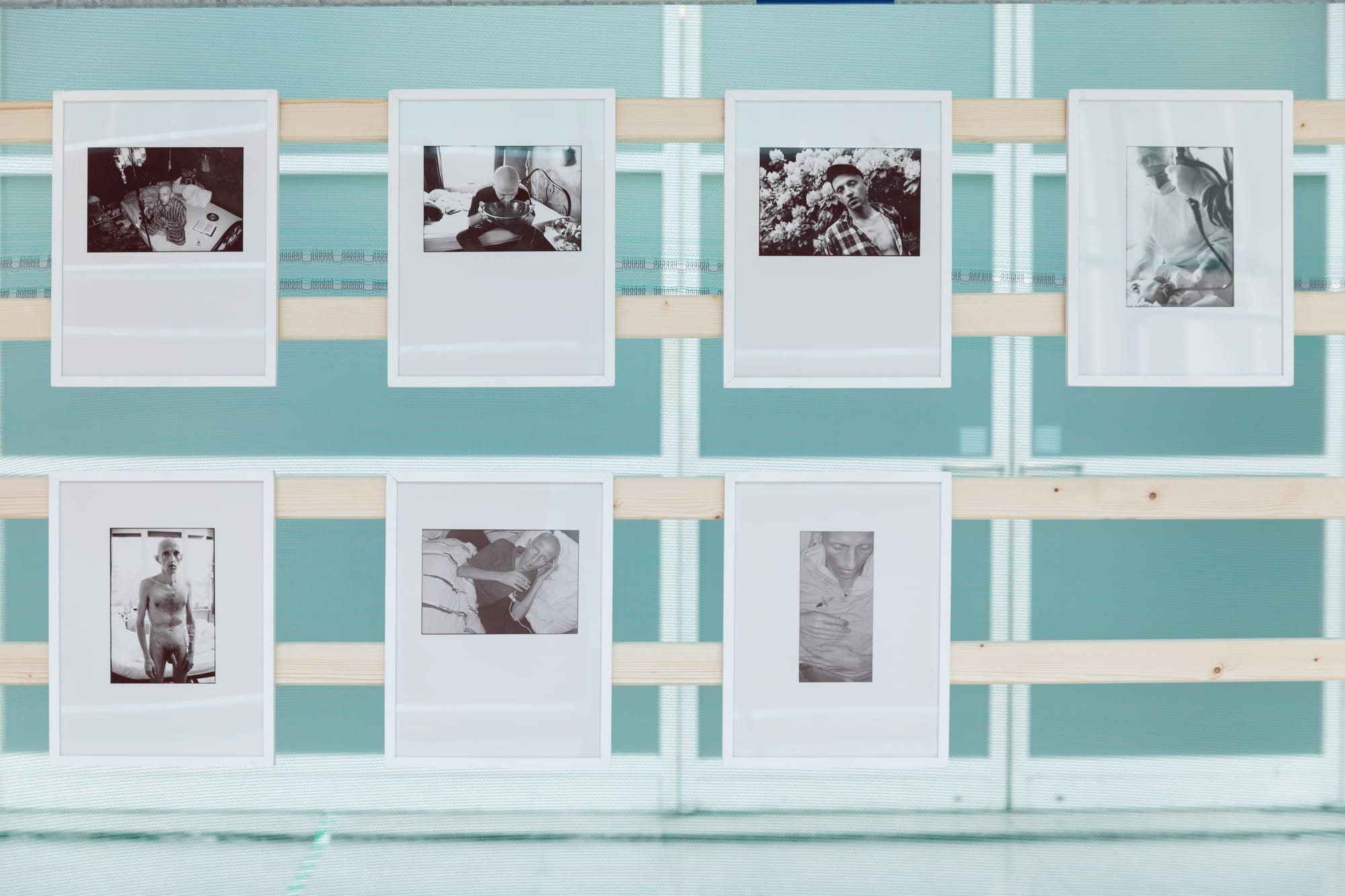
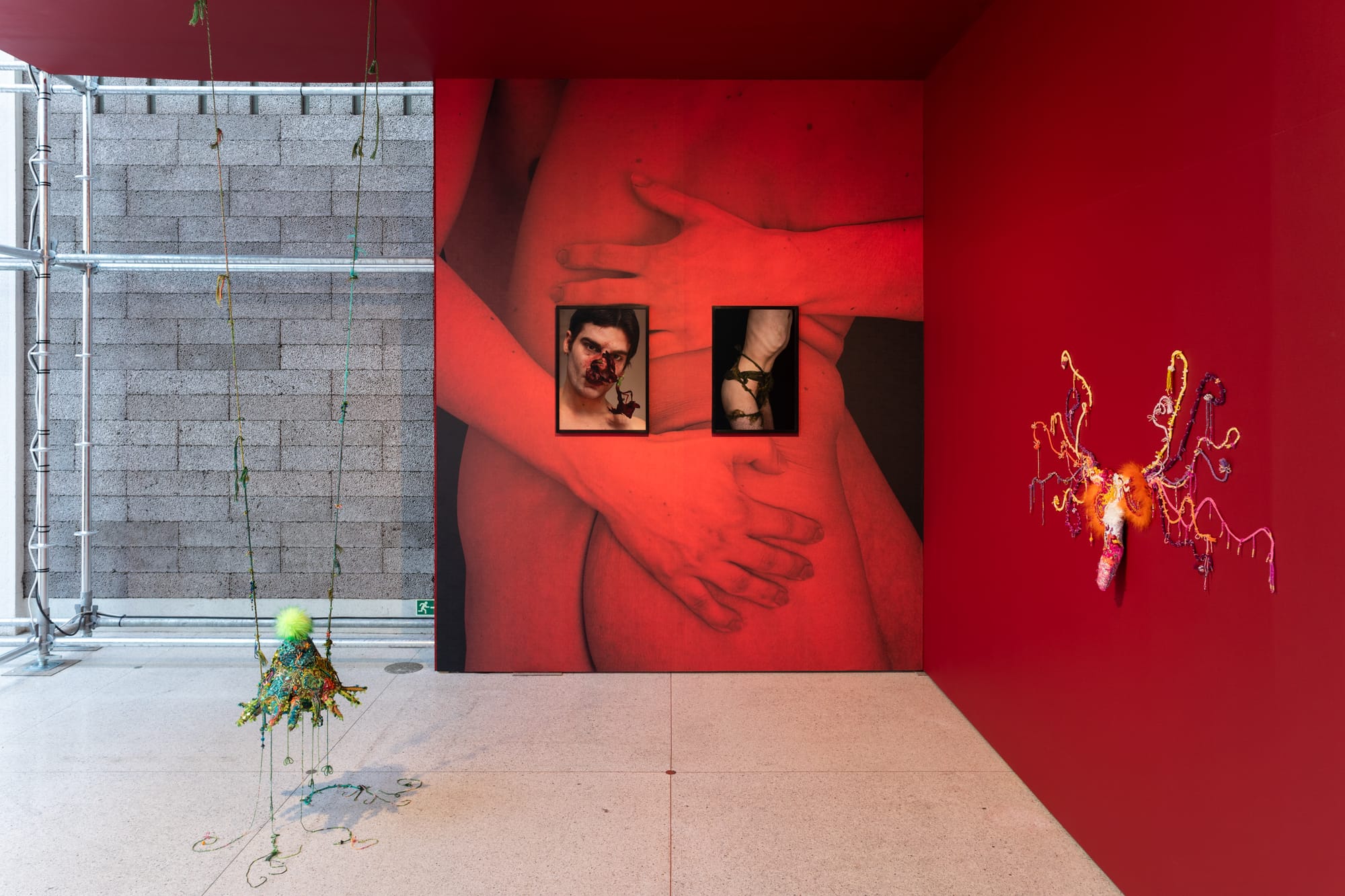
At the same time as presenting these explorations of embodied experience, the curators acknowledge a certain exhaustion around the concept of identity. Political positions can become too quickly framed as fixed identities or desires. Here, the emphasis on bodies is an invitation to share bodily concerns and forms of care through difference.
Ovaries
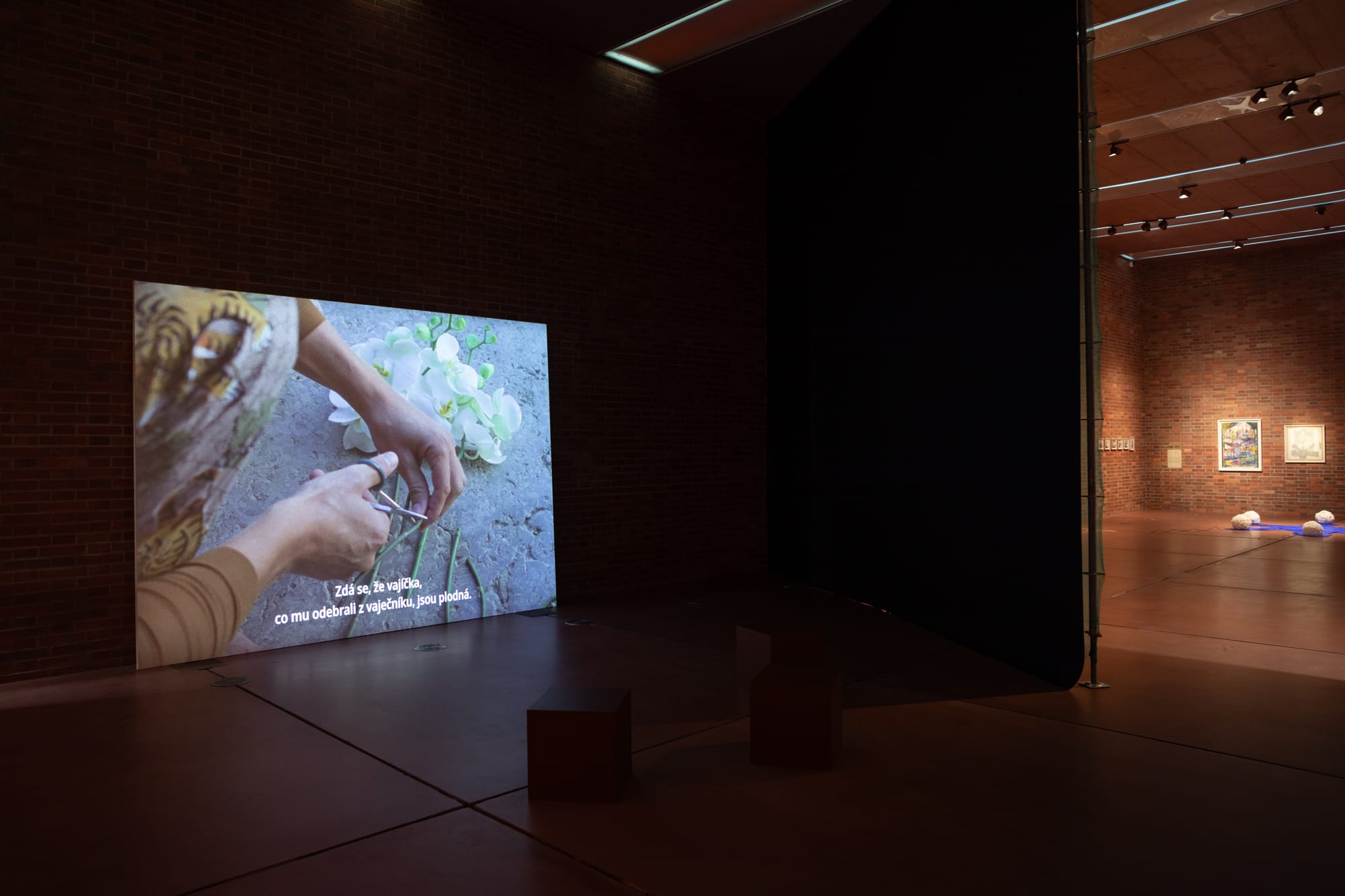
The film Ovary (2021) by Isadora Neves Marques presents perhaps the most symbolic work of the entire exhibition. Originally commissioned for the Liverpool Biennial, the short film consists of fragments: medical examinations, bodies, the sea, and a very brief conversation in which we discover that a gay couple is considering having a child through the implantation of an ovary into a male body.
At first, I needed to rewatch the loop a couple of times to reassure myself I was not missing some details. The film deconstructs Lana Del Rey’s song Let Me Love You Like a Woman, and engages with the fandom genre of Mpreg (short for male pregnancy), a plot device in which men become pregnant, and questions of heteronormativity and reproductive rights. Yet, it leaves us without definitive answers, nor a full-fledged story, resolution, or happy ending.
Instead, Neves Marques places us in a soothing rhythm of waves and repetition: perhaps witnessing a not-so-distant utopia of bodies liberated from fixed gender structures, or even people liberated from hierarchies and privileges.
Fragments
It is these conditions that the neoliberal paradigm was unable to come to terms with. Many forms of liberal politics and aesthetics will obviously go on, including biennales. The question is not literally whether they can survive, but whether they can become places of new social becoming, new (and not only spectacular) forms of production where divisions and fragmentation are symbolic and constitutive of the present moment. In this atmosphere, art cannot but defend diversity, incompleteness, and complexity, and, therefore, even fragmentary, discontinuous ways of making sense. We must respond to the simple fact that reality cannot be fully subordinated to the anthropocentric parochialism inherent in contemporary identity politics or populism. We need to cultivate our ability to cope with diversity and change, our ability to negotiate, and to disagree about basic values.
Matter of Art and “Necessary Wishes” attempt to create such avenues. You may claim that these qualities and meanders have always been part of the biennale format, and of art in general. But the issue is not just to feature artworks working in this direction, but rather to motivate the entire format to such perspectives and strategies.
//
Václav Janoščík is a theorist, professor, artist, and curator focusing on pop-philosophy, vernacular ontologies, speculative history, the democratization of contemporary art and thinking, political ecology (of affects), the philosophy of technology and media, and gaming. He works in the Faculty of Art and Design at UJEP, UMPRUM in Prague, The New Center, and the University of New Haven.