
Poets know love is not all roses. That it is as much about working towards a shared truth as it is about lofty emotions. Adrienne Rich describes love “as a process, delicate, violent, often terrifying.” James Baldwin writes, “love is a battle, love is a war; love is a growing up.” These quotes came to mind inside Cecilia Vicuña’s new installation “Minga for the Sea” at the Kunstnernes Hus in Oslo, her first major presentation in the Nordic region. The Chilean artist, activist, and poet invited Indigenous groups from the Chilean and Norwegian fjords who are defending the ocean and fighting against destructive practices of extraction and pollution. This is because, in the words of Vicuña, “we all love the sea, and this love is at the heart of its defense.” A minga, it should be said, is an Andean tradition of communal, reciprocal labor—a coming together to do work no one can do alone—and the title is less of a poetic flourish than literal description.
More specifically, Vicuña worked closely for this installation with the Red de Mujeres Originarias por la Defensa del Mar, an Indigenous group of women fighting to protect the Chilean coast, and Sámi activists who oppose the dumping of copper mining waste in the Riehpovuotna/Repparfjord, which is a vital ground for wild salmon. Bringing together two separate groups from such different cultures may feel random on the surface—or perhaps simply a marriage of biography and site specificity—yet the presence of these two groups reveal common struggles and hint at the global entanglements of capitalism: we are told that Norwegian farmed salmon are fed pellets partly composed of small fish caught off the Chilean coast and that Norwegian salmon companies have long operated in Chile.
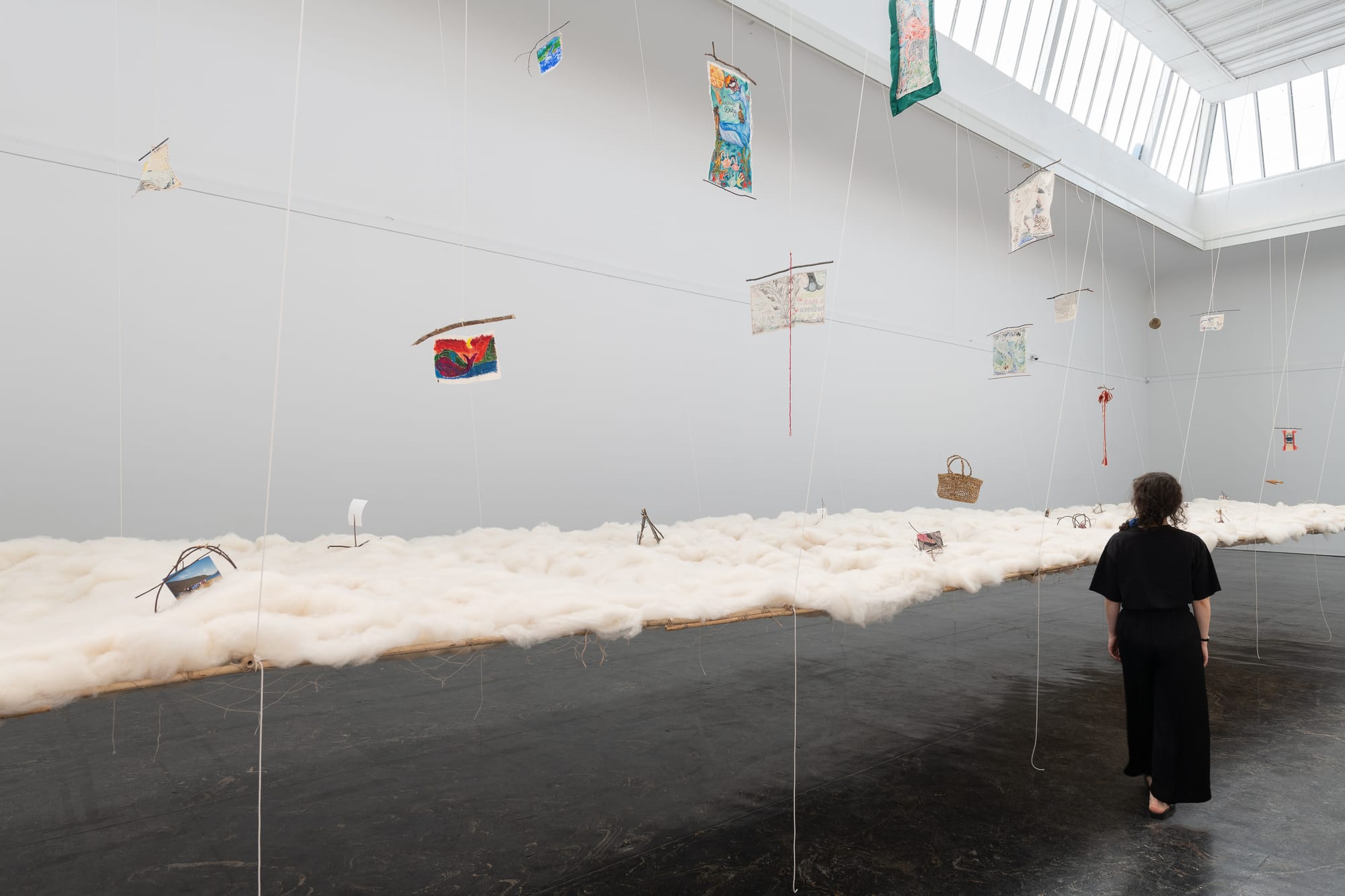
Kunstnernes Hus, Cecilia Vicuna, 2026. Istvan Virag, Kunstdok
In this sense, “Minga for the Sea” unusually attunes to the wider spirit of the Oslo Art Weekend itself. Beyond its program of openings and events, the weekend depends on a dispersed ecology of curators, artists, organizers, and institutions whose work often resembles a labor of care more than a cultural industry—like a minga, which is sustained through countless acts of coordination, hospitality, and commitment that remain largely invisible.
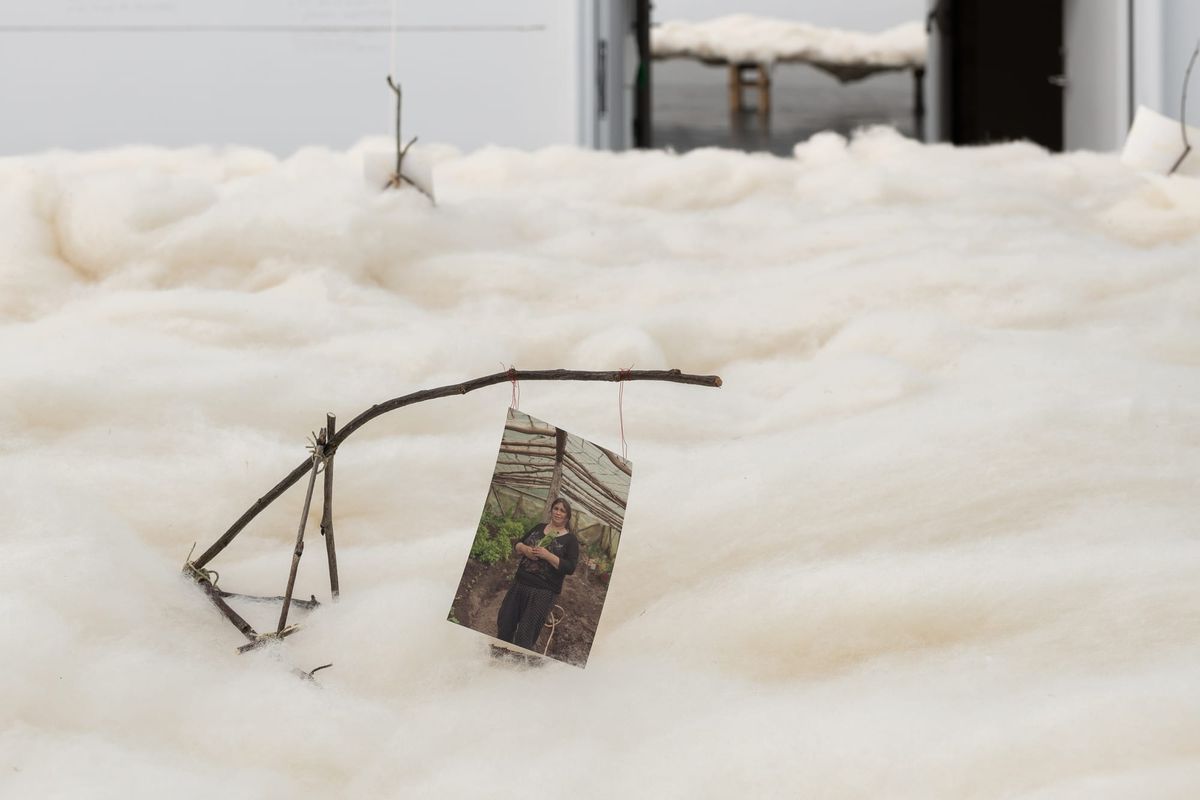
Love’s violence and tenderness are immediately present in “Minga for the Sea”, which prominently features two large quipus: an advanced pre-Columbian system of communication encoded knowledge, a basis for land rights, and forms of governance realized through knots tied along cords. Vicuña has been making her own quipus since the 1960s and, in the Kunstnernes Hus, she has used locally-sourced and untreated wool to create records of memory. Installing them horizontally, such that they appear like banks of fog rolling in over the ocean, each quipu features natural detritus from the sea, including organic matter including broken mollusks and driftwood, as well as traces of industrial waste such as netting and cables. The wool itself carries a faint lanolin smell into the galleries, and the daylight falling from the building’s skylit halls catches the fibers so that the works seem to breathe—an effect that makes walking alongside them feel less like viewing sculpture than passing through weather. Vicuña does not collapse cultural distinctions in the work. While the Norwegian quipu is more austere and feels very Scandi in its presentation, the Chilean quipu features hand-painted signs and a basket hanging over the clouds of material. The contrast is telling: one tradition of protest speaks in spare gestures, the other in painted slogans held aloft; Vicuña lets each keep its own voice. Each room also features poetry, scratched into the wall in pencil, that is something between a love letter, mythology, and a call to arms. Vicuña herself writes in one such text that she imagined “Minga for the Sea” “as a call to unite in a collective effort to liberate the ocean from brutal exploitation, to let it be itself.”
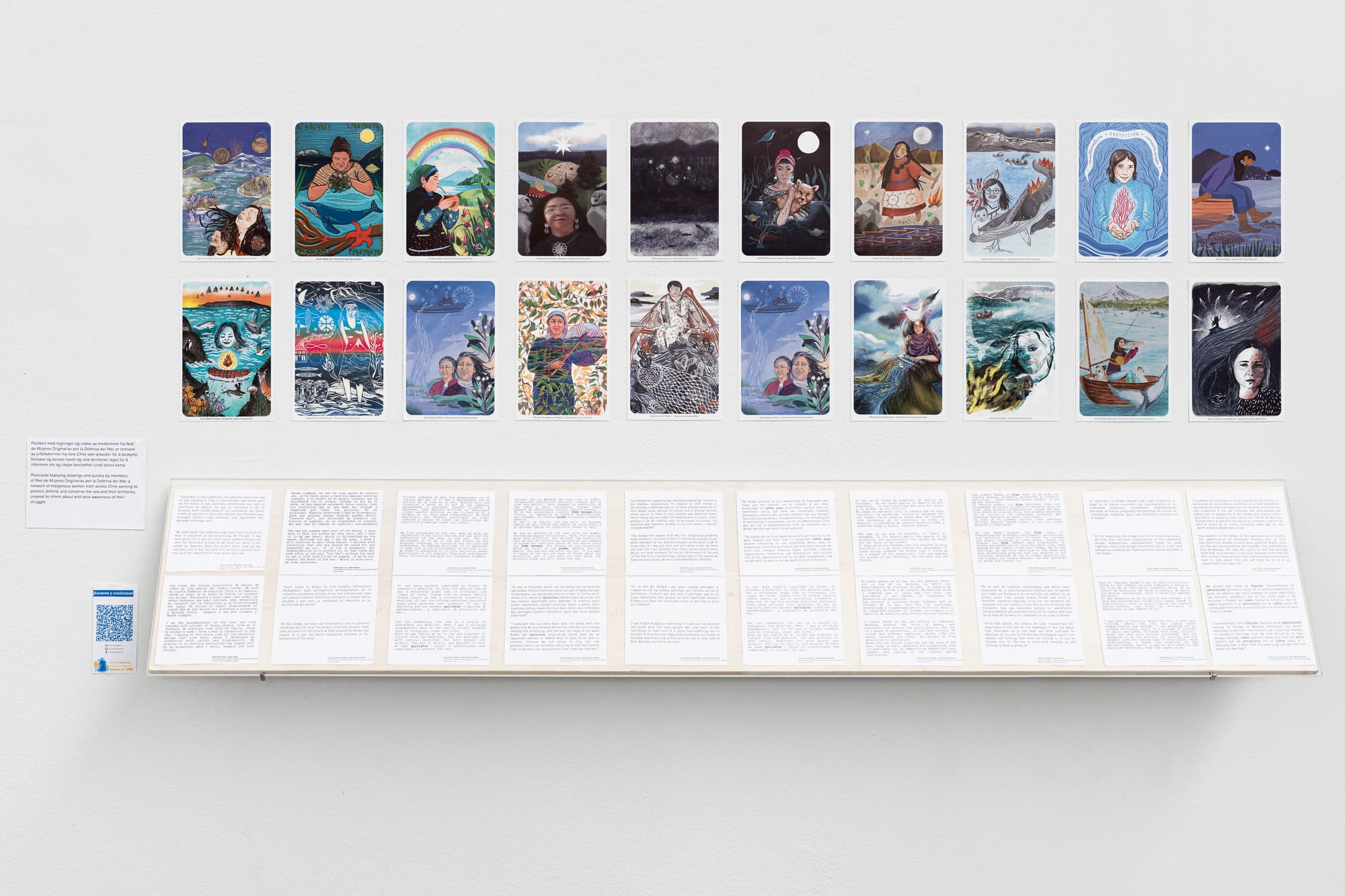
Kunstnernes Hus, Cecilia Vicuna, 2026. Istvan Virag, Kunstdok
Whereas many shows tend to wear their politics on their sleeves as a way of signaling that they’re on the “right side of history”, Vicuña’s unity of art, activism, and poetry feels inherently more natural. This not only results from Vicuña being involved in all of these fields for several decades, but also because she gives space to the Chilean and Norwegian activists to articulate their own causes, for instance, through video screens showing social media clips.
The exhibition succeeds in bringing together activism and poetry in a way that refuses any false distinction between them. One could object that the show is too beautiful—that turning fishing nets and industrial cable into banks of fog risks aestheticizing the very damage it protests. But this would miss what the quipu has always been. A quipu is not decoration but a technology of memory, law, and obligation. Vicuña simply reactivates this lineage. If love is, as Rich warned, a process that is delicate, violent, and terrifying, then “Minga for the Sea” is its record of labor—knot by knot, a communal work in defense of what we love. The dissonance with which the show opens never fully resolves. The sea is not yet free. The minga is not yet finished. Love is still a knot.
//
Cover Image:
Kunstnernes Hus, Cecilia Vicuna, 2026. Istvan Virag, Kunstdok
Shane Anderson is the author of "After the Oracle, Or: How The Golden State Warriors’ Four Core Values Can Change Your Life Like They Changed Mine" (Deep Vellum), "Études" (Broken Dimanche Press), and several chapbooks. His work has appeared in 032c, LARB, The Nation, Ugly Duckling Press, and other publications. He is the translator of "The Great Nowitzki" (Norton) by Thomas Pletzinger, as well as works by Elke Erb (Wallenstein Verlag), Ulf Stolterfoht (Triple Canopy), and many other important voices in German-language poetry. He is represented by Priscilla Posada at Regal | Hoffmann & Associates and lives with his family in Wuppertal.