
I was looking for an old article I had written as a teenager for my local newspaper's youth page. I remembered that it was about relationships and that I had put them on trial. I sat in the archives of my small hometown, and the paper’s archivist lugged kilos of old volumes into the room.
She asked why I was looking for the article, and I told her about my work. I also said that the text was called “Relationship Anarchy”. Her face briefly contorted into an expression that looked like a gesture that had been cut short—as if she wanted to clasp her hands over her head.
At that moment, I remembered. I remembered why I wanted to leave my town when I was seventeen. How the urge for normativity suffocated me. What was normality supposed to be anyway?
When I explained the concept of relationship anarchy to her, she replied with a sentence that began, “There are always a few who...” and ended like all sentences do that downplay deviations as much as possible so that sacred normality remains unshakeable.
Back then, I didn't have any grand words for the idea, but the direction of travel was clear. When I finally found the article, I read my criticism of the fixation on romantic love. I suggested that all the energy that people put into heteronormative monogamy would be better spent on political work or caring for others in non-romantic ways. I questioned romantic love, even more fundamentally. To me, it seemed like a mask for humanity’s biological will to survive.
I wrote about the intoxicating state that leaves no choice, about the fact that you cannot choose the object of your desire. I was afraid of the dependence that clouds the mind and takes away control. I wrote:
Those who love are doomed to care for the other person. You lose sight of the big picture, live in a private microcosm until you see nothing else. Trapped in the clinging arms of a partnership, you turn away from the world and waste your potential on a single person.
I now live in Berlin. Not because I wanted to, but because people like me end up in big cities at some point. Just like Berlin, I didn't choose the concept of relationship anarchy—it found me.
After the end of a very long relationship, I used dating apps. My favorite? OKCupid. A highly intellectual proposition, because on that site I could reveal an extensive amount about myself in questionnaires and find out just as much about others. I set my relationship preference to “poly”. I didn't want anyone who saw love as a form of ownership.
Under the self-designation of “poly,” I encountered a strange assortment of types: Sex-positive hippies who sought happiness in copulation every day, decked out in leggings, studs, and fishnet clothing; control-freak hedonists (I dated heterosexuals) who watered their feelings like houseplants in perfectly measured proportions. Also, there were a few political people. And some paschas who didn't understand the word “poly” to mean “ethical non-monogamy”, but rather the opportunity to collect women.
In particular, the profiles of the control-freak hedonists taught me a lot. Their wokeness didn't make me feel erotically nervous in the slightest, but I was taught words that I hadn't heard in my long-term relationship, where I was far removed from the latest trends. Road cyclists with vegan weekly meal plans talked about the “drama triangle” they wanted to break free from, and the hippies wrote about “relationship anarchy”.
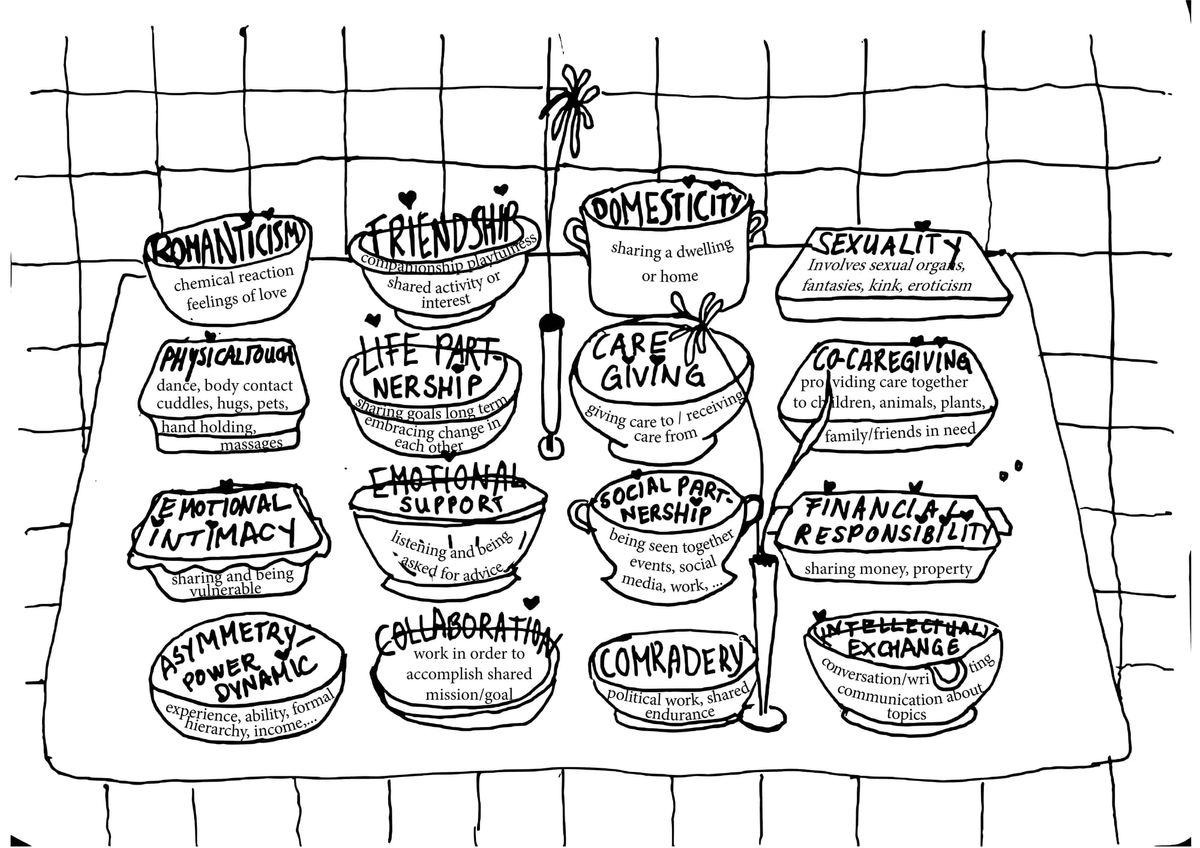
What was that all about? At first, I didn’t come across a book, but a diagram, of which I am printing an adaptation here. The image is called the “Relationship Buffet” (based on the original version: the Swedish Relationship Anarchy Smörgåsbord). It kept popping up on the internet, in forums, at meetings, in constantly new versions. The “buffet” explains the concept without requiring any prior knowledge of the concept of political anarchy. And that's exactly why it's so successful: it creates a language for experiences that we have anyway, but which we may find difficult to grasp. The diagram was so easy to understand that I knew immediately that it would accompany me from then on.
I began to map out my own relationships. I realized that my romantic relationships often failed because I only wanted to give them a small place in my life. No shared apartment, no family, no everyday life, only reliability, tenderness, closeness, and love. I wanted to make myself vulnerable without arguing about the order in the dishwasher. The only people I wanted to talk to about that kind of thing were my flatmates.
I wanted to shape my everyday life with them, but not show them my entire vulnerability. I expected cooperation, reliability, and a certain level of communication from them—but not shared political ideals. The most important relationships for me were my working relationships: intellectually intense, politically close, long-term, supportive. My interest in this form of collaboration made it clear that my work had to be organized differently from that of most people.
The important thing is that when we combine different foods in different quantities at the buffet, a vast number of emotional relationships are possible. No one has to expect everything from a single romantic relationship. Every other relationship can have the same value. It is up to us to determine that value. However, most people expect a lot from romantic love. Too much.
Romantic love has taken on excessive significance in modern times because it is supposed to fill the void left by other social bonds. Family, religion, community—all of these have lost their footing. So we charge love with meaning.
It is supposed to offer intimacy, belonging, identity, and even moral fulfillment. In a world where work and consumption determine our lives, romantic relationships become the final place where authenticity and wholeness seem possible.
It is precisely this excess of meaning that makes love so fragile. We demand from it what used to be supported by entire social structures—and it collapses under this burden. Monogamous, heteronormative relationships are supposed to redeem us from the isolation that this system creates. But because it can never do so, we fail repeatedly. And this failure gives rise to a feeling of personal inadequacy.
But our society does not have to be organized this way.
Among the Mosuo, a community on Lugu Lake in southwestern China, the social fabric is based not on romantic love, but on the stability of the maternal line. Men only visit their partners' homes and are gone by morning. While romantic love has become overloaded in Western modernity, among the Mosuo it remains decoupled from ownership, marriage, and social order: a practice, not an institution.
This example shows that there is no single natural order to how we live or organize relationships. However, when it comes to the term “relationship anarchy”, many people stumble over the word anarchy. It sounds like chaos, like burning trash cans, like the absence of rules. But that is a misunderstanding.
Anarchy does not mean “without rules”. It means “without domination”. The Greek word an-archía consists of “an”—without, and “arché”—domination, origin, or principle. This is a crucial difference. It is not about everything being permitted, but about no one from outside determining what a good or right relationship should be.
Perhaps love can only be conceived of beyond domination.
bell hooks inextricably linked love, liberation, and justice. Drawing on M. Scott Peck, she defines love as “the will to expand oneself to nourish one’s own or another person’s spiritual growth.” Love, for hooks, is not a feeling but an ethical act, a conscious choice to engage in mutual transformation. To love is to take responsibility for one’s own and another’s becoming, sustaining relationships that enable freedom rather than dependency.
This definition allows for many forms of attachment but roots the concept of love in commitment: a deliberate, ongoing choice to grow together and to create conditions for that growth. Love resists social paradigms of domination; it is not the absence of structure, but the presence of shared responsibility.
From this perspective, people can build rules and structures without reproducing hierarchy. Freedom from domination does not mean the absence of order, but that whatever order exists is co-created, not imposed. True freedom is the capacity to commit—to engage in relationships grounded in care and mutual growth. Love thus becomes a model for anarchic coexistence: voluntary, non-hierarchical, and transformative.
Applied to relationships, this means that we can shape intimacy, care, sexuality, and friendship without an overarching norm dictating what is permitted, important, or “normal”. The anarchy in relationship anarchy does not signify chaos, but instead relationships without domination. Without the silent hierarchy that puts romantic partnerships at the top.
The relationship between an elderly neighbor who is cared for by a young immigrant man who, therefore, lives with her, can be equivalent to the intense romance between two teachers or the friendship between two influencers.
If the concept of relationship anarchy could point to a fundamental restructuring of society, it can also be liberating for those who, on the whole, live in a regulated manner. The described deficiency—for example, if a romantic relationship is not enjoyable or does not exist at all—loses its significance when other forms of proximity are allowed to have the same value.
I once read a Reddit thread about a man who was surprised when a friend pointed out that his wife was spending a lot of time with her best friend—they were planning vacations, organizing leisure activities, and even discussing having children together. Until then, it had never bothered him. But when the online community told him that his wife needed to prioritize their romantic relationship, he started to have second thoughts.
From a relationship anarchy perspective, one could say that perhaps both partners simply place less importance on everyday organization or joint future planning in their romantic relationship, but the woman had found this aspect in her friendship. So it's not about one relationship being “more important” than the other, but about different needs being met in different places.
Relationship anarchy was first introduced twenty years ago, in August 2005, to a group of fifty people attending a small anarchist festival on a Swedish island. Founders Andie Nordgren and Jon Jordås spread the concept in a Swedish-speaking (online) community, from where it migrated to blogs, forums, and Facebook groups. The “Relationship Anarchy Smörgåsbord”, or the relationship buffet, became a tool for thinking about closeness and attachment in a self-determined way.
Individuals spread the term further: to Madrid, where it was taken up by queer collectives and academic circles. The first official meeting of relationship anarchists took place there in 2016. The researcher Juan-Carlos Pérez-Cortés published the first academic book on the subject in 2020 (Relationship Anarchy – Occupy Intimacy!; English translation 2023). Although he actually researches artificial intelligence at the Polytechnic University of Valencia, he is involved in the organization ARAEN Valencia (Asociación para las Relaciones Afectivas Éticas), which is now one of the most active relationship networks in Europe.
Since then, universities, queer groups, asexual and aromantic communities, and postcolonial movements have been exploring the idea. The latter, especially in places where colonial structures have replaced indigenous forms of relationships with Western, possessive sexuality.
At its core, however, relationship anarchy remains something unfinished—an attitude, not a movement. It is not an identitarian concept or a flag under which people can gather, because every relationship is unique. Anyone who tries to standardize them contradicts the very nature of relationship anarchy. With relationship anarchy, you can have both “classic” relationships and radically different ones. It is diverse and open by its nature.
Nevertheless, some points must be viewed critically. Relationship anarchy assumes that jealousy does not play a central role. But jealousy is not something that simply disappears—it must be unlearned. It stems from the possessive individualism of capitalism, as well as religious and cultural notions of domination. Unlearning this takes strength, time, and often privileges that not everyone has.
Furthermore, the concept assumes that people consciously shape their relationships, negotiate rules, and make decisions together. But many relationships simply “happen”. They arise from habits, unspoken gestures, and bodily knowledge. Not everyone has the interest, the ability, or the education to view their own relationship so analytically.
And finally, some things are not a matter of choice. Income, care work, children, social expectations, or gender-specific privileges: all of these create inequalities that influence relationships beyond the control of those involved. Nordgren herself wrote on the Anarchist Library in 2018: Relationship anarchy must be equipped with [...] power analysis and be open to defining a structure for relationships when necessary to protect individuals from each other—in other words, even more work!
But conscious social change doesn't just happen; it takes work. Where there is discomfort with one’s own relationships, relationship anarchy facilitates relief; where it is deliberately practiced, it may bring about social change. Relationship anarchy is not just something that happens in the mind, either; it gives us words and means to deal with our existing relationships, to appreciate them, and consciously perceive how we relate to each other and what (social) value we attribute to these relationships.
When I think back to my 17-year-old self, I believe I wasn't far off the mark. Except that today I know, it's not about abolishing love—it's about liberating it.
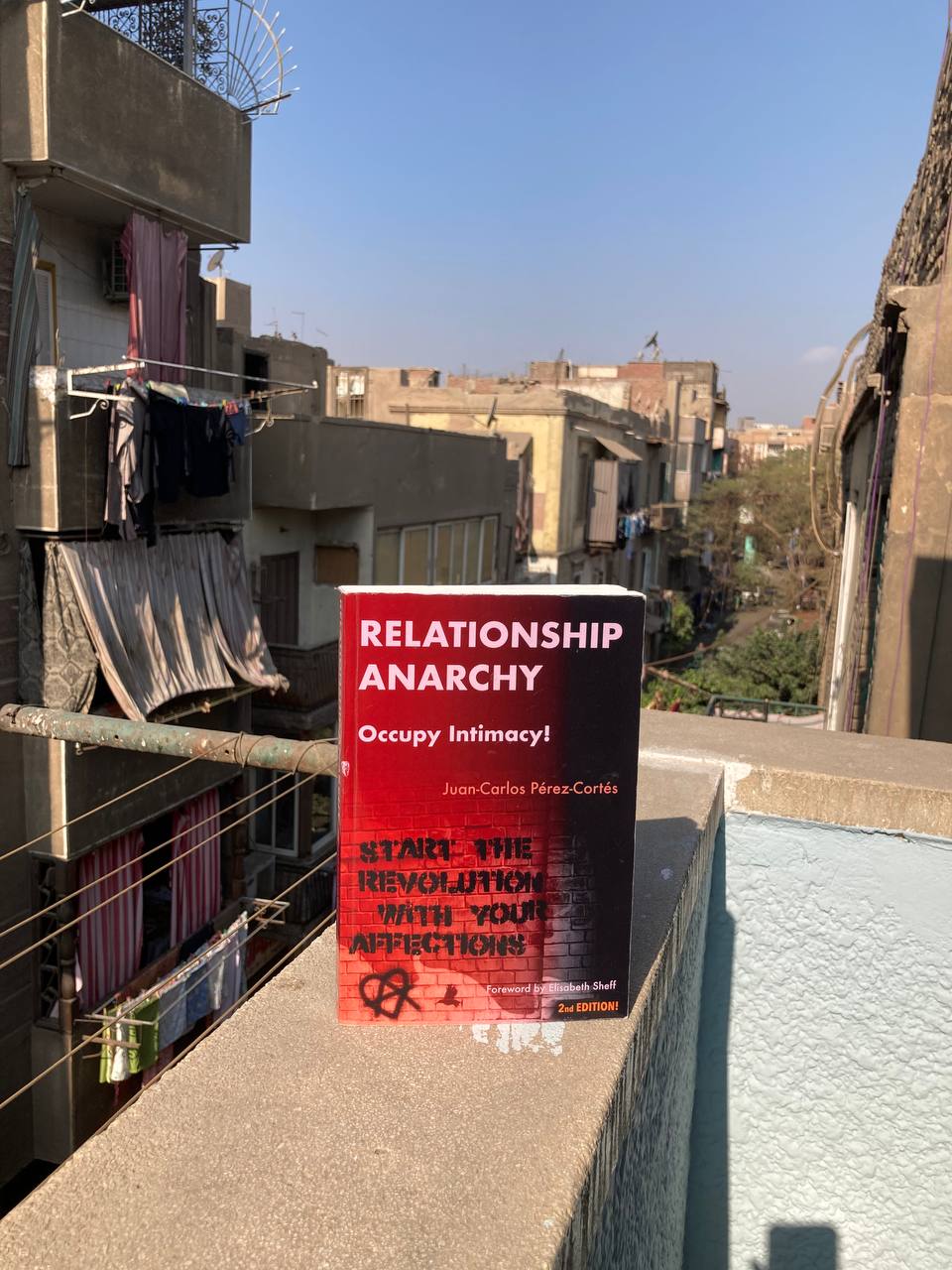
Fig.1
//
Images:
Cover: Adapted version of Relationship Anarchy Smörgåsbord, 2025. Courtesy of the author of this text
Fig.1: Image of one of the reference books for the article: Pérez-Cortés, Juan-Carlos. Relationship Anarchy: Occupy Intimacy! Independently published, 2022. (Originally published in Spanish as Anarquía relacional: La revolución desde los vínculos, La Oveja Roja, 2020.) © the author.
Amelie Jakubek is an artist, editor and organizer researching methodologies of collectives. She is working with AWC, Archive Books, the Collective Commune/ الكوميونة (Cairo and Berlin) and the association Membrane e.V..