
September 14, 1986. Nancy and Ronald Reagan sit stiffly on a beige couch with a delicate floral pattern in a living room in the residential quarters of the White House. Legs crossed, Nancy’s wearing a red suit. Ronald sits somewhat slouched, legs parallel above the beige carpet. Her left hand rests on his. He draws a shallow breath to speak, hesitates, then the moment passes. He closes his mouth again. They exchange glances. She squeezes his hand encouragingly. He swallows and begins an address to the nation [1].
The interaction stages a deep charitable Christian concern that weighs heavily on both of them—because, as Ronald explains, the state of America is bleak. To convey the scale of the threat, he and his wife deploy the full figurative arsenal of biopolitical, religious, and militaristic metaphors: the “cancer” of drugs has taken hold of the nation. To fight the “uncontrollable fire” of marijuana, heroin, and crack cocaine, they call for nothing less than a “national crusade” begun from their beige living room, a total “mobilization” of each and every single member of “the American family” similar in scale and moral urgency to that deployed in World War II.
As Ronald’s administration expanded the prison-industrial complex, escalated the militarization of the police, and, in the name of the so-called “War on Drugs”, targeted low-income and Black communities, as well as crushing leftist uprisings around the world, his wife Nancy turned her attention to the nation’s still innocent youth: what should they do if they are offered drugs? It’s easy: “Just Say No”. Her anti-drug campaign using this slogan was rooted in a prohibitive moralism dressed as patriotism, linking abstinence with moral rectitude and family values, all while nurturing an affective climate of gloating indifference to the repercussions of oppressive state violence. At its antisocial ideological core was the idea that addiction is the result of personal choice; an individual failure to refuse to get high. Hence, the campaign's affective strategy operated via the dull repetition of the call to reject, aiming to make refusal an automatized (and atomized) act.
Upon entering Liz Craft’s exhibition Just Say Nein at Grotto in Berlin, one is confronted with a gesture of rejection. At the center of the exhibition space, located in the Hansaviertel district and founded by Leonie Herweg and Simon Freud, a gilded miniature bronze statue is raised on a pyramidal white pedestal. The statue’s head has the shape of a typical cartoon alien head. It was originally a souvenir ceramic bell brought from Area 51, a military base in Nevada that has become a focal point for science fiction pop culture and modern urban mythologies surrounding UFO sightings and suspected covert otherworldly operations by the US military. The figure’s humanoid feminine nude body, contrasting with the alien head, is posed in a classical contrapposto, resting one hand casually on her hip. The other hand is extended toward the viewer in a gesture bearing an unmistakable semiotic charge: No.
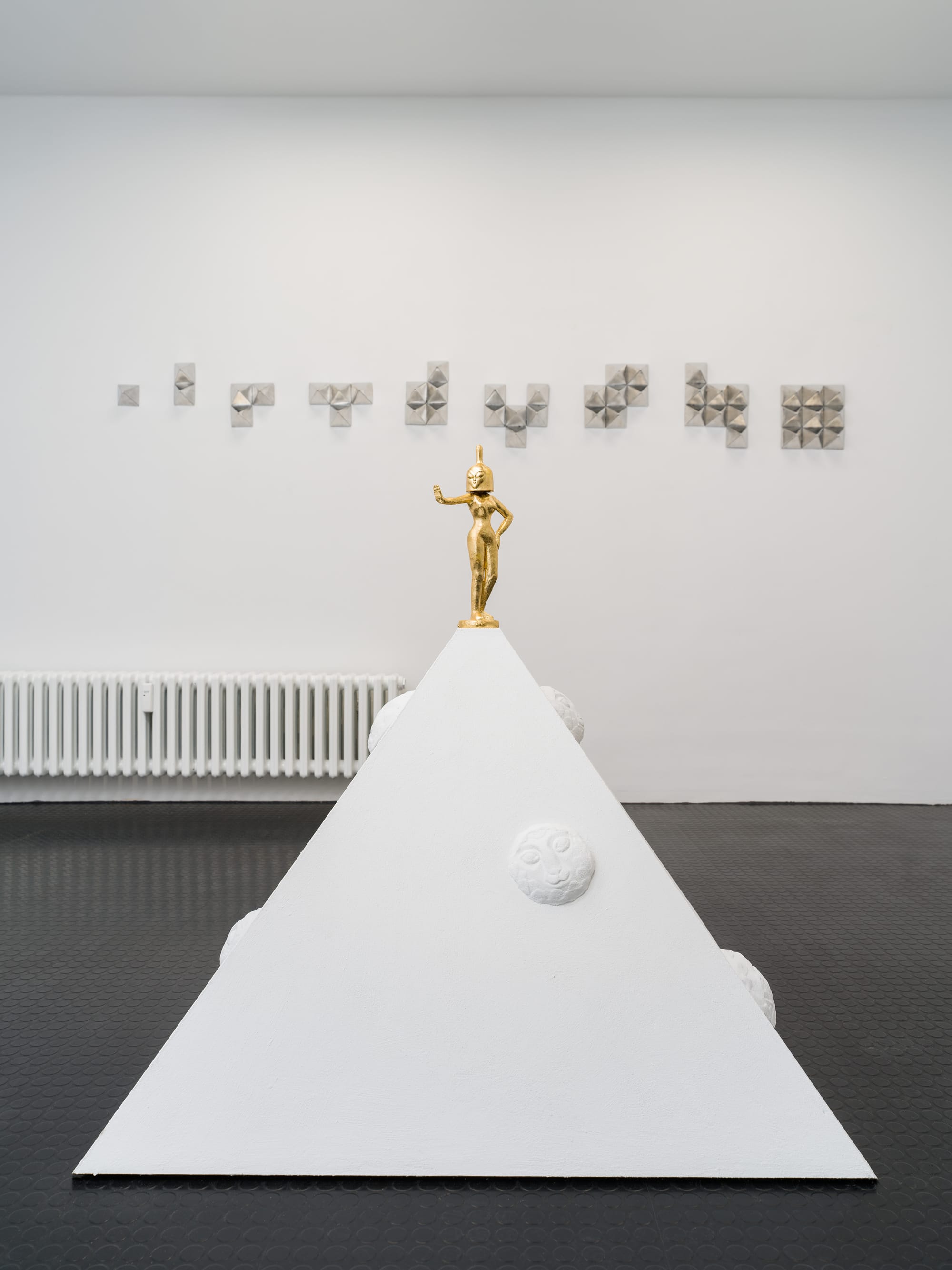
Fig.1
It is a proposal for a giant gilded public sculpture, Craft tells me over email. If an enlarged version of the gilded refusing alien-woman were erected in front of Grotto, it would face another golden female statue nearby: the 8.3-meter-high bronze figure of Victoria, the deified Roman personification of victory, which stands atop the Siegessäule in the Tiergarten. Originally erected to celebrate Prussia’s victories in the so-called “unification wars”—a foundational event in the construction of the modern German nation-state—the “Goldelse” (“Golden Lizzy”, as the monument is known in Berlin vernacular) was relocated to its current location by Albert Speer, Hitler’s chief architect, to mark the East-West axis of the planned world capital known as “Germania”.
The oversized white pedestal in the shape of a pyramid on which Craft’s sculpture is enthroned is adorned with circular reliefs of animal faces. Craft made these casts on-site from decorative bronze ornaments embedded in the cast-iron railing of Köthener Brücke, a bridge over the Landwehrkanal near her former Berlin studio, which she has crossed daily when she was living in Berlin. The Art Nouveau ornaments, protective and gatekeeping symbols on the bridge, are here transformed into cryptic, talismanic, mythical avatars, chiming with the otherworldliness of the figure’s alien head. Since leaving Berlin, the artist has returned to her hometown of Los Angeles, where she studied at UCLA. She has remained deeply engaged with West Coast artistic and subcultural scenes ever since.
Behind the golden sculpture, a series of wall-based works is installed: 1–9, an arrangement of silver metal pyramidal objects, echoing the shape of the sculpture’s pedestal. The objects are arranged in geometrical groups, forming pixelated compositions reminiscent of early arcade games such as Tetris, their components growing in number incrementally in accordance with the titles. They appear as perfectly geometric objects from afar, but upon closer inspection, are revealed to be textured by auspicious imperfections. Oversized metal rivets come to mind viewing the works, adorning white walls instead of worn leather clothes.
Throughout the 1980s, the slogan “Just Say No” entered the American vernacular. Not in the way Nancy intended, however. A truism of armchair pop psychoanalysis is that prohibition and taboo foment curiosity and desire in their wake. If negating (saying no) is the requirement, a risible primary negation can become a double negation (saying no to saying no), which, in the vicissitudes of the negating trajectory, somersaults eventually into affirmation. “Anti” or, in this case, “anti-anti” unfolded new registers of cultural production and modes of (often drug-affirmative) sociality in the many punk and DIY countercultures from the 1980s through 1990s across the US, which pushed against the currents of institutional frameworks. These countercultures shaped visual languages that are sedimented in Craft’s artistic vocabulary—the enlarged rivets on the wall in Just Say Nein are just one example of the many relics of punk imagery and of vanished rock music subcultures that often run through her works. Craft’s interest in countercultural urban mythologies and cults—exemplified at Grotto by the souvenir alien-head, the pyramidal structures, the animal reliefs, and a crystal gemstone on a windowsill—taps into a persistent imaginary of L.A. as a city suspended between glossy spectacle and chaotic, murky undercurrents of New Age mysticism, vernacular symbolism, and aesthetics of kitsch. These aesthetic codes and adjacent materialities here are folded into an attention to major (e.g. Victoria) and marginal (animal ornaments on the bridge Craft crossed daily) iconographies from the surrounding urban topology of Berlin, channelled through her own personal quotidian urban trajectories during her time living in Germany.
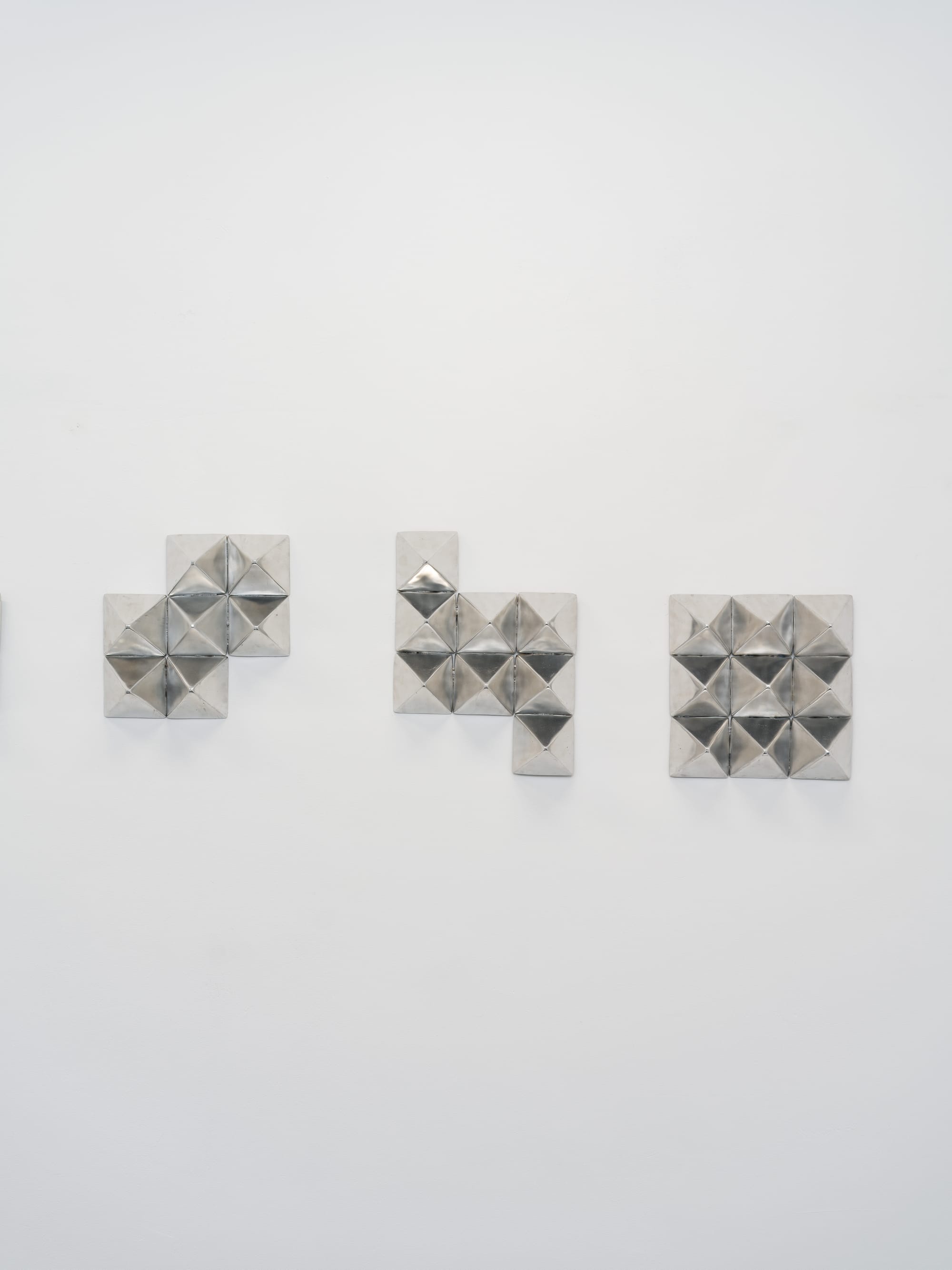
Fig.2
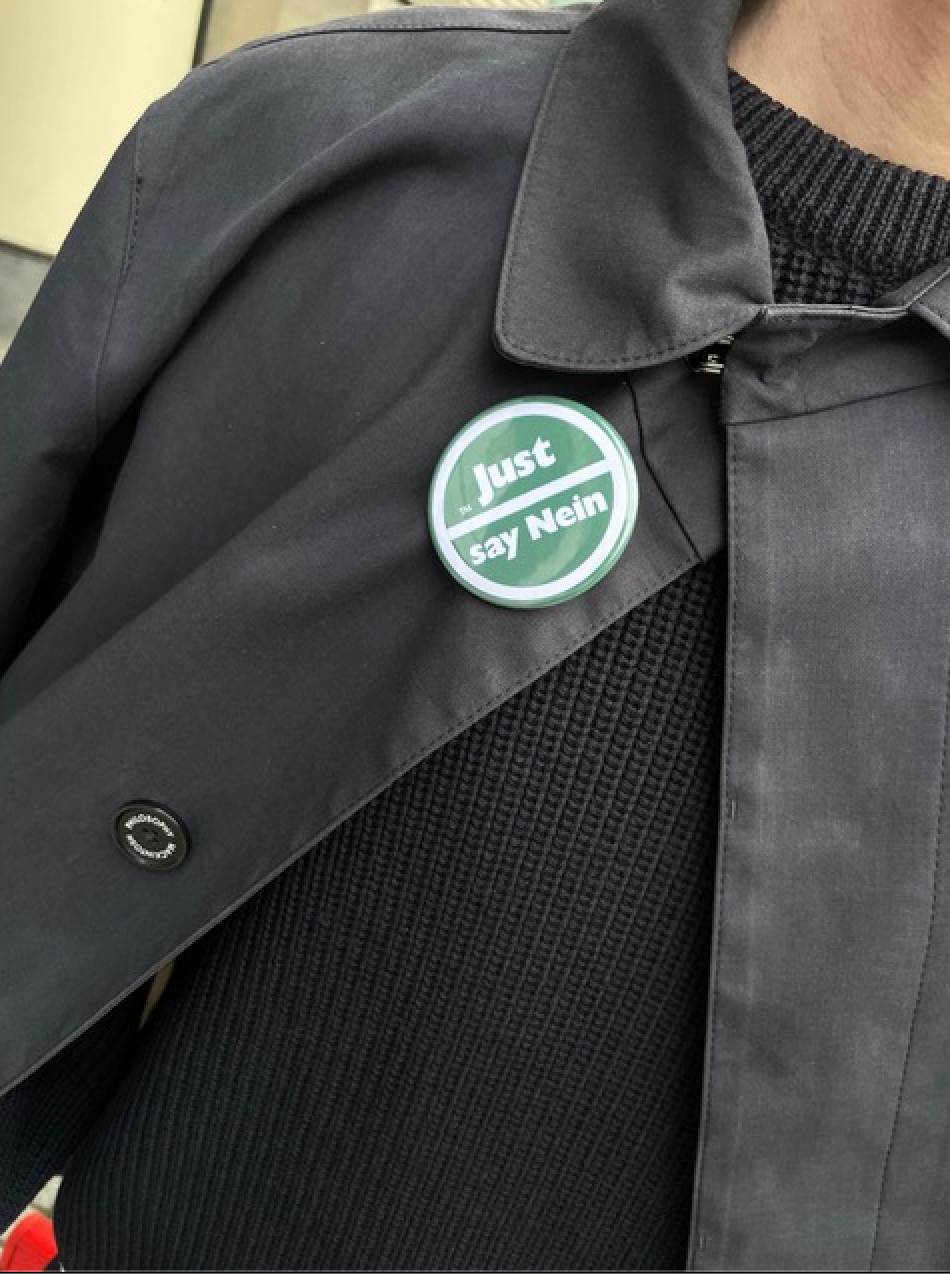
In the fiction of Germanness and its socio-historical, infrastructural, and bureaucratic iterations, an automatized and atomized “Nein” is probably much more heavily implied than “Ja”: Nein, you cannot have this license. Nein, you cannot get this permission. Nein, you cannot get an Anmeldung. Nein, you cannot get an Aufenthaltsstatus. Craft has made a series of green badges reminiscent of those of Nancy Reagan’s “Just Say No“ campaign, a limited edition of which visitors may buy and take home (or to their next appointment at the Bürgeramt or the Ausländerbehörde). As Hannah Arendt argues, “secondary virtues”, such as obedience, discipline, punctuality, and a sense of order—as sedimented in these types of restrictive “Nein”—arise from a fusion of pietistic morality and a military ethos, that she regards most paradigmatically developed in Prussian society, whose victories are monumentalized just around the corner by the “Goldelse”. In his early writings, Ernst Bloch analyzes this Prussian morality as an anti-utopia: obedience, duty, and asceticism here stand for a “no” to the fullness of life, a negation of human possibilities and potential. He sees in this the very opposite of the revolutionary hope he champions. Hope, he says, can be nurtured in a different form of negation: A “concrete” negation of the existing “no“, opening up space of everything that could be, but which remains “not-yet”.
It’s sunny when I leave Grotto and stroll through Tiergarten wearing a “Just Say Nein” badge on my jacket. The glistening Prussian “Golden Lizzy” flashes between the leaves of a treetop. I squint, dazzled, and I see her peeling herself out of her tunic. The insignia of Prussian victory she’s holding—a laurel wreath in her right hand, a field standard with the Iron Cross in her left—slip from her grasp. She stretches out one of her hands, transforming into Craft’s golden dissenter. A monument for refusalists. “History is full of people who just didn’t,”[2] begins Anne Boyer's text “No”. The past is cramped with people who said “no” in a way opposed to the simple “just” of Nancy Reagan’s “no” and the Prussian “no” to the fullness of life monumentalized by the “Golden Lizzy”. Saying “no” to these “noes” (e.g., in the Blochian sense) is actually not that easy. Many double negations—not just those of the once fringe “anti-anti” American countercultures cited in Craft’s work—have lost their edge over time and have been seamlessly adapted by that which they once tried to negate. Neoliberal cultural and institutional programmatics swallow attempts at saying “no” in the form of an avant-garde impulse to transgress. Given these conditions, negating negation proves challenging, but not impossible. There are many alternative lineages of “no”, which can be found in practices of refusal, opting out, fugitivity, turning away, or halting production from within; in the practices of those who, in their refusals, “reshape desire, reorient hope, reimagine possibility”[3]. There are really endless ways of saying “no”. Unruly, excessive, and humorous “noes”, as well as obedient, oppressive, and destructive ones are stalling, echoing, and glitching on the outstretched palm of Craft’s statue.
The negation of negation is brimming with potential.
//
Footnotes
[1]Ronald Reagan and Nancy Reagan, "President Reagan’s and Nancy Reagan’s Address to the Nation on Drug Abuse from the Residence," September 14, 1986, Master Tape #701, courtesy Ronald Reagan Presidential Library, Address_to_the_Nation_on_Drug_Abuse_Campaign,_September_14,_1986.webm, accessed June 7, 2025.
[2]Anne Boyer: ‘No’. In: The Poetry Foundation. 2017 https://www.poetryfoundation.org/featured-blogger/77342/no
[3]Jack Halberstam: ‘The Wild Beyond: With and for the Undercommons’, in: Moten, Fred and Harney, Stefano: The Undercommons. Fugitive Planning & Black Study. New York: Minor Compositions 2013.
Images
Cover: Liz Craft, Just Say Nein, button, 2025, GROTTO. Courtesy the artist and GROTTO, Berlin. Photo: Leonie Herweg.
Fig.1: Liz Craft, Just Say Nein, exhibition view, 2025, GROTTO. Courtesy the artist and GROTTO, Berlin. Photo: Nick Ash.
Fig.2: Liz Craft, Just Say Nein, 1-9 (detail), 2025, GROTTO. Courtesy the artist and GROTTO, Berlin. Photo: Nick Ash.
Jo Pistorius works at the intersection of theory, curating, and text production. They studied philosophy and comparative literature in Berlin and Paris and are currently enrolled in the MA Contemporary Art Theory at Goldsmiths, University of London.