
Àngels Miralda and Catherine Czacki are two cultural workers who first met through their collaborative contributions to Collecteurs Magazine and over a series of weekly discussions held between 2023 and 2025 with artists, activists, and cultural workers in solidarity with Palestine. What began through political solidarity has since evolved into an ongoing dialogue about the deeper structural consequences of this moment and how it has reshaped the relationship between artists and institutions, eroded freedom of expression, and quietly reorganized the economics of cultural life. In the following conversation, they map a landscape in which autonomy and complicity have become the central fault lines of a contemporary art culture that parallels the petro-capitalist world-building of extraction regimes.
Àngels Miralda: We both collaborate with institutions and with so-called “institutional artists”. Shall we depart from this? How do we understand the institutional as a hegemonic art framework?
Catherine Czacki: What I call “institutional art” is what we see so often within a framework of large contemporary art institutions that is beyond the human scale. I am talking about vast scales of sculptural installation, or even such complex architecture that it takes an unjustifiable and insatiable budget, team, and endlessly expanding resources to make it possible. “Institutional art” is, therefore, an art form that cannot be made by individual artists—it needs the institution to exist; it needs resources and validation, and it relies on its budgetary and spatial capacities for its feasibility.
Underlying these structural and economic dependencies, let us understand how they pave the way for the centralization of discourse and practices, or their exclusion. The institutional dismissal of painting, branded as bourgeois or obsolete by academies and art worlds alike, is not incidental. Painting is cheap to make, easy to store and transport, accessible to broad audiences, and above all, it requires no external permission. It is one of the last forms of genuinely autonomous practice: you can make it before your ideas are approved. This is precisely what makes it threatening. The institution has a vested interest in eliminating artistic autonomy because it is sustained by dependency. The same logic extends to craft and the bodily dimension of making. When institutions do engage with craft, it is always on their own terms, folded into the management of artistic biography rather than recognized as a site of independence.
ÀM: The “institutional art” that you are describing is what I will relate to as “the institution as medium”. The idea of the “post-medium condition”—popularized in Rosalind Krauss’s A Voyage on the North Sea: Art in the Age of the Post-Medium Condition (2000)—or the notion that art has liberated itself from any specific form or channel needs to be reformulated. Painting, sculpture, and conceptual art are all alive and well; they are simply not being championed. Instead of a post-medium condition, what we see inside mega-institutions is the display of the institution itself as a medium: its power, its network, its grandiosity communicated through materials with the artist as decorative endorsement. The artist is a vehicle, not a maker. And the scale and grandiosity of the project are the keys to institutional access. Art is only recognised as “art” when it is inside the institution. Which means that any art that tries to exist outside of it must be dismissed, or simply made invisible.
It is no coincidence that independent spaces are being defunded; this is a political mechanism of control because, when something genuinely new and experimental can emerge, it becomes more difficult to control and, therefore, to optimize for institutional supervision. The institution as medium is not fundamentally about art, but about blocking the freedom of artistic practice and replacing it with state-approved discourse and aesthetics. The artists, increasingly, are no longer in a position to create art freely, but are controlled by applications and proposals that need approval, and the elimination of spontaneity that is naturally camouflaged in the production complexities of a biennial-esque exhibition. The art becomes part of a process of state hegemony, approved discourse, surveillance, and management of ideology.
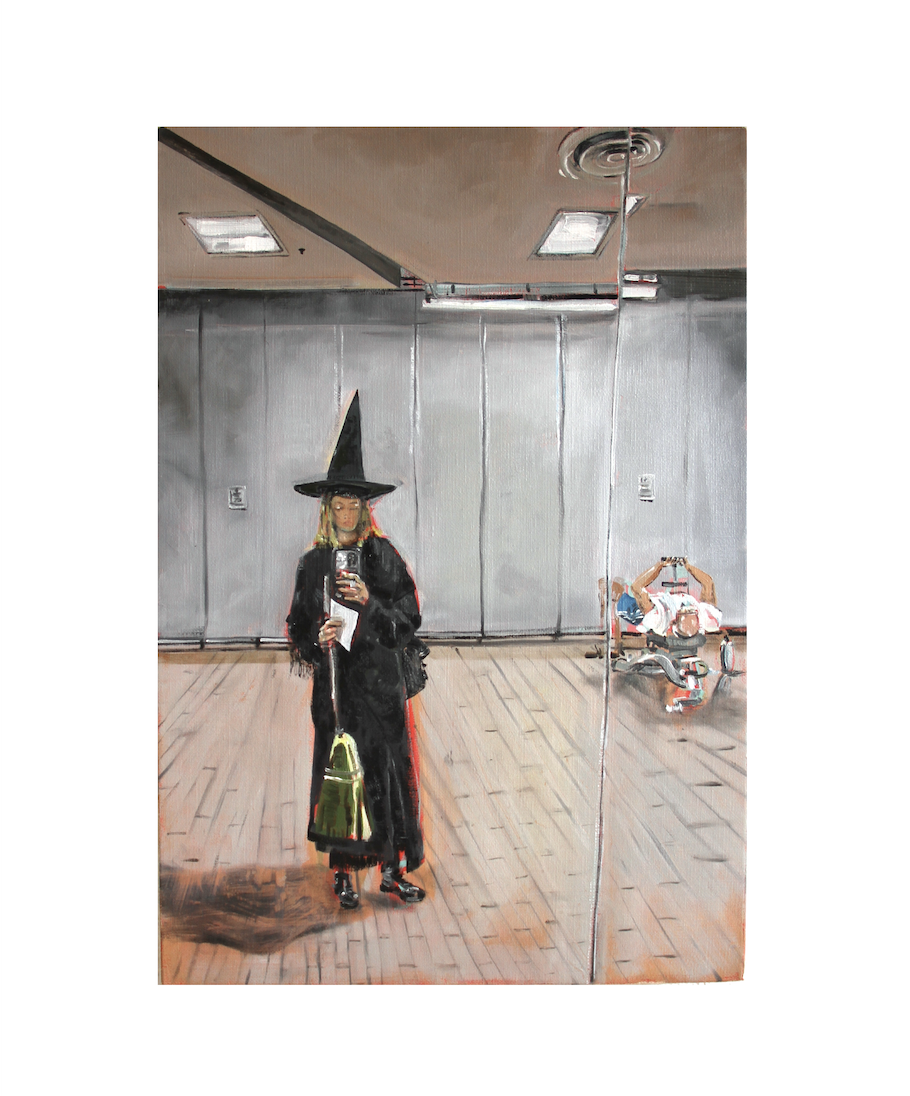
Catherine Czacki, Vanessa at the YMCA Dressed as a Witch (man lifting weights), 2026. Oil on linen, 13 x 19 inches. Image courtesy of the artist.
CC: Guy Debord’s predictions about media technology, that infinite images and their circulation would replace embodied experience, are now embedded in how contemporary art is made, discussed, and circulated. “Spectacle” drives how and what is funded institutionally, creating illusions that prioritize the “superficial over the genuine”. Grandiosity creates a factor of surprise for the audience, which is not necessarily new, given how European art was tied to wealthy patrons and the Church. What is new is the belief that these hierarchies have gone away due to a handful of instances of cultural inclusion and clever dialogic smokescreening. In the midst of increased financially motivated militarization, we see enormous physical spaces for art productions, yet little reflection on the expenditure it entails. The justification of expenditure is made based on a belief that one person can conjure an incredible spatial assemblage, when in reality, it is a team of technicians, many of whom work invisibly inside the museum. The artists’ message is mediated into institutional spectacle. The medium is the institution, in the same way that a series of drawings framed in Art Basel is different from work shown in a school or community center. The art fair, as a medium, had to invent entirely new sections (“Statements”) to incorporate the institutional medium as a parameter.
I moved out of New York some years ago, but I remain in close contact with many colleagues there. All of us are increasingly aware of how institutions measure artistic success, which enforces precisely the kind of labor system many of us initially went into art to escape. I used to work at an art transport company where I witnessed artworks made of concrete being loaded onto ships at costs exceeding forty thousand dollars—closer to eighty thousand today, with increases in transport and materials costs. At the time, I struggled with illness, debt, and housing issues. It was hard to witness this expenditure and not be sure if I could continue personally to make art, let alone survive on the most basic level. How this structure is justified is one of the confounding aspects of contemporary art.
ÀM: It can't be justified, and it connects to something structural, not incidental. There is a circuit of institutions that mutually approve artists and curators. One of the ways this is done is through academies and networks connected to private funders, and it can be seen through the circulation of specific artists—for example, those who have attended the Rijksakademie in Amsterdam—being represented in the majority of global biennials. They create a style of corporate curating in which curators no longer need to research; they are provided with a list of pre-approved candidates from the disconnected safety of Amsterdam without ever having to set foot in the regions that artists make work about. This network is often described benevolently as “like-minded institutions”, but it replicates a globalized and carefully controlled society that enriches itself from economic loopholes and expands its sphere of influence through biennials and new institutional outposts. This is a method that seeks to extend institutional territory to exploit more public resources for a specific personal network while excluding everyone else.
CC: Conquest of territory is the right metaphor. Older traditions, or just community-based forms of art-making, are gobbled up, reframed, and packaged institutionally. The small-scale paintings I recently returned to making are a direct response to this: the craft I began with at a young age, the essence of making. But, also, painting does not position itself as a genius move, because it is so well-worn, removing the need to compete for a tenuous and rarified form of inclusion. Ironically, it also has been an art form that appears solitary, but it has brought me community more than other forms I’ve practiced. This is precisely the kind of autonomy that does not serve the institution, and why institutions benefit most from the seasonal recurrence of declaring one or more media “dead.”
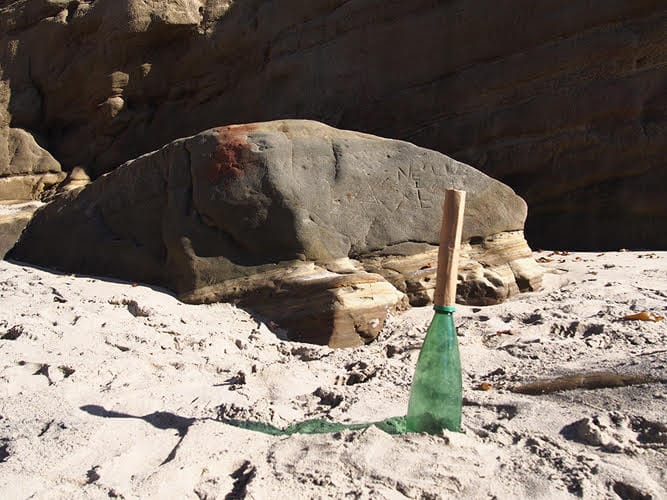
Catherine Czacki, ~, 2015. Paper mache, rocks, bookbinding glue. Installation detail from exhibition at SPF 15, San Diego, CA. Image courtesy of Morgan Mandalay.
Some of the most important works in 20th-century art have been concepts executed with everyday materials, happenings, or instructions. Looking at the larger arc of globally diverse art history, multitudes of crafts, making, and methods—far before specific areas are claimed to be invented by avant-garde-ists—you see that many things, not just painting, keep making their cyclical returns. I think we’ve forgotten this radicality of material simplicity, regardless of form. The current obsession with production and technology is structured by the limitation of resources and is a form of economic and social gatekeeping, an uneven playing field that mirrors contemporary politics’ morbid fascination with extreme extraction and teleological time. We are living through wars and events that can be summarized as the ongoing control of access to resources by a small few, a world ethos that then echoes through the arts, via galleries, museums, and biennials.
ÀM: This is part of a historical acceleration that was set into motion long ago, the end of autonomy of modern art, and the new paradigm of relationality in the contemporary. Modernism ended when Lucio Fontana cut a slit into a monochrome canvas. At that same moment, curating was reinvented. Art as a relation rather than an autonomous object entered the institutionally accepted definition of art. It is in a web with other artworks, with architecture, with time. You see it in Arte Povera, in Land Art. Then it goes further with Rirkrit Tiravanija and Thomas Hirschhorn, where it's not just the gallery but politics and society itself that enter the mix, and the relational becomes more insistent. The curator becomes an increasingly important factor, and in doing so, reduces the role of the artist; the artist takes a step back. This ties in to my recent article for Frieze “Who Killed the Independent Curator?”, where I discuss these shifts and the increasing focus on the accumulation of institutional power. What you get is a competition between museums to outdo each other to attract more funding, more public, more press. The value of the curator now depends not on the curator themselves, but on holding a position within the corporate structure of the mega-museum. First, the artist took a step back, then the curator.
CC: Artists become disenfranchised by this system. They and their artworks are used as paintbrushes, absorbed and repackaged, in the total oeuvre of the institutional circuit. The institutionally savvy curators and directors glimmer and attract more funding, treating artists as utility devices. The well-placed culture worker becomes a brand with a stable of artists and historically vetted themes. Even if the art stems from non-Western and community-based models, in the Debordian sense, it becomes absorbed into the image-making and spectacle-circulation process of the dominant art world. New art markets are opened, sometimes in whatever region the genius artist is selected from, altering scenes by picking the one to support. The museum is structured as a global conduit for capital on the loose, mirroring Wall Street, predatory real estate, or gambling.
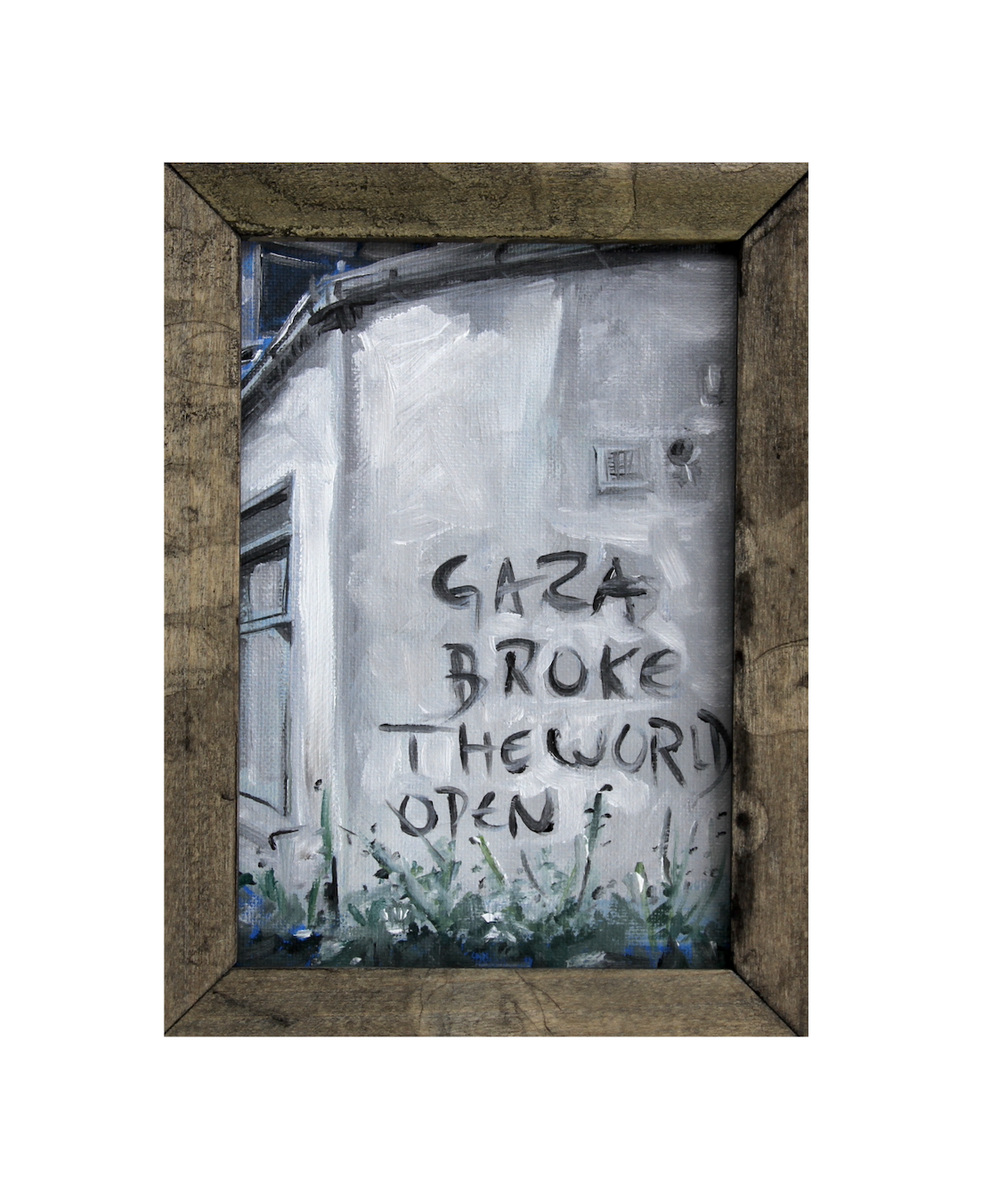
Catherine Czacki, Gaza Broke the World Open, 2025. Painting Raffle for The Sameer Project. Oil on Canvas with Natural Earth Paint Acrylik stained poplar frame, 5 x 7 inches. Collection of Sophia Flood.
ÀM: Yes, and of course, the resources are necessary, but this goes to a handful of people, and the point is that these resources are necessary for all artists, so the current structure is directly opposed to the demands for redistribution championed by contemporary art's dominant discourse, and it structurally prohibits the expansion of the art scene to expand the institution as a medium. There is too much gravitation of resources toward these black hole mega-institutional juggernauts while the rest of the normal art world fights over crumbs for bare-minimum survival. It may be a human condition that we are always trying to get more than we have and more than our neighbor, but in the end, the existence and proliferation of these mega-institutions, and of curators who hold ten positions simultaneously, is a symptom of the avarice that is devouring our world. It is voracious resource extraction and unhinged warmongering.
CC: These systems need to be addressed because they are not producing art. They are eliminating worlds of it to support one world of it. Much like the voracious war mongering you describe, that seeks a totalized hegemony.
ÀM: So what do we do about the institution as a medium?
CC: At least, we can describe what is happening. On an artistic and curatorial level, we can counteract the circulation of the same curators and artists in favor of expanded networks. We can honor smaller scales as reflecting social and cultural needs with less funding. We must refuse the model of “get inside the institution and keep others out”. Solidarity with Palestine revealed deep fault lines that already existed within the institutional aspects of the art world; issues of true autonomy and how complicity towards financial gain exists within these systems are now irrevocably visible. Naming these problems, revealing the cost to “bare life” of these structures, are the seeds of resistance to total hegemony. We can also create new art worlds where funds are more evenly distributed, allowing more people to create rather than fewer. Angela Davis’ “You have to act as if it were possible to radically transform the world. And you have to do it all the time,” should be a maxim in the arts, the knowledge that we create these systems, and, therefore, we can also change them.
//
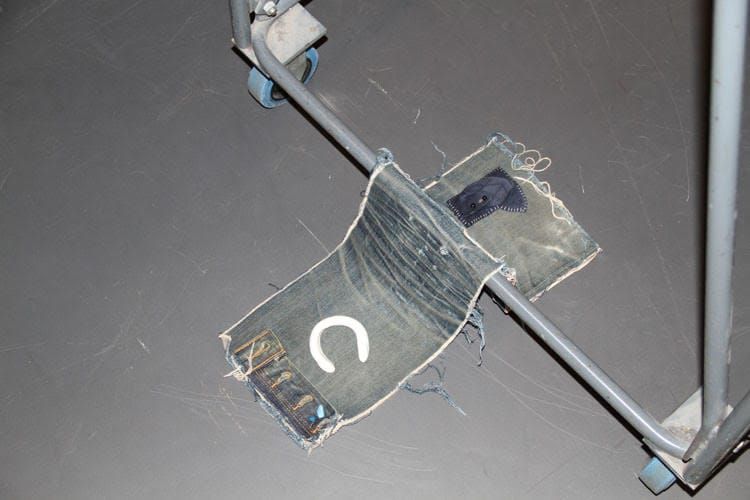
Cover Image:
Catherine Czacki, It Is, 2017. Denim scraps, sock, thread, beads, glazed ceramic. 6 x 22 x 1 inches. Image courtesy of the artist.
Àngels Miralda is an independent curator and art writer based between Amsterdam, the Netherlands and Terrassa, Spain. Catherine Czacki is an artist, writer and musician of Polish/Tatar and American descent.