
Sometimes listening is better than explaining. While preparing for the Whitney Biennial, curators Marcela Guerrero and Drew Sawyer didn’t impose a thesis. Instead, they listened to more than 300 artists, letting them shape the exhibition. Through these conversations, Guerrero and Sawyer identified “relationality” as a recurring concern among the artists, and adopted it as one of the exhibition’s guiding terms.
The biennial, as always, aims to “take the temperature” of American art—offering a provisional snapshot of what artists working or living here are thinking, making, and confronting at this moment. Yet any institution that sets out to measure a nation’s art faces a familiar problem: the act of taking stock inevitably implies a definition of what that nation is.
The Whitney Biennial has long been criticized for deciding, implicitly or explicitly, what counts as “America.” Earlier editions were faulted for presenting a narrow vision—white, masculine, and market-driven. Attempts to repair that history in the 1990s and in recent years were accused of simplifying differences into the language of identity politics.[1] In both cases, the suspicion is the same: an “elite” institution ultimately wants to declare, “This is America.”
Guerrero and Sawyer are seemingly aware of this trap. Their solution is not to redefine the nation but to sidestep definition altogether. The artists gathered here do not present a unified image of the United States, nor do they offer a coherent alternative. Instead, the exhibition conceptualizes the unstable, historical, economic, ecological, and emotional relationships that bind people, territories, and infrastructures together. In practice, the curators rely on the vibe—the sensory pulse of these entanglements—as the closest the show comes to representing contemporary power as experienced from here.
“Relationality,” then, becomes less a theme than a method: a way of thinking about subjectivity as something formed through entanglement rather than identity, as a space to consider extant, forgotten, and potential ways of existing together.
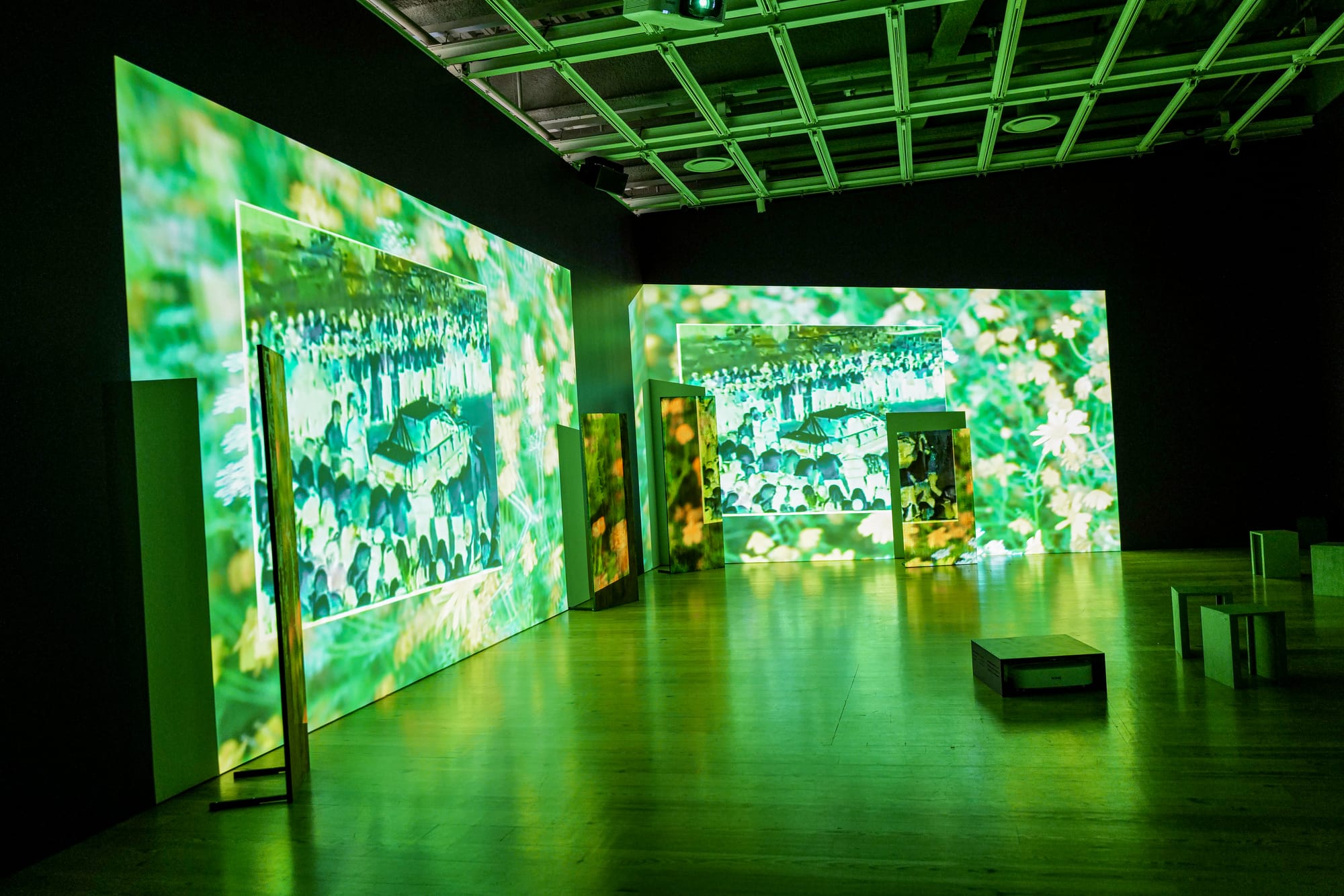
Basel Abbas and Ruanne Abou‑Rahme’s three-channel video and sound installation Until we became fire and fire us (2023–ongoing). Installation view of Whitney Biennial 2026 (Whitney Museum of American Art, March 8–August 2026). Photograph by Jason Lowrie/BFA.com. © BFA 2026
The result is an intentionally eclectic exhibition. The works shout against neoliberal policy, (neo)colonialism, militarization, racial capitalism, technology, intergenerationality, ecology, and other spheres that bear on our relationships to each other and the living, material world. With many artists engaging sensorial energies through sound, texture, color, and smell, there is a deep investment in the revelatory potential of the aesthetic experience. Yet, while refusing finality, the biennial’s vibe insists in reformation through multiplicity, feeling, and community.
It acknowledges that “America” cannot be confined to its territory; its economic and military brutality has shaped lives far beyond it. Among the most noteworthy contributions is Basel Abbas and Ruanne Abou‑Rahme’s three-channel video and sound installation Until we became fire and fire us (2023–ongoing). Rusted steel panels intercalate with a multi-channeled projection, fracturing the image and preventing any illusion of visual coherence. Drawings made in Jerusalem during the 1970s and ’80s by Abou-Rahme’s father accompany the installation, grounding it in lived memory. The artists describe Palestine as a space defined by systems of colonialism and racial capitalism—a zone rendered disposable. Yet their work refuses this definition: fragments of sound, color, and poetry circulate through the installation, creating an atmosphere that exceeds the language of occupation and control. Resistance here is not articulated as a clear political program; instead, it appears as a field of affective possibility, an insistence on presence within the very structures meant to erase it.
“We found that many of the artists we encountered were, like us, drawn to the idea of infrastructure,” Sawyer claims in a catalogue essay. Drawing on Lauren Berlant’s theory of “living mediation,” Sawyer frames infrastructure not only as roads, pipelines, or buildings but as relationalities alongside and through affect. If critically “inhabited,” these systems have the potential to expose the forces that covertly coerce, as we observe that infrastructure is neither natural nor inevitable. Infrastructure is that which both sustains and confines us—the agricultural or the carceral—yet these are not distinct or neutral forms.
In her piece System’s Void (2026), Sung Tieu recasts the infrastructure that powers an unsustainable economy as a violent monolith. A massive, austere, metal pipe that resembles those for extracting and transporting gas from fracking wells runs along the Whitney’s central staircase while sound, amplified through the pipe, converts illegible data from fracking sites that Tieu has appropriated. Through this haunting atmospheric gesture, she reveals how life-sustaining infrastructures remain concealed while conveying the perilous consequences of that invisibility.
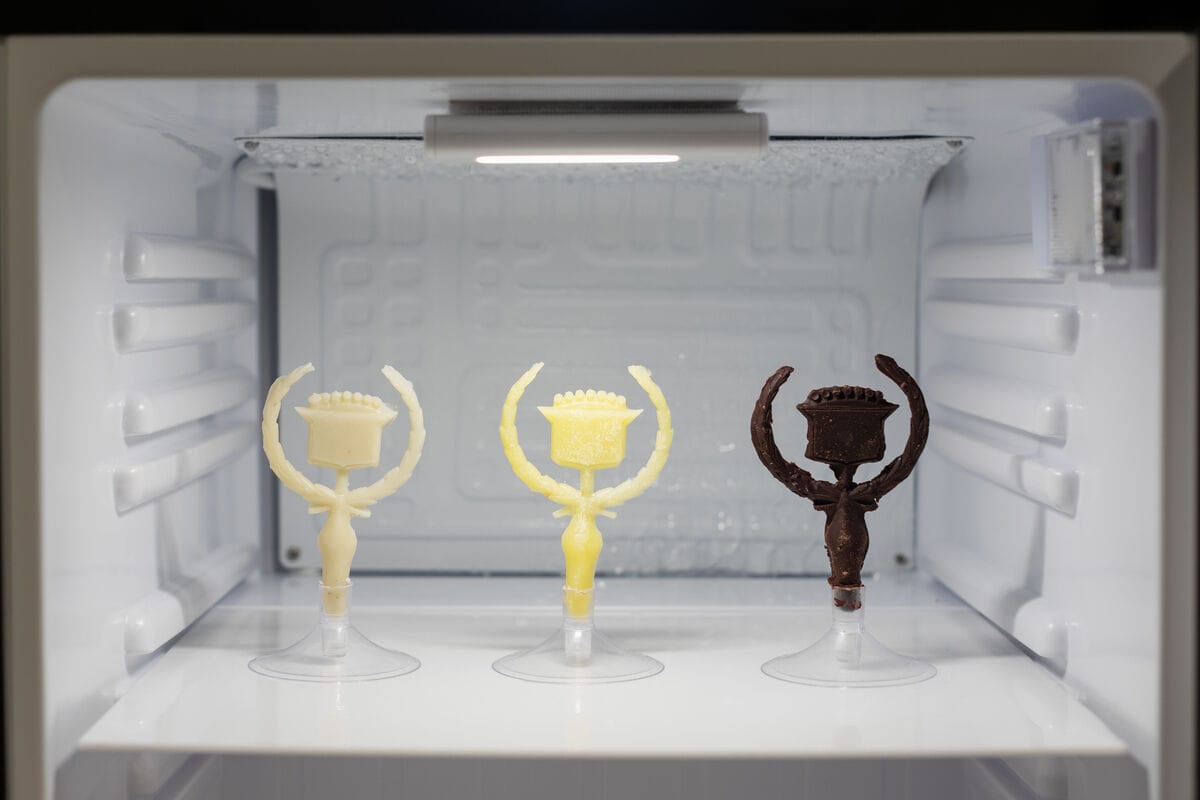
Ash Arder, Consumables, 2023 (detail). Display refrigerator, solar-powered battery storage system, shea butter, butter, chocolate, plastic, and light, 19 1/2 × 17 3/8 × 20 in. (49.5 × 44.1 × 50.8 cm). Collection of the artist. Image courtesy the artist. Photography by Clare Gatto
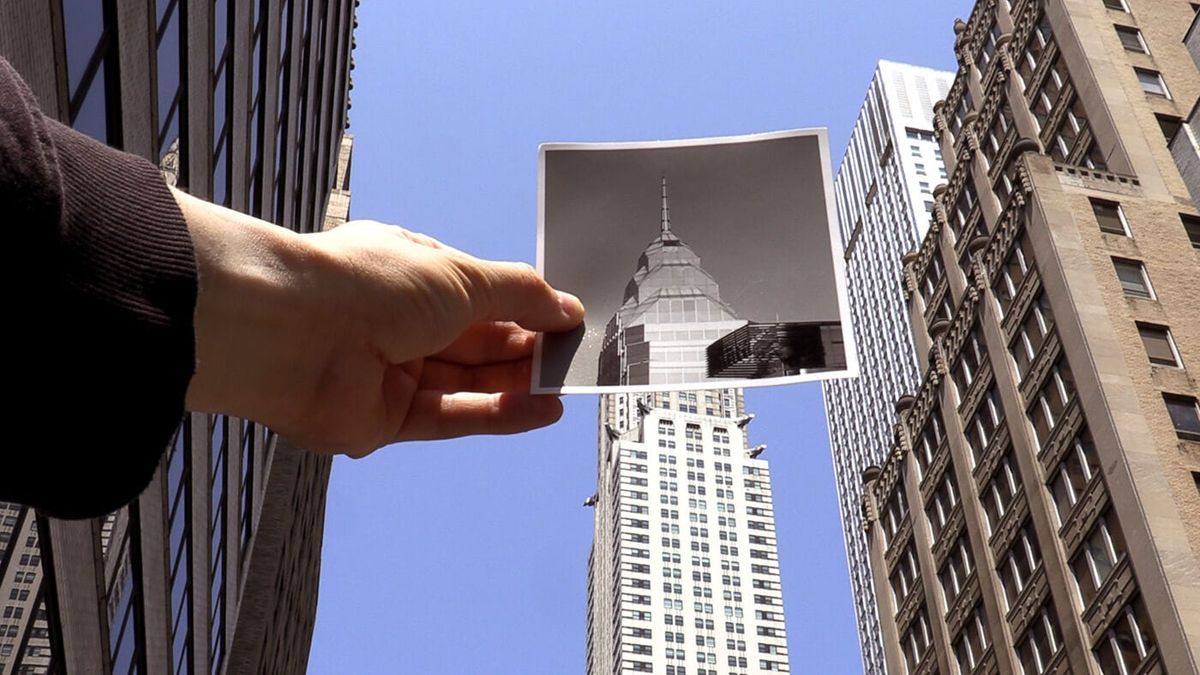
While Sung Tieu renders infrastructure audible, Ignacio Gatica makes it spatially and historically legible, exposing how financial architecture travels across continents as both model and imposition. In his single-channel video Sanhattan (2025) installed in front of a large window overlooking Manhattan, Gatica intercuts images of the financial districts of Santiago de Chile and New York City, revealing architectural and symbolic similarities between them. While listening to Chilean academics and poet Ileana Elordi reflect on how neoliberal economic structures imposed during Pinochet’s regime reshaped Chilean urban life, the viewer stands between the filmed city and the real one, momentarily inhabiting the very system the work describes. The skyline outside becomes part of the film’s argument, and the work collapses the distinction between representation and reality.
Understanding how we live with oppressive systems is a key part of refusing them. Artist Ash Arder reflects on their upbringing in Detroit, where manufacturing jobs supported families while also reinforcing racial inequality and environmental damage to a historically discriminated Black community. Arder’s sculpture Consumables (2023) places a butter, shea butter, and chocolate Cadillac hood ornaments inside a refrigerator powered by solar panels on the museum’s roof. The fragile materials belong to Detroit’s industrial history while pointing toward more precarious forms of sustenance. If removed from refrigeration, the sculptures would melt. Stability, the work suggests, depends on delicate systems that are themselves unsustainable. Arder connects this reflection to the growth of urban farming in Detroit after the collapse of industrial manufacturing. As infrastructure failed, communities turned to land, sunlight, and cooperation. The sculpture hints at a different economy, one grounded less in industry than in ecological cycles and shared labor. Arder describes the piece as our “spiritual positioning between the earth and the sun.”
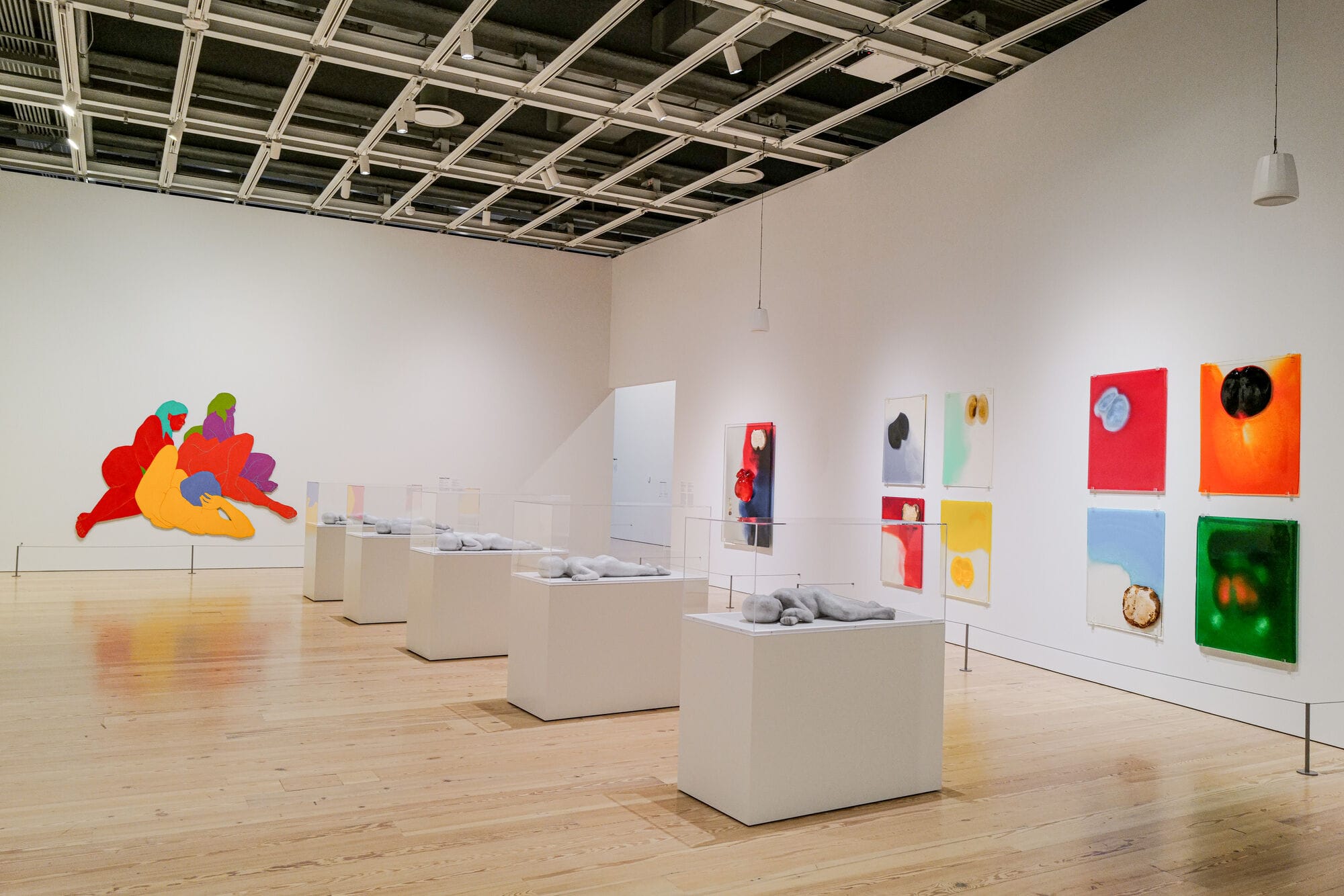
Andrea Fraser’s Untitled (Objects) (2024). Installation view of Whitney Biennial 2026 (Whitney Museum of American Art, March 8–August 2026). Photograph by Jason Lowrie/BFA.com. © BFA 2026
Attention to relationality shifts to the body in one gallery, with an emphasis on motherhood. At first, it may seem far removed from the infrastructural concerns elsewhere in the biennial, yet the logic is continuous: just as pipelines and financial systems shape collective life, so too do biological and intimate networks of care and dependency. Andrea Fraser’s Untitled (Objects) (2024) displays disturbingly realistic wax sculptures of two-year-old children lying down, enclosed in Plexiglas vitrines. Their fragile material requires careful preservation—without protection, they would melt—and the display evokes multiple environments at once: museum case, hospital nursery, laboratory, even morgue.
In this gallery dedicated to motherhood, Fraser’s sculptures are imbued with another contextual layer in that they share the room with work by Fraser’s mother, Carmen De Monteflores. Her colorful monochrome silhouette paintings—depicting intertwined bodies in scenes of vivid intimacy—echo themes present in Fraser’s earlier collaboration with a collector, in which she sold and documented a sexual encounter as an artwork.
Vis-à-Vis, Nour Mobarak presents casts of her body from the Recto Verso series alongside Broad Cast (Montage) (2024–26), a sound installation composed from recordings captured by a microphone placed inside her body during pregnancy. Together, these works shift the conversation from social infrastructures to corporeal ones—the biological processes through which life is sustained. Yet the tone remains ambivalent. The gallery produces a strange mixture of tenderness and unease: preservation, protection, and vulnerability blur together, suggesting that even the most intimate forms of relationality are shaped by regimes of care and control.
A more celebratory vision of collective embodiment is perhaps most strikingly envisioned by Young Joon Kwak’s sculpture Divine Dance of Soft Revolt (2024). Kwak casts body parts from members of their queer community in Los Angeles, and uses these molds to assemble a floating helix of shimmering fragments. Outlines of harnesses and heels retain an impression of bodies, but they are formed into something almost extraterrestrial, harmonizing into an indefinite structure that resists gravity. As visitors move around it, their own reflections appear in the mirrored fragments of the disco-ball surface. Community is not a stable identity here but a shifting constellation of bodies and reflections. Kwak channels the sense of fragmentation often tied to bodily subjection, organizing excerpts from their community into an image of connection and solidarity that extends beyond individual selfhood.
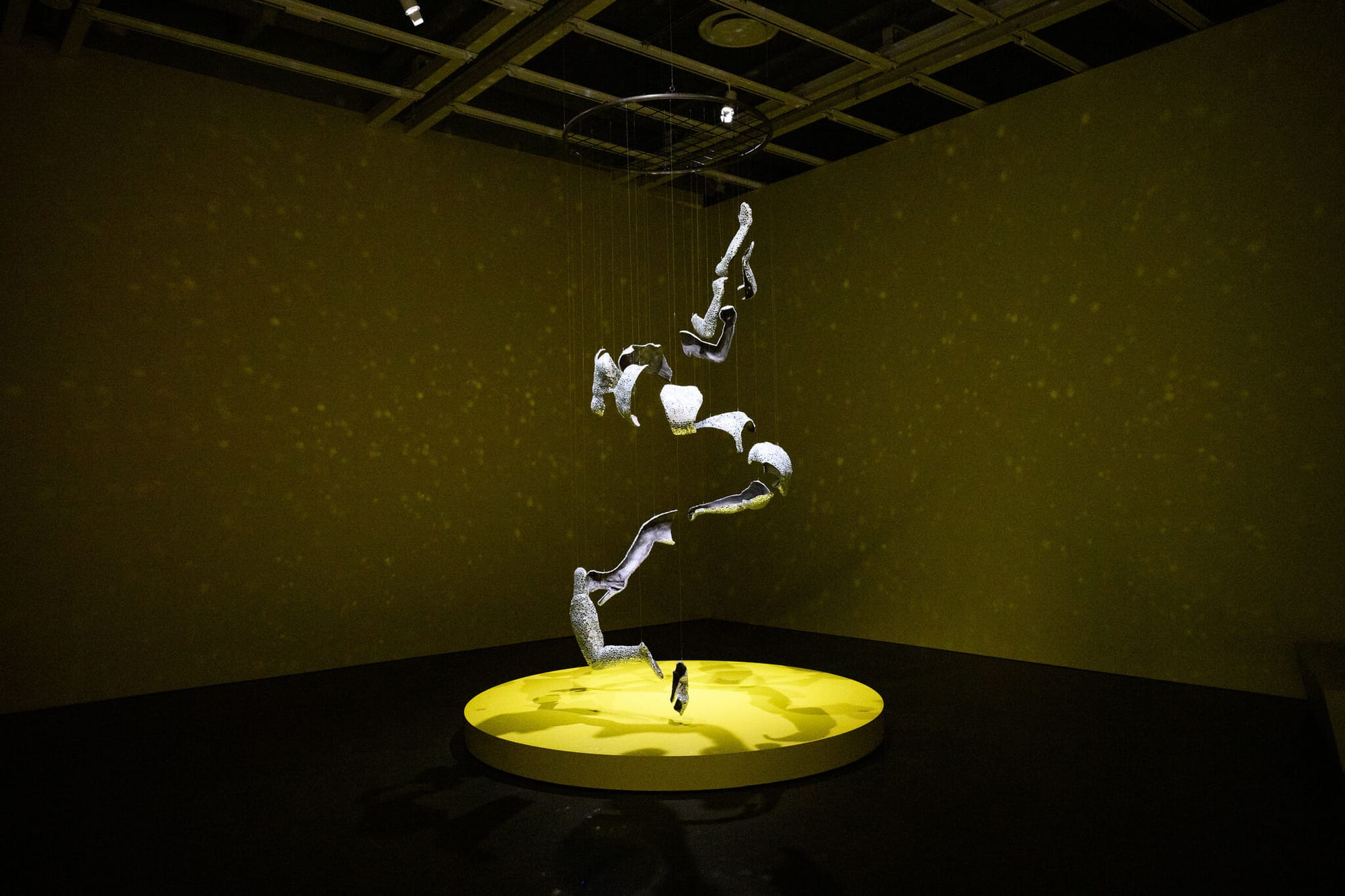
Young Joon Kwak, Divine Dance of Soft Revolt (2024). Installation view of Whitney Biennial 2026 (Whitney Museum of American Art, March 8–August 2026). Photograph by Darian DiCanno/BFA.com. © BFA 2026
This emphasis on sensation and shared atmosphere echoes Fred Moten and Stefano Harney’s idea of “hapticality,” which describes a mode of relation emerging within yet against formalized structures of institutional recognition that is based on touch, feeling, and mutual presence. Many works in the biennial operate in precisely this register. Rather than articulating concrete political arguments, they attempt to create spaces where viewers can experience the emotional and sensory conditions of a life defined by infrastructures of US-American power. Through this experience, the exhibition advances a form of refusal by affectively destabilizing the systems it operates within.
This strategy is the exhibition’s strength and its limitation. On one hand, the refusal to define “America” produces an unusually open biennial. By avoiding a singular thesis, the curators enable artists to explore relationships that extend far beyond national identity: colonial histories, global infrastructures, ecological networks, and intimate forms of care. The exhibition’s ambiguity creates space for complexity, contradiction, and vulnerability. On the other hand, that same ambiguity might dull the exhibition’s political force. When critique appears primarily through atmosphere, sensation, and relational feeling, it risks replacing argument with mood. Throughout the exhibit, we feel the structural violence, the collapse of support systems, and the collective confusion recognizable for many who live in relation to the US. We sense the presence of alternative relationalities in the earth and the community, yet these recourses do not crystallize into explicit directives for political action.
In this sense, the 2026 Whitney Biennial reflects a broader shift in contemporary exhibition-making. Undeniably, large-scale shows move away from articulated political positions and toward affective environments designed to evoke relationality. Instead of declaring what America is—or even, what it might become—the exhibition asks us to feel the systems that shape it. Some have criticized the absence of a call to action, but it seems the biennial, like the artists, may be finding new forms of refusal. The attention to affect signals a resistance to the fatigued practice of precise, overt politicization, and may imply a new source of political significance for art, in a way that it can make invisible structures feel real.
//
Footnotes
[1]danielle jackson, “The ‘Dissonant Chorus’ of the 2024 Whitney Biennial Lost Me,” Artnet, 2024.
Cover: Ignacio Gatica, still from Sanhattan, 2025. Digital video, color, and sound, 18:57 min. Courtesy the artist
Max MacLaren is a writer and artist based in New York City and Los Angeles. His work focuses on systems of power, value, and representation in politics, literature, and art. In addition to writing, he works in sculpture and documentary film.