
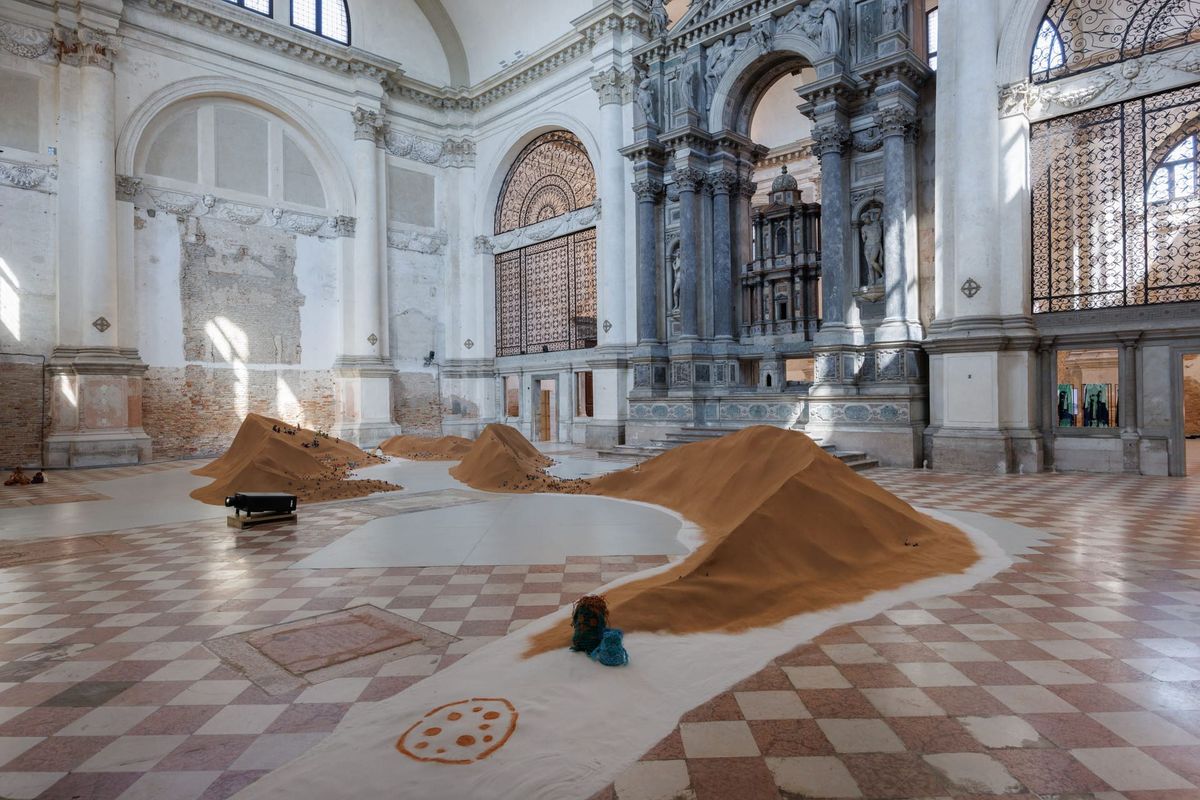
On March 25, the United Nations voted on a resolution to define the transatlantic slave trade as the most atrocious crime against humanity and to call for reparations addressing the historical injustice that saw 12.5 million Africans abducted and sold into slavery between the fifteenth and nineteenth centuries. The resolution received support only from countries in Africa, Latin America, and the Caribbean. All European countries abstained. Only a few hours later, I entered Ocean Space in Venice. And the news of this abstention reframed what I was about to see.
I felt a sense of commotion when stepping into the sumptuous former Church of San Lorenzo in Venice, a sanctuary of spirituality and trade, now housing TBA21 Ocean Space. I encountered a landscape of reduced scale: an artificial dune populated by hundreds of figurines organized into constellations. I was a giant in comparison to them. I came closer to getting acquainted with this society and discovered that each character was made from shells and characterized by distinct ornamentation. The sounds of waves accompanied this miniature landscape and somehow animated it. A video projected on a large screen followed a group of women, amongst them two sisters, Noeleen Lalara and Annabell Amagula, in the activity of collecting shells from the seashore, cleaning and organizing them, painting them, and dressing them with textiles and beads. The video offered background to contextualize My Mother's Country (2026), by Repatriates Collective, taking position in the West Wing of Ocean Space.
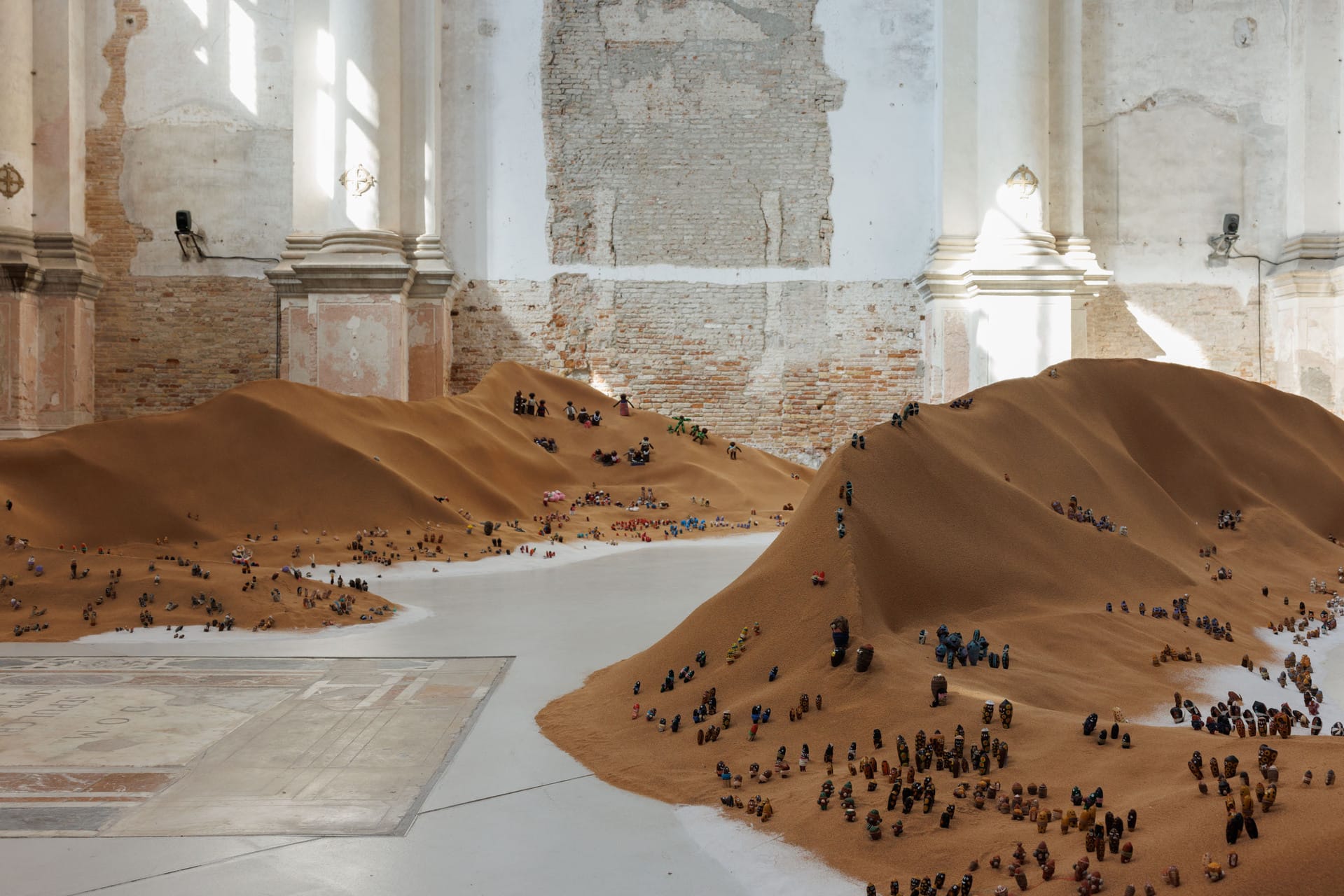
Repatriates Collective, “From My Mother’s Country”, 2026. Exhibition view of “Tide of Returns”, Ocean Space, Venice. Commissioned and produced by TBA21–Academy. Photo: Jacopo Salvi
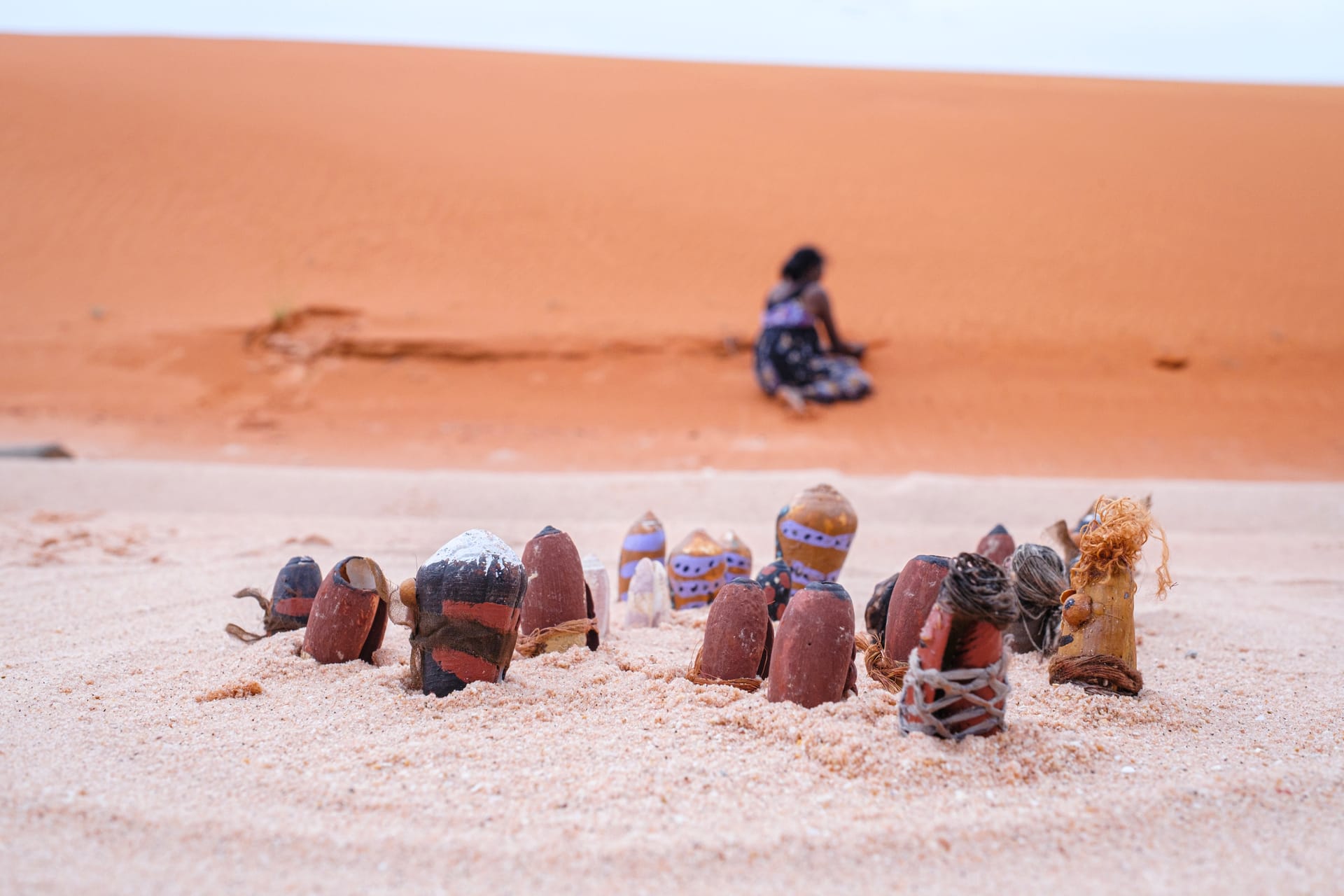
Film stills from “Tide of Returns”, Groote Eylandt, 2025. Ph: Britten Syd Andrews
The installation is part of the exhibition "Tide of Returns", curated by Khadija von Zinnenburg Carroll, and inaugurates the new oceanic season of TBA21 in Venice. The show reflects on the notion of "return": of practices, artifacts, relations, and of cultural aliveness in the face of colonial erasure. It draws attention to the intergenerational and ritualistic aspects of cultural resistance, and to the relationships formed in the process of restitution of colonial artifacts from Western museums to their countries of origin. The ambition, often, is genuine, and restitution has been amongst the most debated decolonial actions for institutions to undertake, yet such gestures arrive in a political system that has not relinquished much of itself. Indeed, European members of the UN General Assembly had formally declined to try.
The creation of Dadikwakwa-kwa (shell dolls) is endemic to the Anindilyakwa women of the Groote archipelago in Australia's Northern Territory. Under the caring and connective hands of the Repatriates Collective, the creators of the installation, the practice has been brought to Venice and placed in conversation with the Namibian ritual of doll-making known as ounona. Through shell dolls, young girls learn about the cycles of life, the significance of their bodies, and the importance of honoring the wisdom of their ancestors. Dadikwakwa-kwa are also used to teach children about relationships to their land, food, and family. In parts of Namibia, as I learned from the artist Laimi Kakololo, a doll is given to a girl, and the name of the doll becomes the name of her first child. In the making process, a double bond is formed: that amongst the group of dollmakers, and bonds with the dolls themselves. Each figurine in the installation has an individual name and represents its maker, whose presence is summoned by the doll itself. The work, therefore, becomes a prefiguration of a world of cultural conjunctions, where processions of women return to each other to relentlessly celebrate their generative and protective role in relation to the Earth.
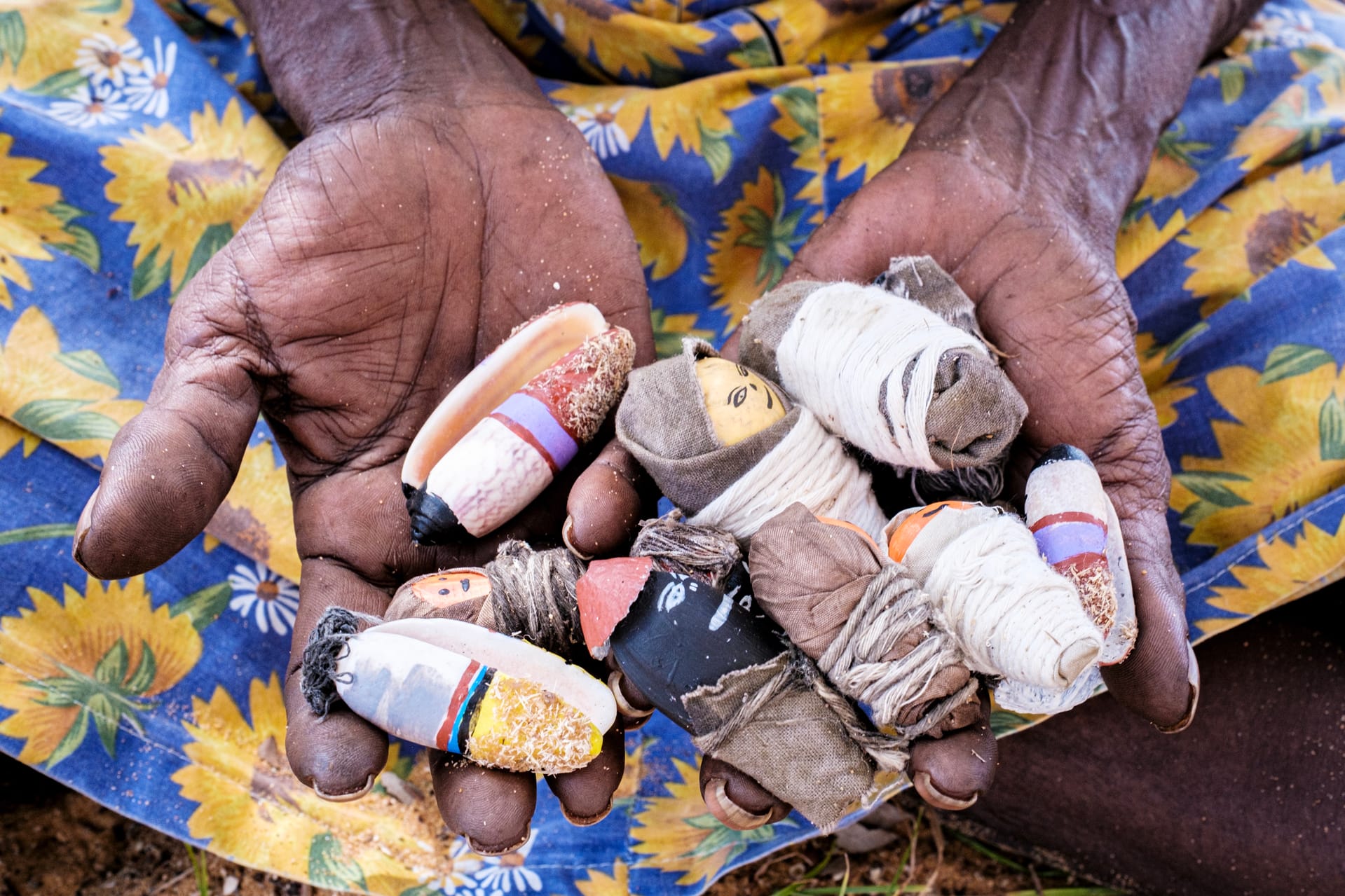
Film stills from “Tide of Returns”, Groote Eylandt, 2025. Ph: Britten Syd Andrews
By observing the different scales of personhood, the human as well as the talismanic transfigurations represented in the multimedia installation, I found myself confronted by the limitations of Western expressions of motherhood, sisterhood, and even of camaraderie. These are often reductivist, oriented around the nuclear family. The installation invites us to think about how making, ritualizing, and practicing together are intrinsic to these enduring pre-colonial cultures and expand these definitions. These are ways of relating to personhood in its many forms and temporalities, essences and manifestations that Western social constructs do not recognize, or which they ipso facto exclude, reduce, or annihilate. A whole world of relational richness opened to me, which may have been why, entering the space, my pre-verbal awareness alone had moved me to tears.
In the East Wing of Ocean Space, the installation Weaving Connections (2026) by Verena Melgarejo Weinandt carries the argument further and sharpens it. Where My Mother's Country speaks of return through the tenderness of collective making, Weaving Connections confronts the violence that makes return necessary in the first place. Large textiles in different gradients of blue and black hang sinuously in the space, resembling streams of water coming together. Two screens document women, half immersed in a stream of water, invested in the acts of braiding and ritualizing. The artist follows water's path of movement and transformation, creating a continuous cycle where waters are never truly separate but exist in a state of perpetual connection. One of the braids passes through a small hole in the wall. I bent to see where it led to and encountered the Venetian lagoon.
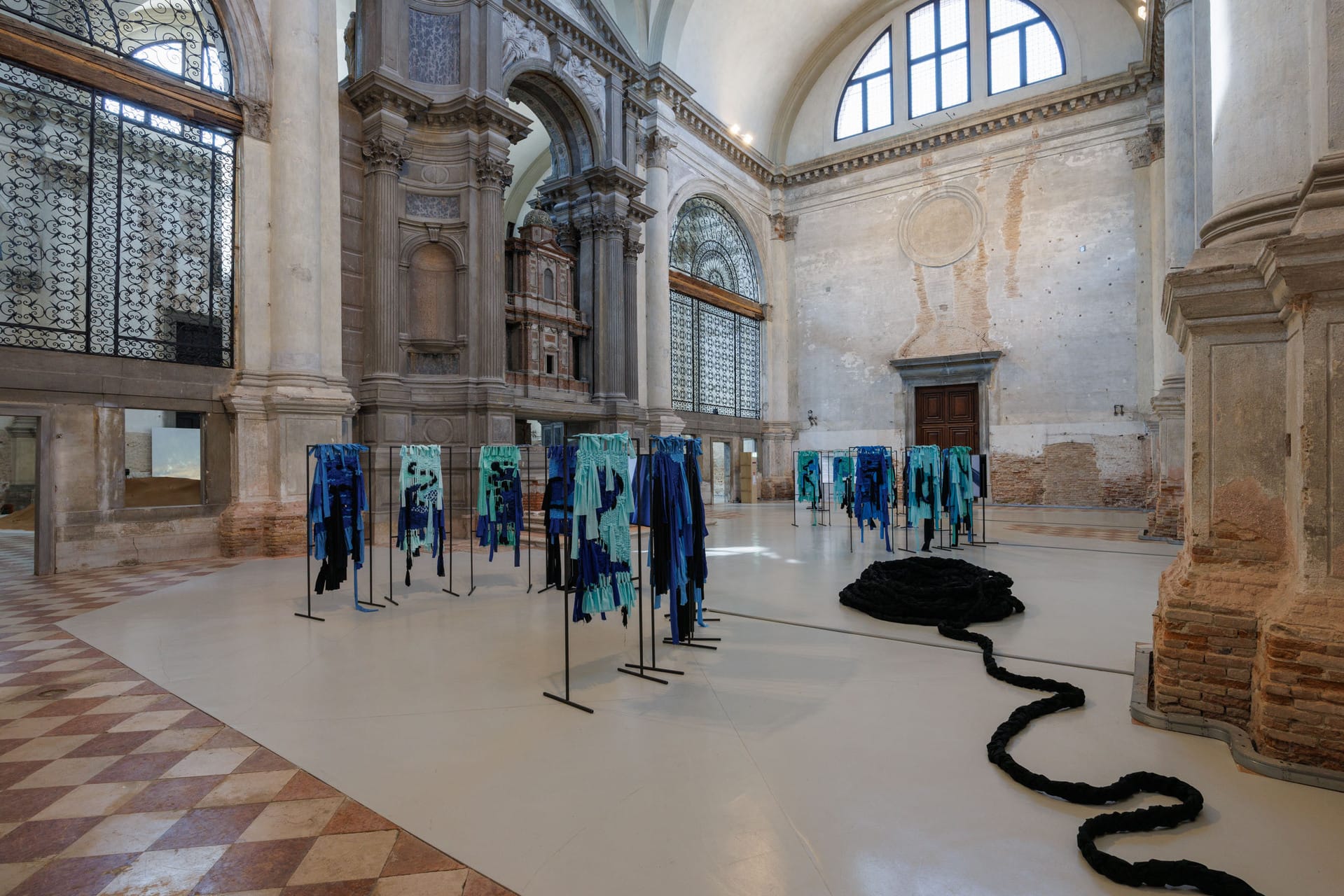
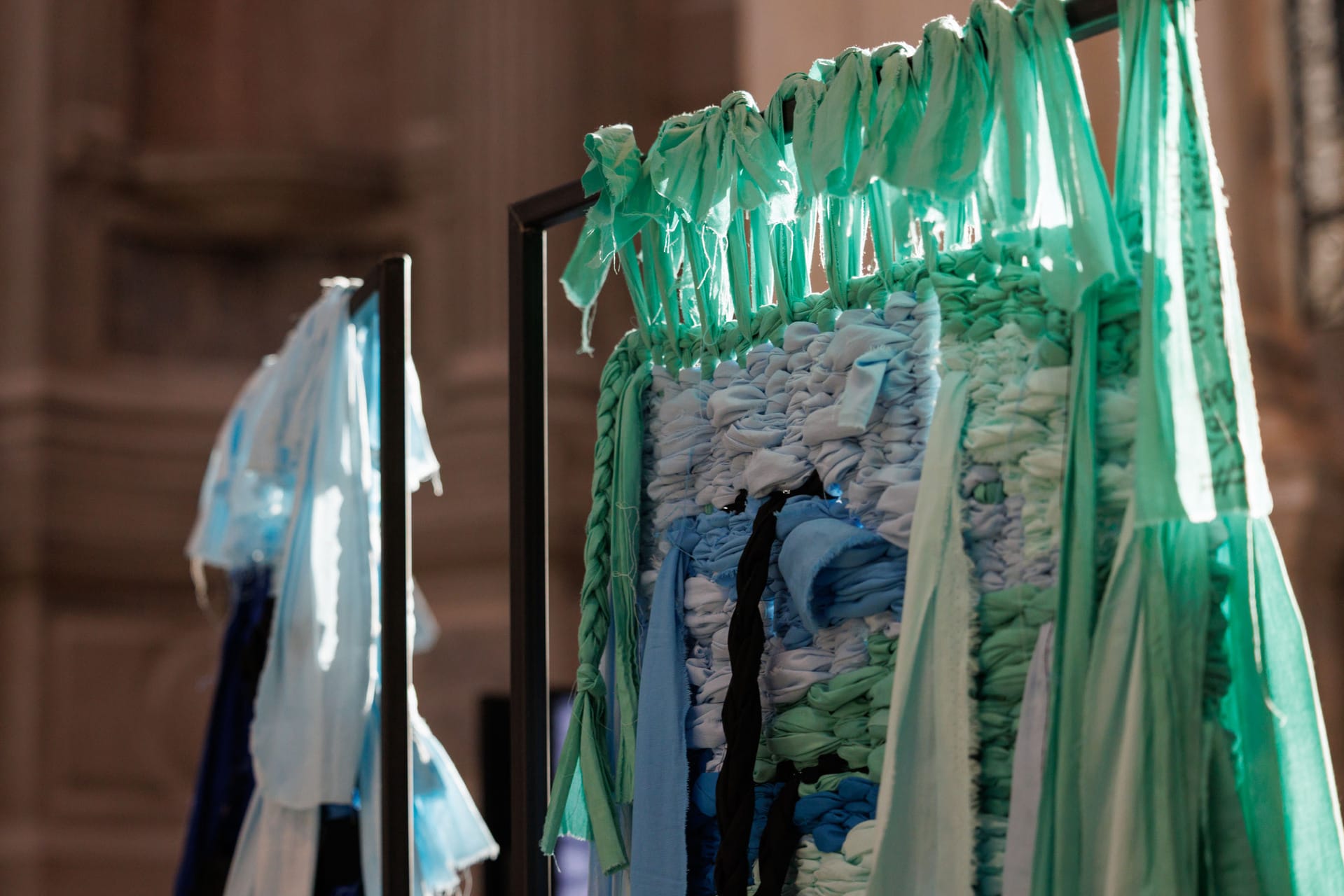
Verena Melgarejo Weinandt, “Weaving Connections”, 2026. Exhibition view of “Tide of Returns”, Ocean Space, Venice. Commissioned and produced by TBA21–Academy. Photo: Jacopo Salvi
The installation is part of a longer performative inquiry into how the cultural imaginary in Germany has represented and framed Indigenous peoples in mainstream media and culture, constructing the infantilized and romanticized colonial "other." This racist mechanism functions as the counterpart of German national identity: the stereotyping and dehumanization of Indigenous people against which a sense of national belonging is defined and consolidated. Weinandt responds to this violence through the act of braiding. This quiet gesture contains the work's central argument: that connection is not metaphor but practice, and that separation, between cultures, between peoples, between the human and the more-than-human world, is not natural but produced. Institutions replicate the separations, dichotomies, and categorizations that fracture practices from their cultural and material legacy. The braiding undoes the fracture, stitch by stitch, strand by strand, in full view of the institutions that produced it.
Together, these two works crystallize what the exhibition as a whole is navigating: the difference between restitution as a formal gesture and return as a living practice. Restitution operates within the logic of the institution: it is transactional, documented, and authorized. It moves objects across borders through legal frameworks, curatorial decisions, and diplomatic agreements. It presupposes that what was taken can be catalogued, located, and handed back, and that the handing back constitutes a form of repair. European memory and history are built on preservation, on transcribing and naming of facts until they lose any trace of mystery for the rational eye. Restituting, as a formal gesture, must also confront the fact that memory cultures are plural, not necessarily based on preservation, or objects, and definitely not to be found in carefully displayed rooms. Return, as these works propose, is something else. It is not the movement of an object but the reactivation of a relationship, a practice, a way of knowing. It does not require an institution to authorize it, because it has never stopped happening, even when institutions have tried to interrupt it. These traditions hold an intrinsic power that Western culture deliberately subsumed and restrained, and which Western culture now finds difficulty returning to.
When these "returnings" are recognized and legitimized because they come to us in the legible formats of "artworks" and are interpretable to the Western institutional eye, we should ask what the price of that recognition is. The ecological and epistemological cost of this process, indeed, is not a footnote. Part of the sand used in My Mother's Country, for example, was transported from the Gulf of Carpentaria in Australia to Venice, itself a sinking city. The gesture is part of a larger concern: even the most self-aware acts of restitution carry an expenditure, a trace of extraction. They are symptomatic of a globalizing institutional logic that carries the world into a single room.
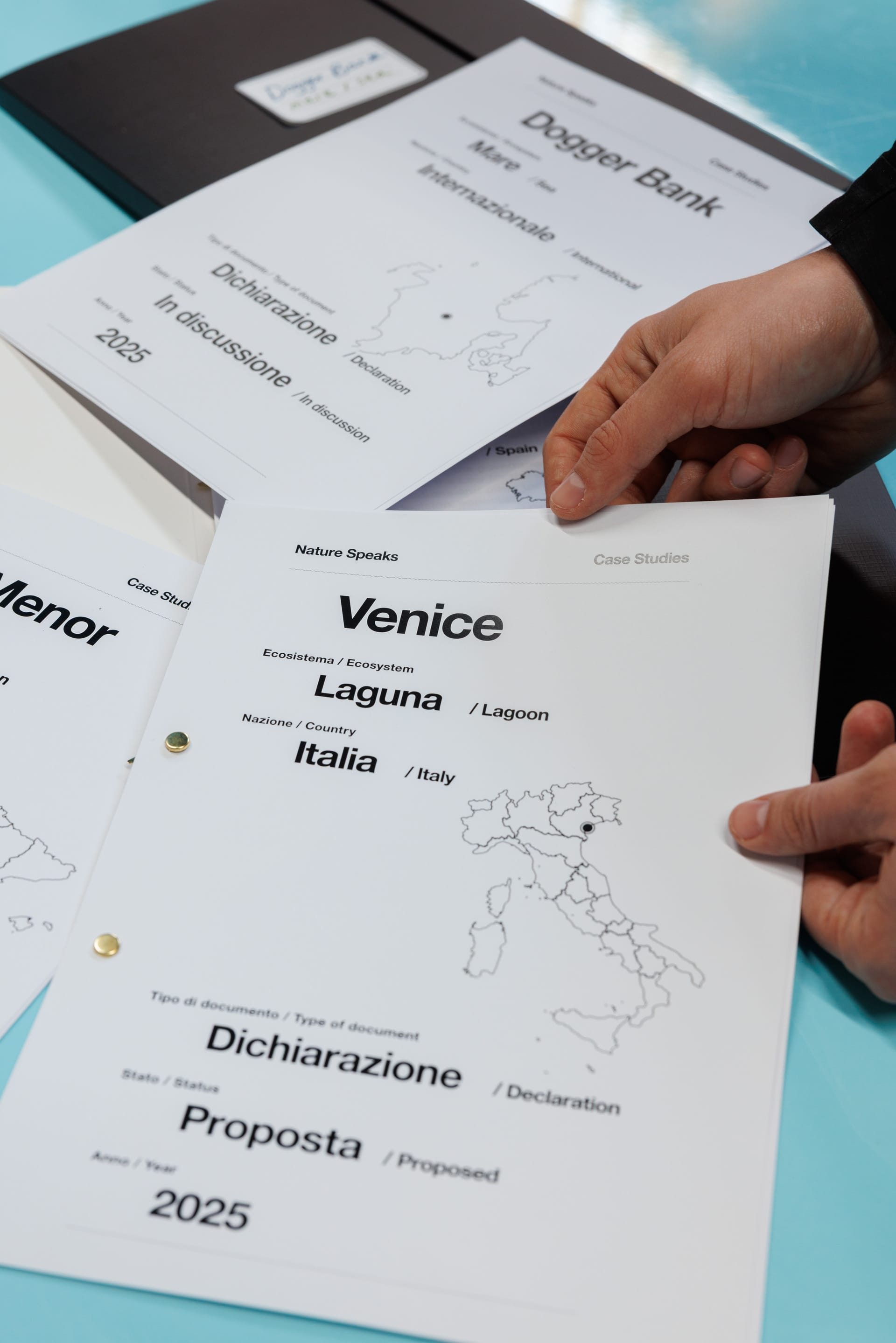
View of the Research room hosting the initiative “Nature Speaks. Listening for Rights of Nature in Venice and Europe” (2026), co-produced by TBA21–Academy and the NICHE Centre for Environmental Humanities, Ca’ Foscari University of Venice, in collaboration with IDRA and the Confluence of European Water Bodies
In the research room of Ocean Space, this tension finds a somewhat paradoxical extension. "Nature Speaks. Listening for Rights of Nature in Venice and Europe", a documentary exhibition curated by Pietro Consolandi and Amalia Rossi and co-produced with the Centre for Environmental Humanities at Ca' Foscari University of Venice, pulls in the opposite direction: it is radically site-specific, rooted in the particular legal and ecological emergency of the Venetian Lagoon. Developed in direct collaboration with local activist networks, the project invites civic participation around the lagoon's environmental and legal future, aiming to grant it rights as if it were a juridical person. An act of care that risks becoming an anthropocentric subsumption: the lagoon is recognized, but on human legal terms. The gesture is nonetheless significant. It repositions the institution not only as a space of display, but as an actor with obligations, one that is asked to intervene in the conditions that surround it rather than merely reflect on them. In a city that is slowly being reclaimed by water, the difference between those two positions is not abstract.
The tides of return, it turns out, do not move in a single direction. And the hands that give back never return empty.
//
Image cover:
Repatriates Collective, “From My Mother’s Country”, 2026. Exhibition view of “Tide of Returns”, Ocean
Space, Venice. Commissioned and produced by TBA21–Academy. Photo: Jacopo Salvi
Dalia Maini is a writer, spoken words performer, cultural agitator, and AWC editor in chief.