
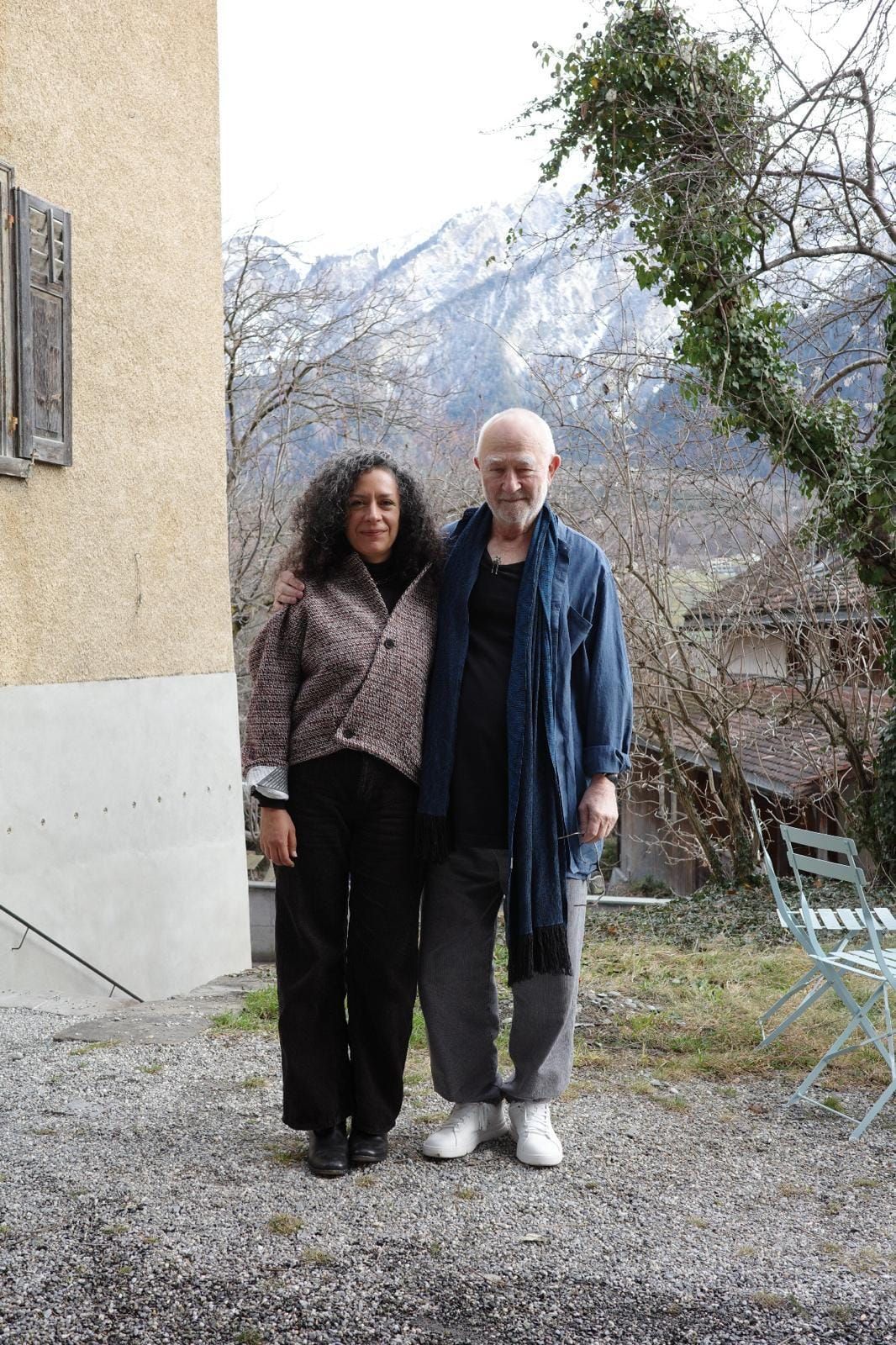
Built above a former riverbed near the La Brea Tar Pits, on land shaped by extraction, displacement, fossilization, migration, and labor, the building poses questions that exceed architecture as form. It asks what it means to build on living ground, to exhibit displaced objects, and to rely on invisible, often precarious labor to produce public culture.
This conversation between the artist Mariana Castillo Deball and the architect Peter Zumthor unfolds from within that tension. Rather than offering a promotional account of their collaboration shaping the new galleries, it traces a shared inquiry into ground, material memory, and the ethics of making. Both approach architecture and art as practices that register emotion, history, and power at the level of matter itself.
Zumthor’s architecture for LACMA has often been described through its formal qualities: horizontality, meandering circulation, and an archipelagic plan. Yet the building’s most radical dimension may lie in its insistence on remaining in contact with the site, refusing to seal itself off from the soil, and resisting the smoothness typically demanded by institutional construction in the United States. Castillo Deball’s intervention on the museum’s grounds extends this logic. Her floor work, developed with and through the hands of Mexican and migrant workers, embeds traces of ancient animals, cartographies, and bodily labor into the museum’s largest public surface.
As the conversation reveals, this collaboration unfolded against a backdrop of heightened structural violence toward migrant communities in the United States and particularly in Los Angeles. Many of the workers who physically built the museum live under conditions of fear, legal precarity, and systematic erasure. The polished surfaces of museums, like those of cities, are often produced by hands that are rendered invisible once construction is complete.
Mariana Castillo Deball (MCD): Your book has accompanied me. [It’s] a conversation between you and Mari Lending. I was surprised, and honestly very moved, by how many images there are of the Acropolis, especially of the pavement, of the ground itself. I was also happy to read how much attention you give to the history of the ground, not as an abstract idea, but as something material, something lived.
What struck me most, though, was the way you describe your own formation. You write about your early education in architecture, which was very modernist, very rigorous, almost doctrinal. And then there is this turning point, where your thinking begins to shift—toward materials, toward history, toward the memory embedded in spaces.
And, eventually, toward something that is much harder to name: emotions. When I first started working with you, I didn’t immediately understand what your position was. But over time, I realized that emotions are really at the center of your work—emotions that live in colors, in materials, in the weight of a building, in how it meets the ground.
Peter Zumthor (PZ): I don’t have an abstract or theoretical approach in the academic sense. Architecture, at least for me, is not about theory first. Or maybe it is more honest to say: I try to work through emotions. I’m not even sure I always succeed.
MCD: I come from Mexico, where the ground itself is very emotional. There are earthquakes all the time. The earth moves. And because of colonial history, because of conquest and destruction, so many things were built, destroyed, and rebuilt again. For us, it is normal to think that the ground is alive.
When I moved to Germany, I was really surprised. It felt as though there was almost no emotional connection to the ground at all. Or rather, the only connection seemed to be tied to death and guilt. When you spoke about your work on the Topography of Terror, you described how difficult it was to establish an emotional relationship to the site—and how there was resistance to that. Why do you think that is?
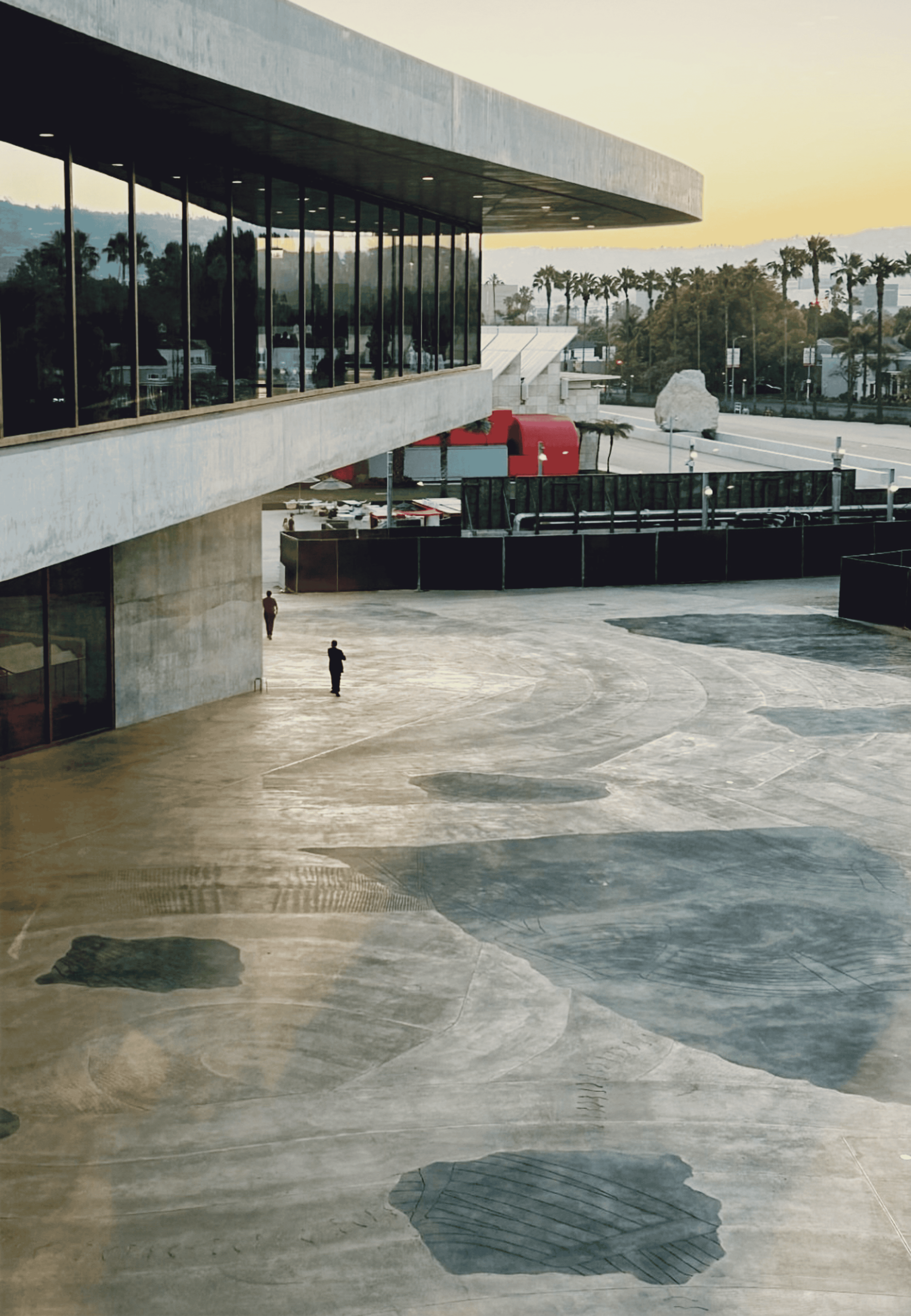
Mariana Castillo Deball, Feathered Changes, 2026. Documentation of on-site work at LACMA. Courtesy of the artist.
PZ: Historians are trained to move from paper to paper to paper. They quote books, then other books that quote those books, and everything becomes abstract. Even when they refer to physical evidence, it is mediated.
For them, the physical presence of the [Topography of Terror] was almost irrelevant. And when I proposed to keep certain remnants open—for example, the only remaining torture cellar that survived by chance. They said no. They told me: to emotionalize history is not allowed. It sounds absurd, but that is exactly what they said.
They insisted on facts, on distance. Emotion was seen as manipulation, as something dangerous. I remember one historian saying very clearly: this is not allowed. We do not want this.
Wim Wenders will address this question in the film he is working on about my practice. He spoke with Karl Schlögel, a historian who works with places rather than just texts. Schlögel understands that space itself is historical evidence. He once said that this refusal of spatial engagement was a kind of curse for Berlin. And I think he is right.
MCD: Yes, completely. A curse. I often feel disappointed by architectural projects that deal with history but fail, because they rely on a combination of sources without truly listening to the space without listening to what is already there.
PZ: For me, contact with the place is essential. Especially in Germany, there are certain sites where this contact is not optional—it is necessary. At the Topography of Terror, I designed the building so that you are always in relation to the site itself. As you move through the building, from front to back, the place is always present. There was a long Trümmerhügel (a rubble hill) left over because no one had decided what to do with it. It was full of debris from destroyed buildings. I incorporated this rubble hill into the building’s configuration. When you were inside the building, you could see the shadow of the rubble through the façade, because there was no glass. The historians hated this. They asked, “What is this?” When I returned to the site one day, the rubble was gone. They had removed it without telling me. I said, this is part of the design. They replied, “Oh yes, we can put it back later.”
It was absurd. In the end, we never found common ground.
MCD: Yesterday I was teaching, and one of my students, Henry Schlosser, made a work that really resonated with this conversation. He works with architecture and memory. He recreated the childhood memory of a büro (office) he made out of fabric and wire—a gesture children do instinctively to respond to their place in the domestic environment. He talks about how architecture is remembered, how it is reconstructed later through memory.He also collects very small objects from the street—everything must be smaller than his fingernail. Each object carries a story. I see a connection here with your work: the attention to fragments—floors, pavements, details—alongside the experience of large volumes. How do you think about this relationship between the very small and the architectural whole?
PZ: It is an important question. As architects, we create the surroundings for life—for people, but also for objects. My task is to tune the atmosphere, to make it right for the use of the place. But it is true: spaces are not inhabited only by people. They are also inhabited by things.
MCD: They speak.
PZ: Yes. Objects speak. This small object here was made by an artist friend. For the last two weeks, it has contained the ashes of my wife. I haven’t opened it. She wanted us to bring the ashes to her house in the Alps, in spring, and scatter them around when the flowers come. For now, she is here. She is not there—and not here—but somewhere in between.
MCD: In both places. Objects allow that. When you speak about objects, and about how they carry histories, I keep thinking about museums—and especially about LACMA. The objects here come from many places, many cultures, many temporalities. They are displaced. I sometimes think of them as homeless objects. Or maybe uncomfortable objects—because they don’t quite belong.
PZ: Yes. They are alienated.
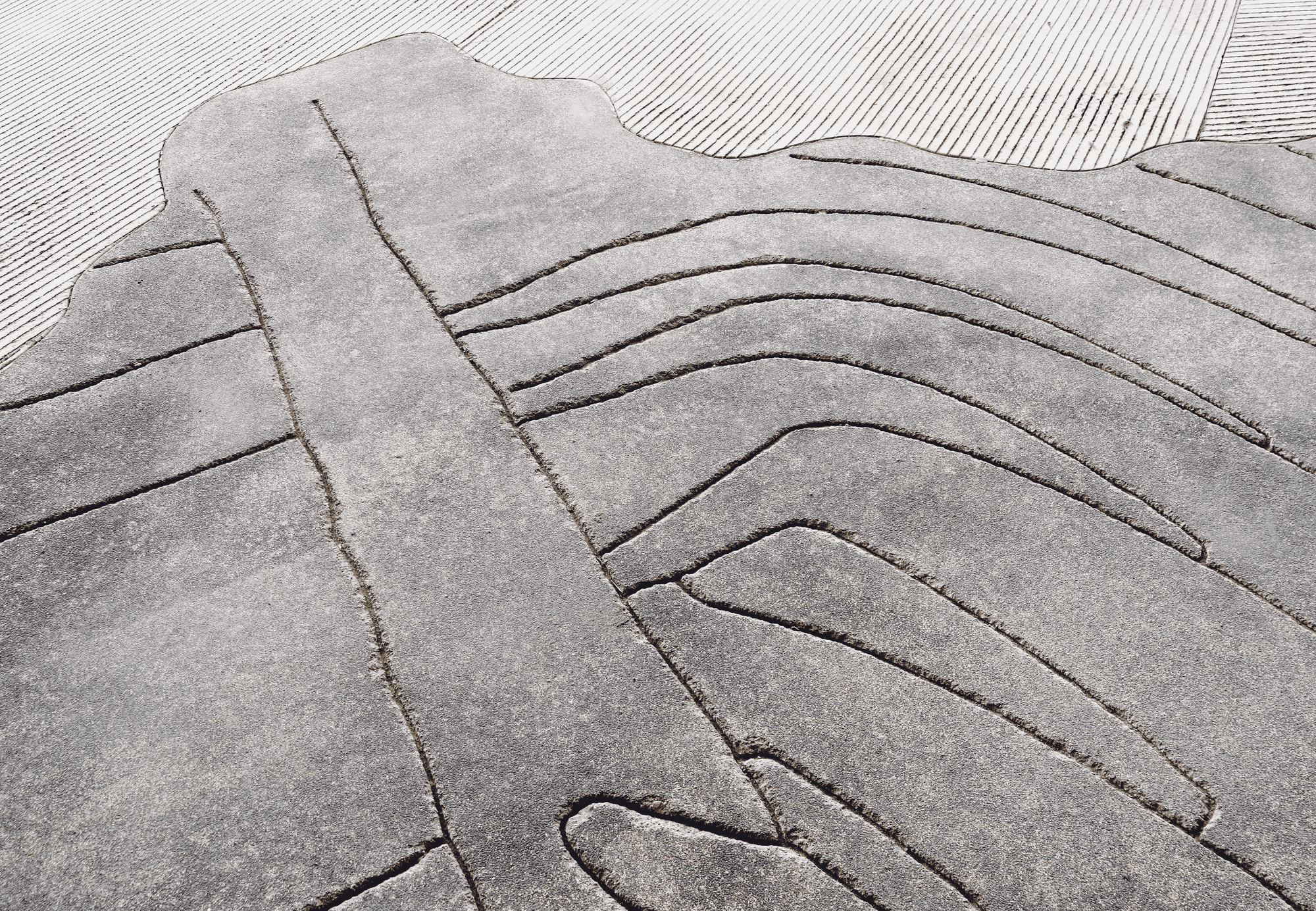
Mariana Castillo Deball, Feathered Changes, 2026. Installation view, detail, and documentation of on-site work at LACMA. Courtesy of the artist.
MCD: Exactly. And at the same time, that alienation forces us to look differently. We are reminded that these objects do not belong naturally to this place. There is a tension between belonging and not belonging that feels very important to architecture itself. A house is a place of belonging—but people and things are always arriving that do not fully belong.
PZ: In a private house like this one, my house, the objects speak of my life. They belong to me, and I belong to them. They carry the history of friendships, of work, of time. This is something precious. It does not have to be monumental. In a museum, it is completely different. These objects are taken from places we often know very little about. And I have the feeling that many curators and exhibition designers do not feel compassion for them. They classify them according to what they learned at university: earlier, later, influence, school. But this does not touch the essence of things. What we tried to do here—at least a little—was to give the objects a chance to speak without too much didactic framing. Not too many schoolteachers pinning everything down. Whether this will work in the long term, I don’t know. Michael [Govan] warned me: you may be disappointed. These things take time.
MCD: I saw some of the rooms already installed. I thought they were beautiful.
PZ: That makes me glad. The furniture we designed was very important to me. Simple principles. All objects on wood—no plastic, no steel surfaces. The vitrine is one architecture: glass, steel, wood. And inside the vitrine, no little podiums of different heights. That would be like building a bad miniature city inside the case.
MCD: Yes, like a caricature of architecture inside the vitrine.
PZ: Michael managed to let us interfere with the exhibition designers, which is not easy. He is very skilled diplomatically. He knows when to push and when not to offend.
MCD: It’s a delicate balance between respecting the work of others and insisting that something must change. Museums should not simply reproduce habits. They need to question how we move, how we look, how we inhabit space.
PZ: Many people say now that this is a new kind of museum. I always insisted: these are not corridors. This is an exhibition space. But it is difficult to explain this verbally. You have to experience it. The meandering, the openness, the firmness—it only makes sense when you are inside.
MCD: It feels like an archipelago.
PZ: Yes.
MCD: That’s why I also made islands on the ground. It was a way of picking up what the building itself is already doing.
PZ: From the beginning, five, six, seven years ago—I always said we should have Mexican workers doing the ground. I imagined mosaics, something done by hand. Indigenous knowledge, people who have been there for a long time. That is why I was so happy when you became involved.
MCD: I already had a connection. I did a series of wood pavement works in which early-colonial-era maps are enlarged and engraved onto the floor. Vista de Ojos (2014), is a wooden pavement engraved with the drawing of the Santa Cruz map (1550).
The original drawing was created by an indigenous cartographer or Tlacuilo, and is considered to be the oldest representation of Mexico City, some thirty years after the conquest. The wooden pavement also serves as a printing matrix. The complete surface of the map was printed on paper and bound as an atlas, each of the 500 pages corresponding to a fragment of the image. LACMA acquired Vista de Ojos in 2014. Michael remembered that and thought, maybe this artist has an idea for the ground. Diana [Magaloni] called me, and that’s how it started.
PZ: For me, it was intuition. I kept saying: This cannot be just concrete. Michael never said no—but it took time. There was pressure. This is the largest public space being built in Los Angeles, I said. It must be simple, robust, and American. But now, when you stand above and look down, it becomes something else. A carpet. A field. A story. You see animals, ancient animals, traces—maybe we made doors for animals, or animals made doors for us. Who knows.
MCD: It was also a coincidence. For the last five years, I have been working on an artwork for a metro station nearby, at La Cienega. I learned about the tar pits, about fossils, and about the indigenous land. When I was invited to work with the black mud here, I already felt connected to the site.
PZ: You were not a foreigner anymore.
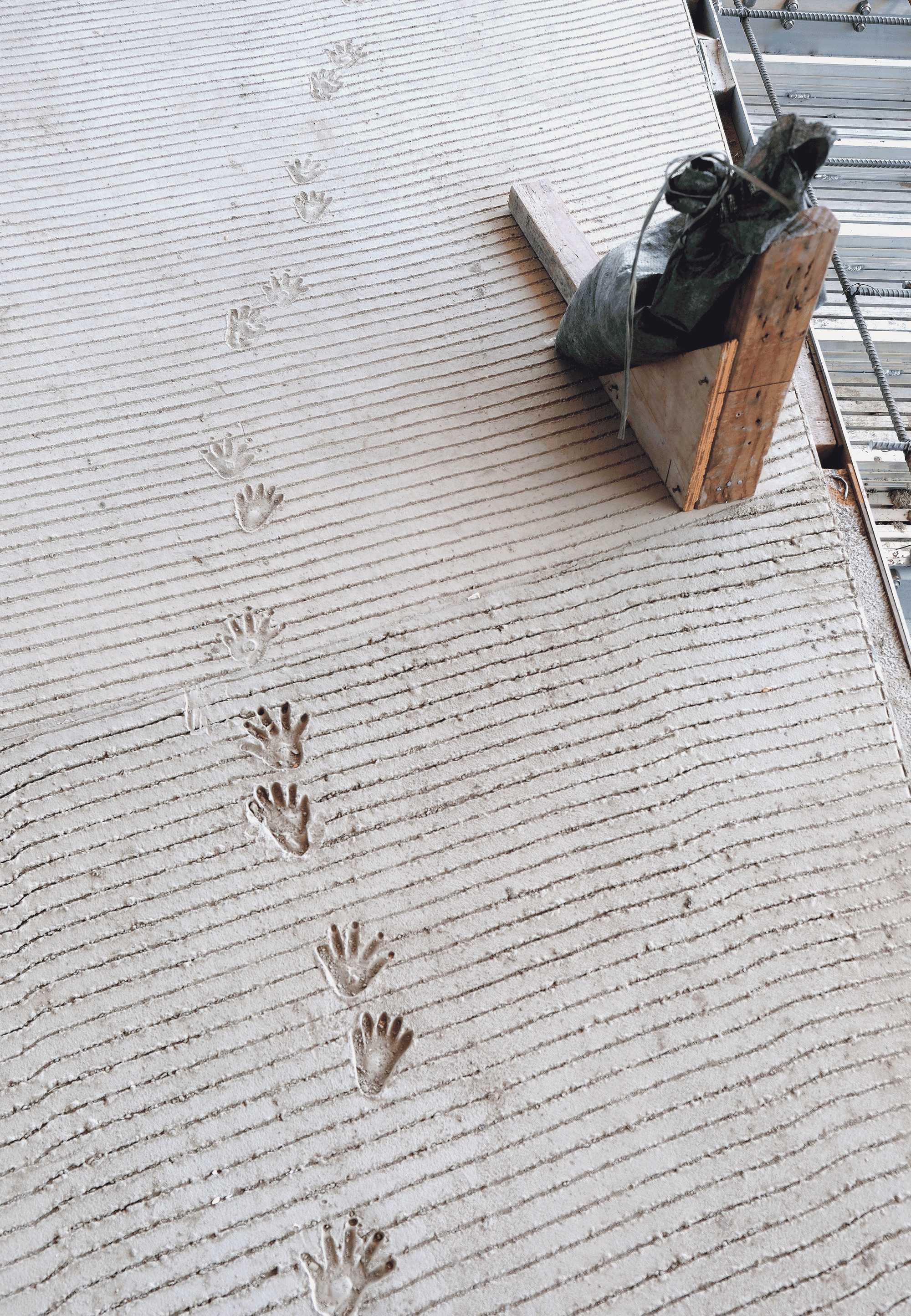
Mariana Castillo Deball, Feathered Changes, 2026. Installation view, detail, and documentation of on-site work at LACMA. Courtesy of the artist.
MCD: But during the last months, especially since the new Trump administration, everything changed. Many of the workers are Mexican. Some have papers, some don’t. Many were afraid. Some stopped coming to work.
At some point, I realized: they made this work. I gave instructions, yes, but they taught me techniques, gestures, and knowledge. Their hands are on the surface. It became an homage to labor, to people who build our streets, our houses, and who live in danger.
PZ: This is not right.
MCD: No.
PZ: It reminds me again of how labor is hidden. Precision [work] is transferred to factories. On-site work is reduced. Liability dictates everything. Craftsmanship becomes a luxury.
I remember when Marius came—a painter carrying centuries of knowledge. The American painters didn’t know how to clean a brush. So he gave them a lesson. From then on, they learned respect for tools, for work.
MCD: Cracks are also traces of work. I learned so much about crack control here—about how materials behave, about forcing them to do what they don’t want to do. Modernism hates cracks. But cracks are emotional.
PZ: I love cracks. Natural cracks are beautiful. Once, concrete leaked and made a terrible surface. The workers wanted to fix it. I said: This is a sculpture. You cannot repair a sculpture. Leave it. In twenty years, you can come back with your grandson and say: I worked here.
MCD: Cracks reveal labor, which is why they are hidden.
PZ: Yes.
MCD: I wanted to ask you about trees. Carlos Velasco, one of the people I worked with for the pavement piece, knows everything about what grows under concrete. How do trees enter your architecture?
PZ: I always plant gardens. Trees mark my life. I need living things around buildings. Growth. Time.
MCD: In Mexico, trees break pavements. They make cracks. People cut the trees instead of accepting the cracks. Concrete wants flatness. It blocks emotion.
PZ: The building must know the ground. Here in Haldenstein, I could see the gravel of the Rhine on the terrain foundations. I could place the building directly into history.
MCD: It reminds me of a story. Angel, a man who worked for my family once, dreamed there was a treasure in the garden. He dug and found a colonial wall. They covered it again—but the gesture of discovery stayed.
PZ: I had a similar dream—about color. I knew the painted walls were wrong. Then another Peter came to me and said: you must do what you feel. That’s how I found the stain technique.
MCD: It gives the walls life. Like clay on black or white ground.
PZ: Exactly.
MCD: I brought you two gifts. A paliacate. I made 100 of them and gave one to every worker, as a bandana, or to wrap on their construction belt if they like to. And a piece of ceramic that I made for my upcoming exhibition on the LA project “Feathered Changes”.
PZ: Did you ever make mosaics with the colors of stones and things?
MCD: One day, I want to make mosaics.
PZ: Maybe we will find a nice occasion.
//
Peter Zumthor is a Swiss architect whose work is frequently described as uncompromising and minimalist. He is the winner of the 2009 Pritzker Prize and 2013 RIBA Royal Gold Medal.
Image:
Mariana Castillo Deball and Peter Zumthor, 2026. Courtesy of the artist
Mariana Castillo Deball is an artist who takes a kaleidoscopic approach to her practice, mediating between science, archaeology, and the visual arts and exploring the way in which these disciplines describe the world.